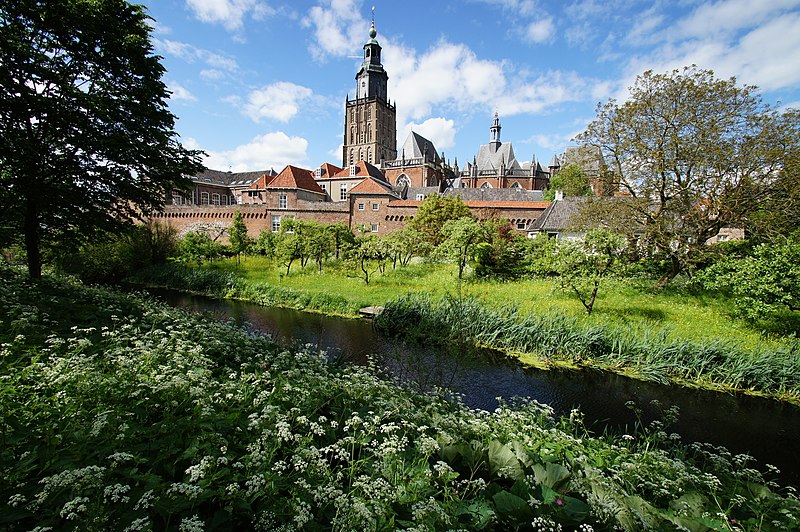
File:Walburgkerk,_Zutphen.JPG · Wikimedia Commons · See Wikimedia Commons
Zutphen
Sign in to saveZutphen (; Dutch Low Saxon: Zutfent) is a city and municipality located in the province of Gelderland, Netherlands. It lies some northeast of Arnhem, on the eastern bank of the river IJssel at the point where it is joined by the Berkel. First mentioned in the 11th century, the place-name appears to mean "south fen" ( in modern Dutch). In 2005, the municipality of Zutphen was merged with the municipality of Warnsveld, retaining its name. In 2021, the municipality had a population of .
OverviewAI-generated
Zutphen is a city in the Netherlands, situated within the province of Gelderland. It is located on the IJssel river and shares a border with Brummen. The city serves as the capital of the municipality of Zutphen and is classified as a Hanseatic city. Its postal codes range from 7200 to 7207 and 7230 to 7232, with a local dialing code of 0575.
The area of Zutphen is 42.84, and it has an elevation of 10 above sea level. The population is recorded as 47,423. The city is twinned with Satu Mare, Horstmar, and Shrewsbury. Residents are referred to by the demonym Zutphenaar.
Synthesized by Vinony from 53 facts across 7 sources: Wikidata, Open Meteo, Openweathermap, OpenStreetMap, GeoNames, Vinony graph, Geo. Generated from structured data (not the Wikipedia text) and checked against those facts — may still contain errors.
Weather now
7-day forecast
via Open-Meteo
Place details
- Locality
- Zutphen
- Region
- Gelderland
- Country
- Nederland
- Population
- 36,188
- Timezone
- Europe/Amsterdam
via OpenStreetMap · GeoNames
Key facts
- Settlement.name
- Zutphen
- Settlement.settlement_type
- City and municipality
- Settlement.image_skyline
- Walburgkerk, Zutphen.JPG
- Settlement.image_size
- 280px
- Settlement.image_caption
- St Walpurga's Church in Zutphen
- Settlement.image_flag
- Flag of Zutphen.svg
- Settlement.flag_size
- 100x67px
- Settlement.image_shield
- Coat of arms of Zutphen.svg
- Settlement.shield_size
- 100x80px
- Settlement.image_map
- Map - NL - Municipality code 0301 (2009).svg
- Settlement.map_alt
- Highlighted position of Zutphen in a municipal map of Gelderland
- Settlement.map_caption
- Location in Gelderland
- Settlement.pushpin_map
- Netherlands#Europe
- Settlement.pushpin_map_caption
- Location within the Netherlands##Location within Europe
- Settlement.pushpin_relief
- 1
- Settlement.subdivision_type
- Country
- Settlement.subdivision_name
- Netherlands
- Settlement.subdivision_type1
- Province
via Wikipedia infobox
Wikidata facts
- Instance of
- Hanseatic city
- Demonym
- Zutphenaar
- Country
- Netherlands
- Located in
- Zutphen
- Population
- 47423
- Area
- 42.84
- Elevation
- 10
- Time zone
- UTC+01:00
- Body of water
- IJssel
- Capital of
- Zutphen
- Shares border with
- Brummen
- Official website
- www.zutphen.nl
- Image
- Zutphen, Walburgkerk met stadsmuur foto4 2011-02-17 13.43.jpg
- Dialing code
- 0575
Show 11 more facts
- twinned administrative body
- Shrewsbury
- Commons category
- Zutphen
- postal code
- 7200–7207
- topic's main category
- Category:Zutphen
- category for people born here
- Category:Births in Zutphen
- category of associated people
- Category:People from Zutphen
- Commons gallery
- Zutphen
- different from
- Zutphen
- described by source
- Brockhaus and Efron Encyclopedic Dictionary
- P12749
- 27
Sources (8)
via Wikidata · CC0
Travel guide
Understand
Zutphen is located in a river valley at the river IJssel, a sidebranch from the branch of the Rhine known as the Nederrijn. The small river Berkel (no shipping possible) as well as the major Twentekanaal (canal) flow into the IJssel near Zutphen. The city lies at the border of the hilly forested Veluwe region and the more flat and agricultural Achterhoek. The language spoken is Dutch; nearly everyone speaks English, and German is widely understood.
Get in
thumb|The rail bridge spanning across the IJssel. In the background the Walburgiskerk.
Get around
Inside the city center, everything is within walking distance. The railway station is located 200 meters away from the edge of the old city center. Walking from one side of the city center to the other side takes about 20 to 30 minutes.
For the rest of the city, and for the surrounding area, the best way to get around is definitely by bicycle. You can rent bicycles at the railway station's bicycle depot, which is not very expensive and offers excellent bicycles. You can find it by turning left when you leave the station; the bicycle depot is located in a space under the railway station, next to the ING Bank. Most bicycle shops in town will also rent bicycles.
Parking a car in Zutphen is possible, but may be difficult on some days (such as Saturdays and market days). In the city center, expect to have to pay for your parking spot. Your best chance for a parking spot is at the parking lot in front of the Albert Heijn XL supermarket, at the edge of the city center. Directly north of the railway station, close to the river IJssel, there is a free parking lot with 80 spots from which it is a 10 to 15-minute walk to the city center. This parking lot is accessible via the rear entrance of the train station.
The bus network in the city has been improved over the past few years. All areas of the city are now served by buses from the early morning until the late evening. On the buses, you can buy a 1 euro ticket which is valid for two journeys on the same day. The buses are operated…
See
thumb|250px|Saint Walburgis church Its Dutch tourist promotion slogan, "Torenstad", means "Tower-city", which refers to the large number of towers. The largest is the Walburgkerk (officially it's called "St. Walburgiskerk", but the locals say "Walburgkerk"), located at the square where the city originated. Guided tours are available, organized by the VVV located directly opposite the railway station. These tours will also allow you to visit the medieval library "Librije" - books have been kept here secure since the 1600s by chaining them to the desks.
Do
Visit the weekly markets. A large market is held on Thursday morning, breaking up at around 13:00 (1 PM); a smaller market is held on Saturday throughout the day. The Thursday morning market is one of the biggest in the country. Hire a bike (railway station), head out over the old bridge, turn right, and pushbike along the most beautiful riverdike, an oasis of quiet and nature. A gem mainly the locals know and really worth it.
Eat
There are many restaurants in Zutphen in all price classes, ranging from fast-food restaurants (McDonalds) to expensive Italian restaurants. There are also Turkish, Italian, Egyptian, Chinese and Greek restaurants in the city. Many restaurants are located on the market square.
Restaurant "'t Schulten Hues" situated at 's Gravenhof 5-7 is awarded a Michelin star of excellence. Close to the Wijnhuistoren (Whine house tower) lies the 'Volkshuis' (People's House), a small cafe ran by mentally handicapped people who work there in a specially guided environment. Their apple pies are world-famous, and the Queen highly recommended it as well.
Drink
The city is full of small cafes and bars, some of them open until the early morning hours. The atmosphere is usually friendly and relaxed. Many cafes can be found in the Nieuwstad quarter, in the small streets of the old city center and on the market square.
There is a new cinema that opened in 2007, (and a McDonald's) on the De Mars industrial area, north-west of the city center. It can be reached on foot easily by crossing the major rail-road crossing opposite the large lake north of the city center and just below the Hanzehof theater, or from the northern (back) exit of the railway station.
Sleep
There are several hotels in Zutphen, mainly multiple star graded (*** and ****).
Go next
The area around the city is highly varied.
In Eefde, a town next to Zutphen, you will find one of the largest inland stews in the country. Toward the north, in the direction of Deventer, you will find small towns, roads, forests and some farming. Toward the east you will find a highly varied landscape consisting of agricultural ground, farming, more small towns, and more small roads. To the south lies Doetinchem, a small town with which Zutphen shares a center-function for the surrounding villages, and to the west you will find the huge Veluwe National Park, consisting of a large forest spanning tens of kilometers in width (W-E) and circa one hundred kilometers in length (N-S).
Other towns and cities nearby, with distances: Arnhem and Nijmegen are 30 kilometers and 50 kilometers, respectively, to the south-west (4 trains every hour in both directions). Deventer is 15 kilometers to the north (2 trains every hour in both directions). Apeldoorn is 20 kilometers to the north-west (2 trains every hour in both directions). Hengelo is 40 kilometers to the north-east (2 trains every hour in both directions). Doetinchem is 20 kilometers to the south (difficult to reach with public transportation).
Travel guide from Wikivoyage (CC BY-SA 4.0)
~17 min read
Encyclopedic overview
23 sectionsContents
- History
- Modern city
- Culture
- Interesting buildings and squares
- Religious architecture
- Civic architecture
- Other interesting sights in Zutphen
- Regional center
- Juridical center
- Medical centre
- Educational centre
- Transport
- Rail
- Road
- Bus
- Sister cities
- Notable residents
- Public service
- The arts
- Sport
- Gallery
- References
- External links
Zutphen (; Dutch Low Saxon: Zutfent) is a city and municipality located in the province of Gelderland, Netherlands. It lies some northeast of Arnhem, on the eastern bank of the river IJssel at the point where it is joined by the Berkel. First mentioned in the 11th century, the place-name appears to mean "south fen" ( in modern Dutch). In 2005, the municipality of Zutphen was merged with the municipality of Warnsveld, retaining its name. In 2021, the municipality had a population of .
==History== left|thumb|"Snaphaanschelling" struck in Zutphen left|thumb|Zutphen taken by Fadrique Álvarez de Toledo, 4th Duke of Alba|Fadrique Álvarez de Toledo on 16 October 1572 during the [[Eighty Years' War]] thumb|left|1649 map of Zutphen in Willem Blaeu|Willem and [[Joan Blaeu's "Toonneel der Steden"]] thumb|left|Zutphen (1654) In about 300 AD, a Germanic settlement was the first permanent town on a complex of the low river dunes. While many such settlements were abandoned in the early Middle Ages, Zutphen, on the strategic confluence of IJssel and Berkel, stayed. After the incorporation of the IJssel lands in Charlemagne's Francia, Zutphen became a local centre of governance under the Count of Zutphen. The Normans raided and ravaged it in 882. Afterwards, a circular fortress was built to protect the budding town against Viking attacks.
Excerpted from Wikipedia’s “Zutphen” article, available under the CC BY-SA 4.0 licence.
Gallery (36)
On the map
3 mapped locations
Available in 58 languages
- Español
- Français
- Deutsch
- 中文
- 日本語
- Русский
- Português
- Italiano
- العربية
- Afrikaans
- Albanian
- Armenian
- Bahasa Indonesia
- Basque
- Belarusian
- Bulgarian
- Catalan
- Cebuano
Show 39 more
- Czech
- Danish
- Egyptian Arabic
- Esperanto
- Estonian
- Finnish
- Greek
- Hungarian
- Javanese
- Kurdish
- Latin
- Limburgish
- lld
- Low German
- Malay
- nds_nl
- Nederlands
- Norwegian
- Polski
- Romanian
- Saterland Frisian
- Serbian
- Serbian (Latin)
- simple
- Slovenian
- Svenska
- Tiếng Việt
- Türkçe
- Ukrainian
- Urdu
- Venetian
- Volapük
- Waray
- West Flemish
- Western Frisian
- Zeelandic
- zh_min_nan
- فارسی
- 한국어
via Wikidata sitelinks · CC0