Category
page 1Ancient dishes

bread
Bread is a baked food product made from water, flour, and often yeast. It is a staple food across the world, particularly in Europe and the Middle East. Throughout recorded history and around the world, it has been an important part of many cultures' diets. It is one of the oldest human-made foods, having been of significance since the dawn of agriculture, and plays an essential role in both religious rituals and secular culture.

cheese
thumb| upright=1.2 |A platter with cheese and Garnish (cooking)|garnishes
thumb| upright=1.2 |Cheeses in art: Still Life with Cheeses, Almonds and Pretzels, [[Clara Peeters, ]]

yogurt
Yogurt (; , from , ; also spelled yoghurt, yogourt or yoghourt) is a food produced by bacterial fermentation of milk. Fermentation of sugars in the milk by these bacteria produces lactic acid, which acts on milk protein to give yogurt its texture and characteristic tart flavor. Cow's milk is most commonly used to make yogurt. Milk from water buffalo, goats, ewes, mares, camels, and yaks is also used to produce yogurt. The milk used may be homogenized or not. It may be pasteurized or raw. Each type of milk produces substantially different results.

soup
French onion soup|thumb

sausage
thumb|Plate of German sausage: Jagdwurst, [[liver sausage, blood sausage, Westphalian ham]]
thumb|Sausage making at home

tofu
or bean curd is a food prepared by pressing the curds of coagulated soy milk into solid white blocks of varying softness: silken, soft, firm, and extra (or super) firm.
.%20Leiden%20University%20Library%2C%20Collection%20A.%20P.%20H.%20Hotz.jpg)
kabab
Kebab ( , ), kebap, kabob (alternative North American spelling), kebob, or kabab (Hindi and Kashmiri spelling) is a variety of roasted meat dishes that originated in the Middle East.

omelette
An omelette (omelet in American English; see spelling differences) is a dish made from eggs (usually chicken eggs), fried with butter or oil in a frying pan. It is a common practice for an omelette to include fillings such as chives, vegetables, mushrooms, meat (often ham or bacon), cheese, onions or some combination of the above. Whole eggs or egg whites are often beaten with a small amount of milk, cream, or water.

halva

pilaf
Pilaf (), pilav, pilau or plov () is a rice dish, or in some regions, a wheat dish, whose recipe usually involves cooking in stock or broth, adding spices, and other ingredients such as vegetables and meat, and employing some technique for achieving cooked grains that do not adhere.

ham
thumb|Typical slice of ham
Ham is pork from a leg cut that has been preserved by wet or dry curing, with or without smoking. As a processed meat, the term ham includes both whole cuts of meat and ones that have been mechanically formed.

noodle
Noodles are a type of food typically made from unleavened dough which is rolled flat and cut, stretched, or extruded into long strips or strings. Noodles are a staple food in many cultures and made into a variety of shapes. The most common noodles are those derived from Chinese cuisine or Italian cuisine. Italian noodles are generally referred to as pasta. In Chinese cuisine, the overarching term for noodles is 面 (miàn in Mandarin), which refers specifically to dough-based noodles made from wheat or other grain-based dough. Chinese noodles also include another category, called 粉 (fěn), which a

sauerkraut
Sauerkraut (; , ) is finely cut raw white cabbage that has been fermented by various lactic acid bacteria. It has a long shelf life and a distinctive sour flavor, both of which result from the lactic acid formed when the bacteria ferment the sugars in the cabbage leaves.

kumis
Kumis ( , ), alternatively spelled coumis or kumyz, also known as airag ( ), is a traditional fermented dairy product made from mare milk. The drink is important to the peoples of the Central and East Asian steppes, of Turkic and Mongolic origin: Kazakhs, Bashkirs, Kalmyks, Kyrgyz, Mongols, and Yakuts. Kumis was historically consumed by the Khitans, Jurchens, Magyars, and Han Chinese of North China as well.

chutney
A chutney () is a condiment associated with cuisines of the Indian subcontinent. Chutneys are made in a wide variety of forms, some raw such as with coriander, others cooked with sugar, like mango chutney. During the British Raj, Anglo-Indian cuisine adapted Indian chutney and brought it back to Britain, where green mango chutney in particular became popular. In the Western world, chutneys may be made with local fruits and vegetables, or purchased.
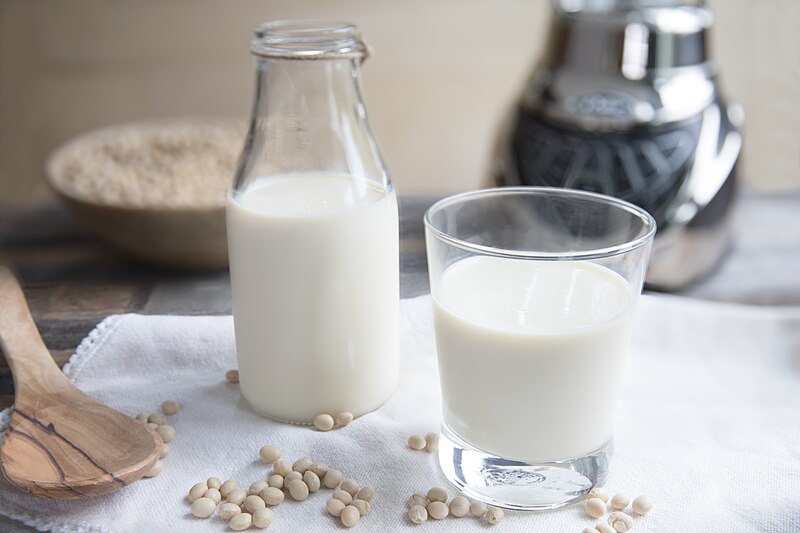
soy milk
beverage made from soybeans

flatbread
A flatbread is bread made usually with flour; water, milk, yogurt, or other liquid; and salt, and then thoroughly rolled into flattened dough. Many flatbreads are unleavened, although some are leavened, such as pita.

börek
Börek (also burek or byrek) is a family of pastries or pies made in the Middle East and Southeast Europe. The pastry is made of a thin flaky dough such as filo with a variety of fillings, such as meat, cheese, spinach, or potatoes. A börek may be prepared in a large pan and cut into portions after baking, or as individual pastries. They are usually baked but some varieties can be fried. Börek is sometimes sprinkled with sesame or nigella seeds, and it can be served hot or cold.
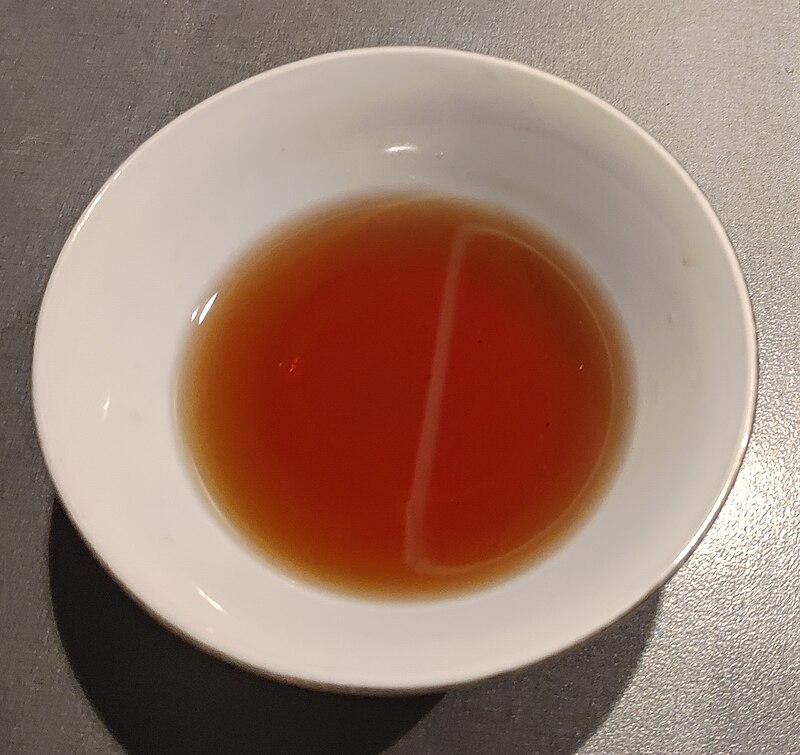
fish sauce
an amber-coloured liquid extracted from the fermentation of fish with sea salt

congee
Congee ( , derived from Tamil ) is a form of savoury rice porridge of Asian origin, primarily made by boiling rice in a large amount of water until the rice softens. Depending on the rice–water ratio, the thickness of congee varies from a Western oatmeal porridge to a gruel. Since the history of rice cultivation in Asia stretches back to the Baiyue-inhabited lower Yangtze circa 10,000 BC, congee is unlikely to have appeared before that date. Congee is typically served with side dishes, or it can be topped with meat, fish, and pickled vegetables.

tamale
A tamale is a traditional Mesoamerican dish made of masa, a dough made from nixtamalized corn, which is steamed in a corn husk or banana leaves. The wrapping can either be discarded prior to eating or used as a plate. Tamales can be filled with meats, cheeses, fruits, vegetables, herbs, chilies, or any preparation according to taste, and both the filling and the cooking liquid may be seasoned.

garum
thumb|upright|Garum amphorae from [[Pompeii]]

French onion soup
soup based on meat stock and onions

lentil soup
type of soup
caciocavallo
'''''' () is a type of ('stretched-curd') cheese made out of sheep's or cow's milk. It is produced throughout southern Italy, particularly in the Apennine Mountains and in the Gargano peninsula. Shaped like a teardrop, it is similar in taste to the aged southern Italian provolone cheese, with a hard edible rind.

gruel
Gruel is a food consisting of some type of cereal—such as ground oats, wheat, rye, or rice—heated or boiled in water or milk. It is a thinner version of porridge that may be more often drunk rather than eaten. Historically, gruel has been a staple of the Western diet, especially for peasants. Gruel may also be made from millet, hemp, barley, or, in hard times, from chestnut flour or even the less-bitter acorns of some oaks. Gruel has historically been associated with feeding the sick and recently weaned children.

Mulukhiyah
Mulukhiyah (Arabic: ملوخية, romanized: mulūkhiyyah), also known as mulukhiyya , molokhiyya, melokhiyya, molohiya or ewédú, is a type of jute plant and a dish made from the leaves of Corchorus olitorius, commonly known in English as jute, '''Jew's-mallow, nalta jute, or tossa jute'. It is used as a vegetable and is mainly eaten in Egypt, the Levant (Lebanon, Syria, Palestine, Jordan and Israel), Sudan, Cyprus, Libya, Tunisia, Nigeria, and Algeria. It is called saluyot in the Philippines. Mulukhiyah'' is rather bitter, and when boiled, the resulting liquid is a thick, highly mucilaginous broth;
nettle soup
traditional soup prepared from stinging nettles
freekeh
Freekeh (sometimes spelled frikeh) or farik ( / ALA-LC: farīkah; pronounced free-kah /ˈfɹiːkə/) is a cereal food made from green durum wheat (Triticum turgidum var. durum) that is roasted and rubbed to create its flavour. It is an ancient dish derived from Levantine and North African cuisines, remaining popular in many countries of the eastern Mediterranean Basin, where durum wheat originated.
Ancient Egyptian cuisine
сuisine of Ancient Egyptian culture
.jpg)
Acquacotta
thumb|Acquacotta at a restaurant in Milan, Italy
thumb|Acquacotta, bean, and minestrone
Acquacotta (; ) is an Italian broth-based bread soup that was originally a peasant food. Its preparation and consumption dates back to ancient history, and it originated in the coastal area known as the Maremma, in southern Tuscany and northern Lazio. The dish was invented in part as a means to make hardened, stale bread edible. In contemporary times, ingredients can vary, and additional ingredients are sometimes used. Variations of the dish include acquacotta con funghi and acquacotta con peperoni.
Tomme de Savoie
upland variety of Tomme cheese, specifically, one from Savoy in the French Alps
poi
Hawaï food
Bissara
Bissara () is a dish in Egyptian and Moroccan cuisine. The dish contains split fava beans, onions, garlic, fresh aromatic herbs and spices. All ingredients are slowly cooked and then blended to yield a creamy and fragrant dip or side dish.
.jpg)
Migas
Migas (, ) ("crumbs" in English) is a dish traditionally made from stale bread and other ingredients in Spanish and Portuguese cuisines. Originally introduced by shepherds, migas are very popular across the Iberian Peninsula, and are the typical breakfast of hunters at monterías in some regions of Spain.
Pane carasau
Thin, crisp, twice-baked flatbread from Sardinia
moretum
Moretum is an herb cheese spread that the Ancient Romans ate with bread. A typical moretum was made of herbs, cheese (typically ricotta), salt, oil, and vinegar. Optionally, different kinds of nuts could be added. The ingredients were crushed together in a mortar, for which the dish is named.

Gofio
thumb|right|Gofio mill, La Orotava, Tenerife

Fatteh
Fatteh ( meaning crushed or crumbs, also romanized as fette, fetté, fatta or fattah) is a dish eaten in the Arab world consisting of pieces of fresh, toasted, grilled, or fried flatbread covered with other ingredients that vary according to region. It is also some times referred to as shâmiyât ( "Damascene") in the Levant area.

testaroli
Testaroli, sometimes referred to as testarolo, is a type of thin spongy pasta or bread in Italian cuisine that is prepared in circular sheets using water, flour, and salt, which is then sliced into diamond or rectangular shapes. A common dish in the Lunigiana region and historical territory of Italy, it is an ancient pasta originating from the Etruscan civilization of Italy. Testaroli has been described as "the earliest recorded pasta". It is also a native dish of the southern Liguria and northern Tuscany regions of Italy.

tomme
Tomme (), occasionally spelled Tome, is a class of cheeses produced mainly in the French Alps and in Switzerland. It can be made from cow's, ewe's, or goat's milk. Tommes are normally produced from the skimmed milk left over after the cream has been removed to produce butter and richer cheeses, or when there is too little milk to produce a full cheese. As a result, they are generally low in fat. However, Tomme de Boudane and Tomme de Revard can contain as much as 20–40% fat. Tomme cheeses date back to ancient history.

gachas
Gachas is an ancestral basic dish of central and southern Spain. It is a gruel whose main ingredients are flour, water, olive oil, garlic, paprika and salt.
Pecorino Siciliano
Italian cheese
Placenta cake
cheesecake recipe from ancient Greece

Fig-cake
fig-based sweet

pinole
Pinole, also called pinol, is roasted ground maize. The resulting powder is then used as a nutrient-dense ingredient to make different foods, such as cereals, baked goods, tortillas, and beverages. For example, it can be mixed with a combination of cocoa, agave, cinnamon, chia seeds, vanilla, or other spices, to make a beverage called pinolillo.
The name comes from the Nahuatl word pinolli, meaning cornmeal. Today, pinole is generally made by hand using wood-burning adobe ovens and a stone and pestle, and is still consumed in certain, often rural, parts of Latin America. Pinole is considered

Kusksu
Kusksu () is a traditional Maltese soup made primarily from seasonal broad beans, small pasta beads, and fresh ġbejniet. Although similar in shape, the small pasta beads, known locally as kusksu, look like couscous, but this one tends to be lighter and fluffier in texture. In contrast, kusksu, which gives the soup its name, is "miniature pasta" which is thick and ideal for simmering. Once cooked, the short-cut pasta beads give the soup its distinctive creamy and warm texture, making it an ideal dish to serve during cold weather.
Maccu
thumb|Vicia faba|Fava beans (here fresh and in the pod, rather than dried) are a primary ingredient of maccu.
thumb|right|Fresh fava beans, shelled and steamed
Maccu (also known as maccu di fave and sometimes referred to as macco) is a Sicilian soup with a dense texture and also a foodstuff that is prepared with dried and crushed fava beans (broad beans) and wild fennel as primary ingredients. Several dishes exist using maccu as an ingredient, such as bruschetta al maccù and maccu di San Giuseppe, the latter of which may be served on Saint Joseph's Day in Sicily.
Dotorimuk
Dotori-muk () or acorn jelly is a Korean dish. It is a jelly made from acorn starch. Although "muk" means "jelly", when used without qualifiers, it usually refers to dotori-muk. The practice of making dotori-muk originated in mountainous areas of ancient Korea, when abundant oak trees produced enough acorns each autumn to become a viable source of food. Dotori-muk does not spoil easily, so it was used as a lunch food when traveling a long way.
Ancient Maya cuisine
diet of the Ancient Mesoamerican civilization
forcemeat
thumb|upright=1.35|Squab (food)|Squab forcemeat with [[cepes, anise, and combava juice]]
Almodrote
thumb|A bowl of almadroc
Almadroc is a garlic-cheese sauce from medieval Catalan cuisine from the Llibre de Sent Soví. There is a similar recipe in the Llibre del Coch by Rupert de Nola for almadrote, a sauce made with garlic, eggs, cheese and broth that was served with partridge. In modern usage it refers to an oil, garlic and cheese sauce served with eggplant casserole. Almadrote may have pre-Inquisition Sephardic origins and served with eggplant has become widespread in modern Turkish cuisine.
Puls
staple dish of Ancient Rome
potée
A potée is a French culinary term which, in general, refers to any preparation cooked in an earthenware pot. More specifically, it refers to a soup or stew made of pork and vegetables, most frequently, cabbage and potatoes of which choucroute is the most characteristic.
whole sour cabbage
fermented vegetable preserve, popular in Romanian, Bosnian, Croatian, Macedonian, Serbian and Bulgarian cuisines
lucanica
thumb|'', a product that derives from the ancient lucanica sausage
Lucanica'' was a rustic pork sausage in ancient Roman cuisine. Apicius documents it as a spicy, smoked beef or pork sausage originally from Lucania; according to Cicero and Martial, it was brought by Roman soldiers from Lucania.
Aush Jushpare
type of Aush
Papadzules
thumb|Papadzules
thumb|Papadzules in Quintana Roo, Mexico
Papadzules (; Mexican Spanish, from Mayan ) is a traditional dish from the Yucatán Peninsula resembling enchiladas. In its simplest form it consists of corn tortillas dipped in a sauce of pepita (pumpkin seeds) and filled with hard-boiled eggs, and garnished with a cooked tomato-pepper sauce.
jeok
Jeok, also spelled as Chok () is a Korean meat dish served with skewers. Jeok is typically made with a large variety of meats, vegetables and mushrooms and is usually served on special occasions such as birthdays (hwangap) and wedding ceremonies. Jeok comes in multiple varieties, including sanjeok and nureum-jeok.
Torta de gazpacho
type of flatbread