Category
page 1Azerbaijani cuisine
.%20Leiden%20University%20Library%2C%20Collection%20A.%20P.%20H.%20Hotz.jpg)
kabab
Kebab ( , ), kebap, kabob (alternative North American spelling), kebob, or kabab (Hindi and Kashmiri spelling) is a variety of roasted meat dishes that originated in the Middle East.

pilaf
Pilaf (), pilav, pilau or plov () is a rice dish, or in some regions, a wheat dish, whose recipe usually involves cooking in stock or broth, adding spices, and other ingredients such as vegetables and meat, and employing some technique for achieving cooked grains that do not adhere.
.JPG)
baklava
Baklava (, or ) is a layered pastry dessert made of filo pastry, filled with chopped nuts, and sweetened with either syrup or honey.

caviar
thumb|The rarest and most expensive form of caviar comes from the critically endangered beluga sturgeon that swims in the [[Caspian Sea.]]
Jalebi
thumb|Jalebi being prepared by a street vendor in Bangalore, India
Jalebi is a common sweet snack in the Indian subcontinent, West Asia and some parts of Africa. It goes by many names, including jilapi, zelepi, jilebi, jilipi, zulbia, zoolbia, jerry, mushabak, '''''z'labia, or zalabia.'''''

lavash
Lavash (; ) is a thin flatbread usually leavened, traditionally baked in a tandoor (tonir or tanoor) or on a sajj, and common to the cuisines of South Caucasus, West Asia, and the areas surrounding the Caspian Sea. Lavash is widespread in Armenia.

tandoor
upright=1.2|thumb|Modern ceramic wood-fired tandoors

dolma
Dolma is a family of stuffed dishes largely associated with Ottoman cuisine. It mainly includes vegetables and leaves, and occasionally seafood, offal, fruits, and meats, that are hollowed out or wrapped, then filled with a mixture of rice, minced meat, herbs, and spices. The leaf-wrapped type can be specifically known as sarma, but colloquially dolma is used for both.

rose water
flavoured water made by distilling rose petals with water

shashlik
Shashlik, or shashlyck ( shashlyk ), is a dish of skewered and grilled cubes of meat, similar to or synonymous with shish kebab. It is known traditionally by various other names in the Caucasus, Eastern Europe and Central Asia, and from the 19th century became popular as shashlik across much of the Russian Empire and nowadays in former Soviet Union republics.
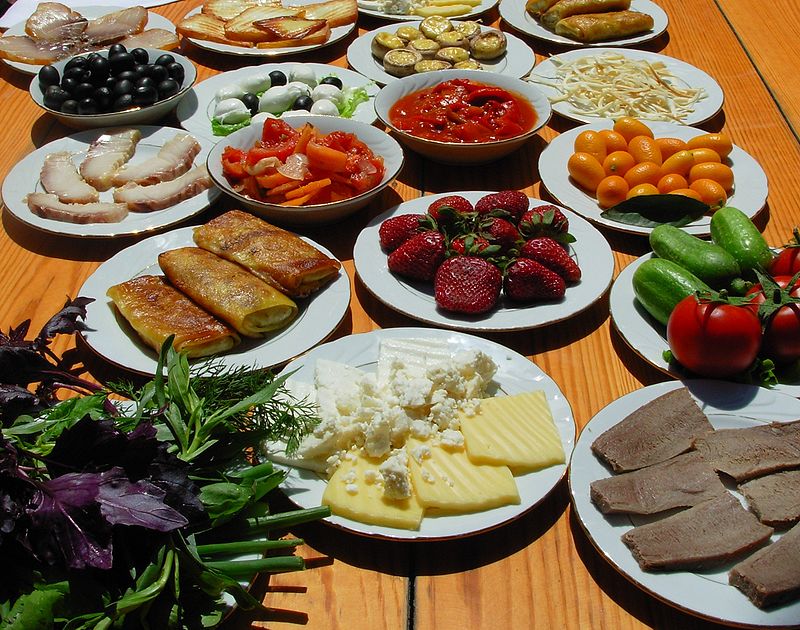
Azerbaijani cuisine
culinary traditions of Azerbaijan

cabbage roll
dish of cabbage leaves with a filling

sujuk
Sujuk, sugou or sucuk (/suːˈd͡ʒʊk/) is a dry, spicy and fermented sausage which is consumed in several Anatolian, Balkan, Middle Eastern and Central Asian cuisines. Sujuk mainly consists of ground meat and animal fat usually obtained from beef or lamb, but beef is mainly used in Turkey, Egypt, Sudan, Armenia, Azerbaijan, Bosnia and Herzegovina, Albania, Georgia, Bulgaria, Kazakhstan, and Kyrgyzstan.
.jpg)
pirozhki
Pirozhki (, ; ; see also other names) is the Russian name for baked or fried yeast-leavened boat-shaped buns with a variety of fillings in Russian and Eastern European cuisine in general. Pirozhki are a popular street food and comfort food. They are especially popular in countries with large ethnic Russian communities, and may also be found in other parts of the world.
khash
type of food

torshi
thumb|Turşu in Turkey
Torshi, tursu or turshi () are the pickled vegetables of many Middle Eastern, Caucasian, Slavic and Balkan cuisines.
Chiburekki
Chebureki ( Cheburek) are deep-fried turnovers with a filling of ground or minced meat and onions. A popular street dish, they are made with a single round piece of dough folded over the filling in a crescent shape. They have become widespread in the former Soviet-aligned countries of Eastern Europe in the 20th century.
chorba
Chorba, ( ; ) shorwa, shurba, shurpa, shurbah or shorba ( ) is a broad class of stews or rich soups found in national cuisines across North Africa, The Middle East, Iran, Turkey, Southeast Europe, Central Asia, East Africa and South Asia. It is often prepared with added ingredients but is also served alone as a broth or with bread.
.jpg)
Kurt
Kashk, kishk, ( Kašk, ), () qurut, qurt, kurut, kurt, qqet, jameed, shilanch (Tuvan and , , , , , Tajik: қурут, ), chortan ( chort’an), aaruul or khuruud (Mongolian: ааруул or хурууд) is a range of dairy products popular in Iranian cuisine, Caucasian cuisine, and Central Asian cuisine. Kashk is made from strained yogurt, drained buttermilk (in particular, drained qatiq) or drained sour milk by shaping it and letting it dry. It can be made in a variety of forms: rolled into balls, sliced into strips, and formed into chunks.

samanu
thumb|200px|Cooking samanak in Isfara, Tajikistan
Fesenjān
Fesenjān (; also called Fesenjoon in Tehrani dialect) is a sweet and sour Iranian stew (a khoresh). The roots of this Persian delicacy trace back to the Sassanid Persia's golden age. It is typically served over rice in the Iranian manner. In Iran, it is made with minced meat (lamb, sheep or beef), meatballs, chicken or duck. Like other khoresh stews served over rice, fesenjan is common also to Iraqi cuisine through Iranian pilgrims visiting Shia sites such as Imam Husayn shrine. As a festive dish for special occasions, it has become part of Jewish Rosh Hashannah celebrations, even though the t

joshpara
Joshpara is a kind of dumpling popular in Central Asia, South Caucasus and the Middle East. They are made of unleavened wheat dough squares filled with ground meat and condiments.

katyk
thumb|Qatiq from Azerbaijan
thumb|Bulgarian qatiq
Qatiq is a fermented milk product from the Turkic countries. It is a more solid form of yogurt than ayran.

Haleem
Haleem or halim is a type of stew that is widely consumed in South Asia, the Middle East and Central Asia. Although the dish varies from region to region, it optionally includes wheat or barley, lentils and meat. It is made by slow cooking the meat in lentils and spices. It is served hot with flat breads or on its own. Popular variations of haleem include keşkek (in Turkey, Tajikistan, Uzbekistan, Azerbaijan and Northern Iraq); harisa (in the Arab world and Armenia); halim (in Afghanistan, Iran, West Bengal, Mauritius, Pakistan and Bangladesh); and Hyderabadi haleem (in India).
sarma
cabbage, vine leaf, or other leaf roll
.jpg)
Kattama
Qatlama (, both ), qattama, katlama, kattama, (; , both ), katmer (), katma (), qator, gambir (, ) is a fried layered bread common in the cuisines of Central Asia, Pakistan and Turkey.
kuku
genre of Persian food, made with egg as a binder and another ingredient
Azerbaijani wine
wine making in Azerbaijan
pomegranate juice
juice obtained from the pomegranate fruit

tsoureki
Tsoureki () also known as bsatir, čʿorek, katʿnahuncʿ (), çyrek (Albanian), kozunak (), cozonac (Romanian), paskalya çöreği (Turkish), or šurēk (), is a sweet holiday bread made with flour, milk, butter, eggs, and sugar. It is commonly seasoned with lemon and orange zest, mastic resin, or mahleb.
yahni
Yakhni (, , , , ), yahni (Turkish), or yahniya (, Serbian, ), jahni (Albanian), iahnie (Romanian) is a class of dishes traditionally prepared in a vast area encompassing South Asia, the Middle East and the Balkans. Generally, it is a stew of meat and vegetables.

Levengi
Levengi, levangi, lavengi or lavangi (; ) is a stuffing, typically for baked fish or poultry, in Talysh cuisine. Typical ingredients include onions, walnuts, and dried fruit stuffed into poultry or fish. Levengi is usually prepared for Nowruz.
Lula kebab
type of kebab, made from minced meat

kesme
thumb|Kesme
Kesme or erişte is a type of egg noodle found in various Central Asian countries. It is also found in Turkish cuisine and is called erişte and “kesme” in modern standard Turkish. The word itself is a nominalisation of the verb to cut or to slice, referring to the slicing of the dough involved in preparing the noodles. The term may refer to the noodles themselves, or the prepared dish made with them. Kesme is traditionally a homemade dish, and not often found at restaurants or cafés. In Turkey, kesme is also known as "erişte", and eaten generally in winter. It is made from flour, eg

Borani
thumb|Turkish borani with spinach
stuffed tomatoes
tomato dish

kuymak
thumb|alt=Cheese dish in a copper pan|Kuymak in a sahan
Kuymak or khavitz () is a dish popular in the Black Sea region that lies in northern Turkey. Its primary ingredients are cornmeal and cheese. It is typically served with bread and a spoon.
qutab
Qutab, or Gutab is a traditional dish in Azerbaijani, Turkmen and Turkish cuisine, made from thinly rolled dough that is filled with a variety of ingredients and cooked briefly on a convex griddle called a saj. This versatile and popular dish comes in many variations, with fillings ranging from savory meats, herbs, and pumpkin to more unconventional ingredients like minced sheep intestines. Usually served as an appetizer and comes in a small size. Some regions of Azerbaijan and Turkmenistan make larger versions where qutab then acts as a main course.
stuffed eggplant
eggplant dish
tahini roll
Turkish sweet bun (çörek) with tahini
Tabriz köfte
Iranian meatball
chigirtma
Chigirtma () is an egg dish of Azerbaijani cuisine. The name chigirtma (çığırtma) means that it includes eggs. Chigirtma literally means in Azerbaijani “screaming”. It is believed that the dish is called so because of the sounds the meat (or vegetable) makes while cooking in hot oil.
Gürzə
Gürzə is a variation of Azerbaijani dumplings consisting of a filling wrapped in 1mm thin dough circle cuts of 5 cm diameter. It originates in Azerbaijan and is a part of Azerbaijan national cuisine. The filling is made from minced fatty lamb and onion, pre-fried before filling. Gürzə are formed as small cylinders with an open top, boiled for several minutes, strained, seasoned with cinnamon and served with yogurt or sour cream mixed with crushed garlic. In some regions of Azerbaijan gürzə dumplings are boiled in lamb stock and served as a soup, seasoned with chopped fresh parsley and ser
squash blossom
the edible flowers of Cucurbita species
Shollar water
.jpg)
Zalabiyeh
Zalabiyeh () is a fritter or doughnut found in several cuisines across the Arab world, West Asia and some parts of Europe influenced by the former. The fritter version is made from a semi-thin batter of wheat flour which is poured into hot oil and deep-fried. The earliest known recipe for the dish comes from a 10th-century Arabic cookbook and was originally made by pouring the batter through a coconut shell. Zalabiyeh differs from lokma in that it is made from batter rather than yeast dough, though the names are sometimes used interchangeably.
pomegranate molasses
a middle eastern condiment made from boiled down pomegranate juice

Şiş köfte
Kofte meatballs grilled on a skewer
Eggplant jam
Turkish jam
Lighvan Cheese
brined curd sheep's milk cheese traditionally made in Iran
hoşmerim
Höşmerim or hoşmerim is a Turkish dessert popular in the Aegean, Marmara, Trakya and Central Anatolia, Black Sea, East Black Sea regions of Turkey. It is sometimes called peynir helva or "cheese halva". It is generally consumed after a meal as a light dessert and may be topped with ice cream, honey or nuts.
stuffed quinces
Turkish and azeri dish
stuffed apples
Apples stuffed with lamb and rice
beer in Azerbaijan
kol böreği
Type of börek
Sabzi khordan
Dish made from raw vegetables and herbs