Category
page 1Belizean cuisine

Allium sativum
Garlic (Allium sativum) is a species of bulbous flowering plants in the genus Allium. Its close relatives include the onion, shallot, leek, chives, Welsh onion, and Chinese onion. Garlic is native to central and western Asia, stretching from the Black Sea through the southern Caucasus, northeastern Iran, and the Hindu Kush. It has naturalized in many other parts of the world, including Mediterranean Europe and China. There are two subspecies and hundreds of varieties of garlic.
.jpg)
Artocarpus heterophyllus
The jackfruit, jakfruit or nangka (Artocarpus heterophyllus) is a species of tree in the fig, mulberry, and breadfruit family (Moraceae).

breadfruit
Breadfruit (Artocarpus altilis) is a species of flowering tree in the mulberry and jackfruit family (Moraceae) believed to have been selectively bred in Polynesia from the breadnut (Artocarpus camansi). Breadfruit was spread into Oceania via the Austronesian expansion and to further tropical areas during the Colonial Era. British and French navigators introduced a few Polynesian seedless varieties to Caribbean islands during the late 18th century.
.%20Leiden%20University%20Library%2C%20Collection%20A.%20P.%20H.%20Hotz.jpg)
kabab
Kebab ( , ), kebap, kabob (alternative North American spelling), kebob, or kabab (Hindi and Kashmiri spelling) is a variety of roasted meat dishes that originated in the Middle East.

curry
thumb|upright=1.2|Lamb Madras curry, Anglo-Indian, c. 1850
Curry is a dish with a spicy sauce, initially in Indian cuisine, then modified by interchange with the Portuguese, followed by the British, and eventually thoroughly internationalised. Many curries are found in the cuisines of countries in Southeast Asia and East Asia.

coconut milk
liquid that comes from the grated meat of a coconut

taco
A taco (, , ) is a traditional Mexican dish consisting of a small hand-sized corn- or wheat-based tortilla topped with a filling. The tortilla is then folded around the filling and eaten by hand. A taco can be made with a variety of fillings, including beef, pork, chicken, seafood, beans, vegetables, and cheese, and garnished with various condiments, such as salsa, guacamole, or sour cream, and vegetables, such as lettuce, coriander, onion, tomatoes, and chiles. Tacos are a common form of antojitos, or Mexican street food, which have spread around the world.

Sicyos edulis
Chayote (; previously placed in the obsolete genus Sechium, now in the genus Sicyos, as Sicyos edulis), also known as christophine, mirliton, güisquil, and choko, is an edible plant belonging to the gourd family, Cucurbitaceae. This fruit was first cultivated in Mesoamerica between southern Mexico and Honduras, with the most genetic diversity available in both Mexico and Guatemala. It is one among dozens of foods introduced to the Old World during the Columbian Exchange. At that time, the plant spread to other parts of the Americas, ultimately causing it to be integrated into the cuisine of ma

guava
thumb|Guava with slice
thumb|right|Ripe apple guavas (Psidium guajava)

burrito
A burrito (, ) or burro in Mexico is, historically, a regional name, among others, for what is known as a taco, a tortilla filled with food, in other parts of the country. The term burrito was regional, specifically from Guanajuato, Guerrero, Michoacán, San Luis Potosí, Sonora and Sinaloa, for what is known as a taco in Mexico City and surrounding areas, and codzito in Yucatán and Quintana Roo. Due to the cultural influence of Mexico City, the term taco became the default, and the meaning of terms like burrito and codzito were forgotten, leading many people to create new meanings and folk hist

cooking banana
banana cultivars commonly used in cooking
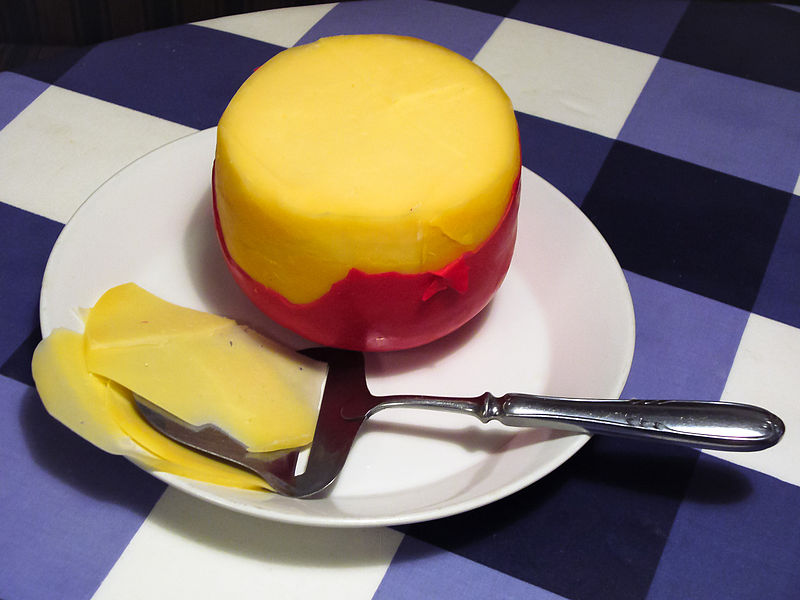
Edam
Dutch cheese
%20caseras.JPG)
empanada
An empanada is a type of baked or fried turnover consisting of pastry and filling, common in Spain, Portugal, other Southern European countries, North African countries, West African countries (where they are known as meatpies in Nigeria), South Asian countries, Latin American countries, and the Philippines. The name comes from the Spanish (to bread, i.e., to coat with bread), and translates as 'breaded', that is, wrapped or coated in bread. They are made by folding dough over a filling, which may consist of meat, cheese, tomato, corn, or other ingredients, and then cooking the resulting turno

ceviche
Ceviche, cebiche, sebiche, or seviche is a cold dish consisting of fish or shellfish marinated in citrus and seasonings. Different versions of ceviche are part of the culinary cultures of various Latin American countries along the Pacific Ocean where each one is native, including Chile, Colombia, Costa Rica, Ecuador, El Salvador, Guatemala, Honduras, Mexico, Puerto Rico, Nicaragua, Panama, and Peru. Ceviche is considered the national dish of Peru and is recognized by UNESCO as an expression of Peruvian traditional cuisine and an Intangible Cultural Heritage of Humanity.

tamale
A tamale is a traditional Mesoamerican dish made of masa, a dough made from nixtamalized corn, which is steamed in a corn husk or banana leaves. The wrapping can either be discarded prior to eating or used as a plate. Tamales can be filled with meats, cheeses, fruits, vegetables, herbs, chilies, or any preparation according to taste, and both the filling and the cooking liquid may be seasoned.

habanero
The habanero (; ) is a pungent cultivar of Capsicum chinense chili pepper. Unripe habaneros are green, and they color as they mature. The most common color variants are orange and red, but the fruit may also be white, brown, yellow, green, or purple. Typically, a ripe habanero is long. Habanero chilis are very hot, rated 100,000–350,000 on the Scoville scale. The habanero's heat, flavor, and floral aroma make it a common ingredient in hot sauces and other spicy foods.
chicken curry
South Asian and Southeast Asian curry that consists of chicken stewed in an onion and tomato-based sauce, flavored with ginger, garlic, mango chutney, tomato puree, chili peppers, and variety of spice.
tortilla chip
snack food made from fried or baked corn tortilla wedges

pupusa
A pupusa is a thick griddle cake or flatbread from El Salvador and Honduras made with cornmeal or rice flour stuffed with one or more ingredients including cheese, beans, , or squash. It can be served with and tomato sauce and is traditionally eaten by hand. Pupusas have origins in Pre-Columbian Mesoamerica but were first mentioned in 1837 by Guatemalan poet José Batres Montúfar. In El Salvador, the pupusa is the national dish and has a day to celebrate it.
dried and salted cod
cod which has been preserved by drying after salting

escabeche
__NOTOC__
thumb|Escabeche of tilapia, from the [[Philippines]]
meat pie
pie with a filling of meat
mole
Mexican sauces containing a fruit, chili pepper, nuts, and such spices as black pepper, cinnamon, cumin, and chocolate
coconut rice
coconut-flavoured rice
Cochinita pibil
Mexican slow-roasted pork dish

callaloo
Callaloo ( , ; many spelling variants, such as kallaloo, calaloo, calalloo, calaloux, or callalloo) is a plant used in popular dishes in many Caribbean countries, while for other Caribbean countries, a stew made with the plant is called . Cuisines, including the plant or dishes called , vary throughout the Caribbean. In countries such as Trinidad and Tobago or Grenada, the dish itself is called and uses taro leaves (known by many local names such as 'dasheen bush', ' bush', or 'bush') or Xanthosoma leaves (known by many names, including cocoyam and tannia).
corn tortilla
unleavened flatbread made from ground corn (maize)
Jamaican patty
pastry that contains various fillings
Belizean cuisine
culinary traditions of Belize
rice and peas
traditional food within the West Indian Caribbean islands

jerk
style of cooking native to Jamaica

recado rojo
spiced food paste
wheat tortilla
type of soft, thin flatbread made from finely ground wheat flour

Johnnycake
Johnnycake, also known as journey cake, johnny bread, hoecake, shawnee cake or spider cornbread, is a cornmeal flatbread, a type of batter bread. An early North American staple food, it is prepared on the Atlantic coast from Newfoundland to Jamaica. The food originates from the indigenous people of North America. It is still eaten in the Bahamas, Belize, Nicaragua, Bermuda, Canada, Colombia, Aruba, Curaçao, Bonaire, Dominican Republic, Puerto Rico, Saint Croix, Sint Maarten, Antigua, and the United States.
curry goat
spicy stew
Ancient Maya cuisine
diet of the Ancient Mesoamerican civilization
Poc Chuc
Mayan dish
pork tail
dish made from pig's tail
coco bread
type of bread
Fry jack
traditional Belizean dish
Balché
Balché is a mildly intoxicating beverage that was commonly consumed by the ancient Maya in what is now Mexico and upper Central America. Today, it is still common among the Maya. The drink is made from the bark of a leguminous tree, Lonchocarpus violaceus, which is soaked in honey and water, and fermented. A closely related beverage, made from honey produced from the nectar of a species of morning glory (Turbina corymbosa), is called xtabentún.
garnacha
Mesoamerican dish
Curtido
Curtido () is a type of lightly fermented relish. It is typical in Salvadoran cuisine and that of other Central American countries. In El Salvador it is usually made with cabbage, onions, carrots, oregano, and sometimes lime juice; it resembles sauerkraut, kimchi, pikliz or tart coleslaw. It is commonly served alongside pupusas, a national specialty.
cow's trotters
cow's feet, used as food
Belikin
Belikin Beer is produced by the Belize Brewing Company. There are several varieties, including Belikin Beer, Belikin Stout, and seasonal brews.
roti
This is a food article about a wrap style sandwich
Papadzules
thumb|Papadzules
thumb|Papadzules in Quintana Roo, Mexico
Papadzules (; Mexican Spanish, from Mayan ) is a traditional dish from the Yucatán Peninsula resembling enchiladas. In its simplest form it consists of corn tortillas dipped in a sauce of pepita (pumpkin seeds) and filled with hard-boiled eggs, and garnished with a cooked tomato-pepper sauce.
Pozol
Salbut
thumbnail|Salbutes
A salbut (pl. salbutes, ) is a puffed deep fried tortilla that is topped with lettuce, sliced avocado, pulled chicken or turkey, tomato and pickled red onion. Salbutes originate from the Yucatán Peninsula and are a staple in Belize.