Category
page 1Externally peer reviewed articles

lead
Lead () is a chemical element with the symbol Pb (from the Latin ) and atomic number 82. It is a heavy metal, denser than most common materials. Lead is soft, malleable, and has a relatively low melting point. When freshly cut or melted, it appears shiny silvery with a bluish tint, but tarnishes to dull gray on exposure to air. Lead has the highest atomic number of any stable element, and three of its isotopes are endpoints of major nuclear decay chains of heavier elements.

Osman I
founder of the Ottoman Empire (died 1323/4)

dyslexia

cerebellum
The cerebellum (: cerebella or cerebellums; Latin for 'little brain') is a major feature of the hindbrain of all vertebrates. Although usually smaller than the cerebrum, in some animals such as the mormyrid fishes it may be as large as it or even larger. In humans, the cerebellum plays an important role in motor control and cognitive functions such as attention and language as well as emotional control such as regulating fear and pleasure responses, but its movement-related functions are the most solidly established. The human cerebellum does not initiate movement, but contributes to motor coo

radiocarbon dating
technique based on carbon-14 decay to determine the age of organic materials

leptospirosis

hippocampus
The hippocampus (: hippocampi), also hippocampus proper, is a major component of the brain of humans and many other vertebrates. In the human brain the hippocampus, the dentate gyrus, and the subiculum are components of the hippocampal formation located in the limbic system.
The hippocampus plays important roles in the consolidation of information from short-term memory to long-term memory, and in spatial memory that enables navigation. In humans and other primates the hippocampus is located in the archicortex, one of the three regions of allocortex, in each hemisphere with direct neural proj

DL-lysine
thumb|Lysine ball and stick model spinning
Lysine (symbol Lys or K) is an α-amino acid that is a precursor to many proteins. Lysine contains an α-amino group (which is in the protonated form when the lysine is dissolved in water at physiological pH), an α-carboxylic acid group (which is in the deprotonated form when the lysine is dissolved in water at physiological pH), and a side chain (which is partially protonated when the lysine is dissolved in water at physiological pH), and so it is classified as a basic, charged (in water at physiological pH), aliphatic amino acid. It is encoded by the

Western African Ebola virus epidemic
2014-15 Ebola virus disease epidemic in West Africa

IPv4
Internet Protocol version 4 (IPv4) is the first version of the Internet Protocol (IP) as a standalone specification. It is one of the core protocols of standards-based internetworking methods in the Internet and other packet-switched networks. IPv4 was the first version deployed for production on SATNET in 1982 and on the ARPANET in January 1983. It is still used to route most Internet traffic today, even with the ongoing deployment of Internet Protocol version 6 (IPv6), its successor.
IPv4 uses a 32-bit address space which provides 4,294,967,296 (232) unique addresses, but large blocks are re

binary search algorithm
search algorithm in sorted lists that operates by decreasing the search space by half each pass

Baryonyx
Baryonyx () is a genus of theropod dinosaur which lived in the Barremian stage of the Early Cretaceous period, about 130–125 million years ago. The first skeleton was discovered in 1983 in the Smokejack Clay Pit, of Surrey, England, in sediments of the Weald Clay Formation, and became the holotype specimen of Baryonyx walkeri, named by palaeontologists Alan J. Charig and Angela C. Milner in 1986. The genus name Baryonyx comes from Ancient Greek βαρύς (barús), meaning "heavy" or "strong", and ὄνυξ (ónux), meaning "claw", alluding to the animal's very large claw on the first finger; the specific
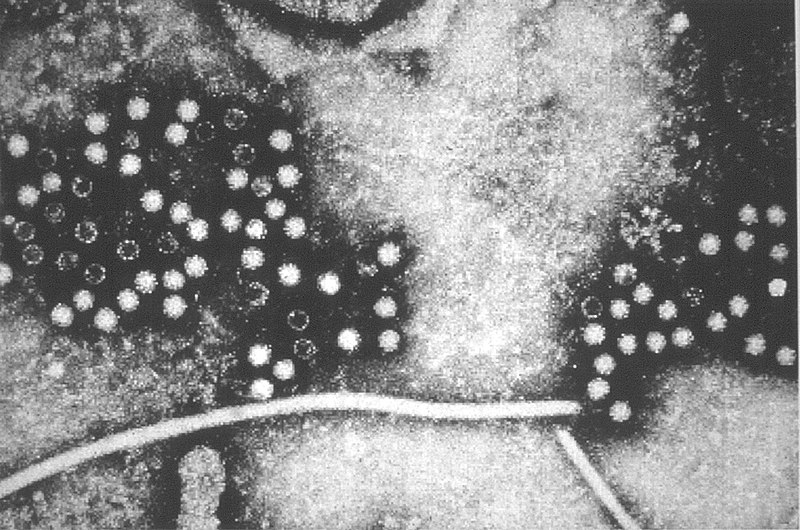
hepatitis E
an inflammation of the liver caused by infection with the hepatitis E virus

Abu al-Faraj al-Isfahani
Arab historian, writer, poet and musicologist (897–967)

Æthelflæd
Æthelflæd ( – 12 June 918) ruled as Lady of the Mercians in the English Midlands from 911 until her death in 918. She was the eldest child of Alfred the Great, king of the Anglo-Saxon kingdom of Wessex, and his wife Ealhswith.

nucleoid
The nucleoid (meaning nucleus-like) is an irregularly shaped region within the prokaryotic cell that contains all or most of the genetic material. The chromosome of a typical prokaryote is circular, and its length is very large compared to the cell dimensions, so it needs to be compacted in order to fit. In contrast to the nucleus of a eukaryotic cell, it is not surrounded by a nuclear membrane. Instead, the nucleoid forms by condensation and functional arrangement with the help of chromosomal architectural proteins and RNA molecules as well as DNA supercoiling. Genome length varies widely (ge
space
mathematical structure of geometric nature

Black-and-yellow Broadbill
species of bird

(RS)-rabeprazole
Rabeprazole, sold under the brand name Aciphex, among others, is a medication that decreases stomach acid. It is used to treat peptic ulcer disease, gastroesophageal reflux disease, and excess stomach acid production such as in Zollinger–Ellison syndrome. It may also be used in combination with other medications to treat Helicobacter pylori. Effectiveness is similar to other proton pump inhibitors (PPIs). It is taken by mouth.
systematic review
publication type, study that gathers, analyzes, and communicates the results of research and information on a topic

melioidosis
Melioidosis is an infectious disease caused by a gram-negative bacterium called Burkholderia pseudomallei. Most people exposed to B. pseudomallei experience no symptoms, but complications can range from fever and skin changes to pneumonia, abscesses, and septic shock, which can be fatal. Approximately 10% of people with melioidosis develop symptoms that last longer than two months, termed "chronic melioidosis".
phage therapy
therapeutic use of bacteriophages to treat pathogenic bacterial infections

anthracycline antibiotic
thumb|Doxorubicin as an intercalating agent. Two doxorubicin molecules intercalated within DNA.
origin of replication
sequence in a genome at which replication is initiated
2018–2020 Kivu Ebola epidemic
Ebola virus outbreak

Paranthodon
Paranthodon ( ) is a genus of stegosaurian dinosaur that lived in what is now South Africa during the Early Cretaceous, between 139 and 131 million years ago. Discovered in 1845, it was one of the first stegosaurians found. Its only remains, a partial skull, isolated teeth, and fragments of vertebrae, were found in the Kirkwood Formation.
peripatric speciation
speciation in which a new species is formed from an isolated smaller peripheral population
reference range
measured values in a control group

RNA sequencing
thumb|419x419px|Summary of RNA-Seq. Within the organism, genes are transcribed and (in a eukaryote|eukaryotic organism) spliced to produce mature mRNA transcripts (red). The mRNA is extracted from the organism, fragmented and copied into stable ds-cDNA (blue). The ds-cDNA is sequenced using high-throughput, short-read sequencing methods. These sequences can then be aligned to a reference genome sequence to reconstruct which genome regions were being transcribed. This data can be used to annotate where expressed genes are, their relative expression levels, and any alternative splice variants.
Hilda Rix Nicholas
Australian painter (1884–1961)
Earth-grazing meteoroid of 13 October 1990
Earth-grazing meteoroid captured above Czechoslovakia and Poland on 13 October 1990
Yolmo
Sino-Tibetan language
selfish DNA
genetic material that promotes its own transmission
TIM barrel
protein fold
Psittacine beak and feather disease
viral disease affecting parrots
Poisson manifold
Mathematical structure in differential geometry
Bioclogging
Bioclogging or biological clogging refers to the blockage of pore space in soil by microbial biomass, including active cells and their byproducts such as extracellular polymeric substance (EPS). The microbial biomass obstructs pore spaces, creating an impermeable layer in the soil and significantly reducing water infiltration rates.
transcriptomics
study of RNA transcripts
widgiemoolthalite
Widgiemoolthalite is a rare hydrated nickel(II) carbonate mineral with the chemical formula . Usually bluish-green in color, it is a brittle mineral formed during the weathering of nickel sulfide. Present on gaspéite surfaces, widgiemoolthalite has a Mohs scale hardness of 3.5 and an unknown though likely disordered crystal structure. Widgiemoolthalite was first discovered in 1992 in Widgiemooltha, Western Australia, which is to date its only known source. It was named the following year by the three researchers who first reported its existence, Ernest H. Nickel, Bruce W. Robinson, and William
hypercycle
theory of molecules organization
Androgen backdoor pathway
series of interconnected biochemical reactions

affine symmetric group
a mathematical structure that describes the symmetries of the number line and the regular triangular tesselation of the plane, as well as related higher dimensional objects
Themes in Maya Angelou's autobiographies
Themes including racism, identity, family, and travel
micropeptide
thumb|300x300px|Micropeptides can be transcribed from 5'UTRs, small genes, polycistronic mRNAs, or mis-annotated lncRNA.
Micropeptides (also referred to as microproteins) are polypeptides with a length of less than 100-150 amino acids that are encoded by short open reading frames (sORFs). In this respect, they differ from many other active small polypeptides, which are produced through the posttranslational cleavage of larger polypeptides. In terms of size, micropeptides are considerably shorter than "canonical" proteins, which have an average length of 330 and 449 amino acids in prokaryotes a
RIG-I-like receptor, C-terminal domain superfamily
receptor family