Category
page 1French cuisine

mayonnaise
Mayonnaise (), colloquially referred to as "mayo" (), is a thick, creamy sauce with a rich and tangy taste that is commonly used on sandwiches, hamburgers, bound salads, and French fries. It also forms the base for various other sauces, such as tartar sauce, fry sauce, remoulade, salsa golf, ranch dressing, and rouille.

fries
deep-fried potatoes

pilaf
Pilaf (), pilav, pilau or plov () is a rice dish, or in some regions, a wheat dish, whose recipe usually involves cooking in stock or broth, adding spices, and other ingredients such as vegetables and meat, and employing some technique for achieving cooked grains that do not adhere.

couscous
Couscous () is a traditional North African dish of small steamed granules of rolled semolina that is often served with a stew spooned on top. Pearl millet, sorghum, bulgur, and other cereals are sometimes cooked in a similar way in other regions, and the resulting dishes are also sometimes called couscous.

cognac
Cognac ( , also , ) is a variety of brandy named after the commune of Cognac, France. It is produced in the surrounding departments of Charente and Charente-Maritime, in an officially designated wine-growing region. This region is divided into six districts with different cognacs produced in each.

caviar
thumb|The rarest and most expensive form of caviar comes from the critically endangered beluga sturgeon that swims in the [[Caspian Sea.]]

ratatouille
Ratatouille ( , ; ) is a traditional French vegetable dish originating in the Provence region of southern France, particularly associated with Nice and its surrounding region. It developed within the context of rural Provençal cuisine, where seasonal vegetables were stewed together as a practical means of using surplus summer produce. The dish consists of a stew or sauté of seasonal summer vegetables cooked in olive oil and is sometimes referred to as ratatouille niçoise ().

absinthe
Absinthe (, ) is an anise-flavoured spirit derived from several plants, including the flowers and leaves of Artemisia absinthium ("grand wormwood"), together with green anise, sweet fennel, and other medicinal and culinary herbs. Historically described as a highly alcoholic spirit, it is 45–74% ABV or 90–148 proof in the US. Absinthe traditionally has a natural green colour but may also be colourless. It is commonly referred to in historical literature as . While sometimes casually referred to as a liqueur, absinthe is not traditionally bottled with sugar or sweeteners. Absinthe is traditional

croissant
A croissant (; ) is a French Viennoiserie in a crescent shape made from a laminated yeast dough that sits between a bread and a puff pastry.

waffle
thumb|Still life with waffles, 17th century
A waffle is a dish made from usually leavened batter or dough that is cooked between two plates that are patterned to give a characteristic size, shape, and surface impression. There are many variations based on the type of waffle iron and recipe used. Waffles are eaten throughout the world, particularly in Belgium, which has over a dozen regional varieties. Waffles may be made fresh or simply heated after having been commercially baked and packaged fresh or frozen.

pretzel
A pretzel ( ; from or , ; ) is a type of baked pastry made from dough that is commonly shaped into a knot. The traditional pretzel shape is a distinctive symmetrical form, with the ends of a long strip of dough intertwined and then twisted back onto itself in a particular way (a pretzel loop or pretzel bow). Today, pretzels come in various shapes, textures, and colors, but the original soft pretzel remains one of the most common pretzel types.
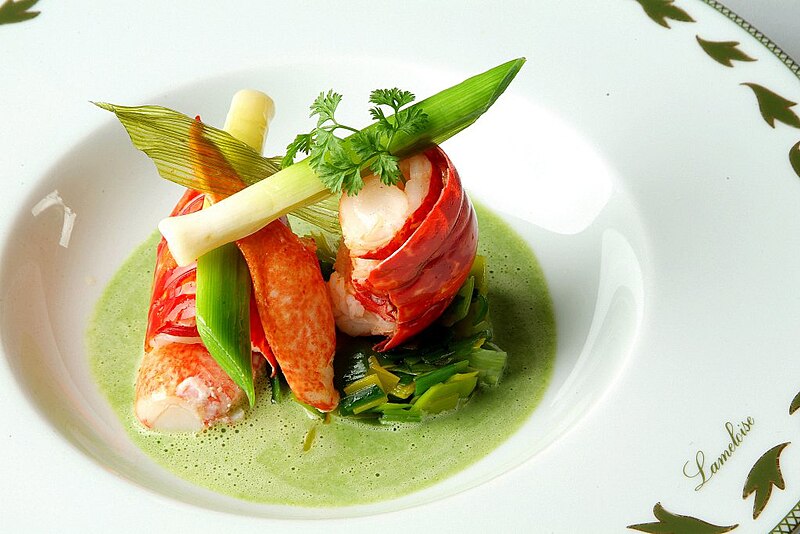
French cuisine
сulinary traditions of France

Ortolan Bunting
species of bird

baguette
A baguette (; ) is a long, thin type of bread of French origin that is commonly made from basic lean dough. The dough of the tradition baguette, unlike the shape, is defined by French law. It is distinguishable by its length and crisp crust.
%2C%20Apicius%2C%20De%20Re%20Coquinaria%207%2C11%2C4%20(23216361733).jpg)
nougat
Nougat refers to a variety of similar confections made from a sweet paste whipped to a chewy or crunchy consistency.

fondue
Fondue ( , , , ; ) is a Swiss dish of melted cheese and wine served in a communal pot ( or fondue pot) over a portable stove () heated with a candle or spirit lamp, and eaten by dipping bread and sometimes vegetables or other foods into the cheese using long-stemmed forks. It was promoted as a Swiss national dish by the Swiss Cheese Union () in the 1930s.

foie gras
French culinary dish

paprika
Paprika is a spice made from dried and ground red peppers, Capsicum annuum. It can have varying levels of heat, but the peppers used for hot paprika tend to be milder and have thinner flesh than those used to produce chili powder. The milder, sweet paprika is mostly composed of the fruit of the pepper with most of the seeds removed; whereas some seeds and stalks are retained in the peppers used for hotter paprika.
.jpg)
meringue
Meringue ( , ) is a type of dessert or candy, of French origin, traditionally made from whipped eggwhites and sugar, and occasionally an acidic ingredient such as lemon, vinegar, or cream of tartar. A binding agent such as salt, flour, or gelatin may also be added to the eggs. The key to the formation of a good meringue is the formation of stiff peaks by denaturing the protein ovalbumin (a protein in the egg whites) via mechanical shear.

pâté
Pâté ( , , ) is a forcemeat. Originally, the dish was cooked in a pastry case and called pâté en croute; in more recent times it is more usually cooked without pastry in a terrine, and called or simply . Various ingredients are used, which may include meat from pork, poultry, fish or beef; fat; vegetables; herbs; spices; wine; and brandy.

strudel
Strudel ( , ) is a type of layered pastry with a filling that is usually sweet, but savoury fillings are also common. It became popular in the 18th century throughout the Austrian Empire. Strudel is part of Austrian cuisine and German cuisine but is also common in other Central European cuisines. In Italy it is recognized as a (PAT) of South Tyrol.

Calvados
thumb|

tartar sauce
sauce

aioli
Aioli, allioli, or aïoli () is a cold sauce consisting of an emulsion of garlic and olive oil; it is found in the cuisines of the northwest Mediterranean.

truffle
thumb|Tuber melanosporum|Black truffle (Tuber melanosporum)

cinnamon roll
sweet food pastry

steak tartare
meat dish made from finely chopped raw beef or horse meat

brioche
Brioche (, also , , ) is a Viennoiserie of French origin whose high egg and butter content gives it a rich and tender crumb. Chef Joël Robuchon described it as "light and slightly puffy, more or less fine, according to the proportion of butter and eggs". It has a dark, golden, and flaky crust, frequently accentuated by an egg wash applied after proofing.
ganache
Ganache (, ; ) is a glaze, icing, sauce, or filling for pastries, made from chocolate and cream.
medieval cuisine
foods, eating habits, and cooking methods of various European cultures during the Middle Ages
crème fraîche
dairy product

Niçard salad
composed tomato, egg, fish and vegetable salad

bistro
thumb|250px|At the Bistro, Jean Béraud
A bistro or bistrot (), in its original Parisian form, is a small restaurant serving moderately priced, simple meals in a modest setting.
cordon bleu
meat and cheese dish

ragout
Ragout (, , ) is a stew served as a main dish.
croque-monsieur
baked or fried ham and cheese sandwich

cassoulet
Cassoulet (, also ,; ; ) is a rich stew originating in southern France. The food writer Elizabeth David described it as "that sumptuous amalgamation of haricot beans, sausage, pork, mutton and preserved goose, aromatically spiced with garlic and herbs". It originated in the town of Castelnaudary in the Aude department in the Occitanie region. Variants of the dish are local to other towns and cities in the Aude.

gratin
thumb|A macaroni, cheese and meat gratin.|170px
right|thumb|Avocado gratin.|170px
Gratin () is a culinary technique in which a dish is topped with a browned crust, often using breadcrumbs, cheese, or egg. The term may be applied to any dish made using this method. Gratin is usually prepared in a shallow dish. A gratin is baked or cooked under an overhead grill or broiler to form a golden crust on top, and it is often served in its baking dish.

Tuber melanosporum
species of fungus
French wine
alcoholic beverage made from grapes grown in France
snail as food
flesh from snails

beefsteak
thumb|Sliced steak with fries, known as steak frites.
Les Halles
formet food market

raclette
thumb|right|Raclette with boiled potatoes, pickles and onions
Raclette (, ) is a dish of Swiss origin, also popular in other countries, based on heating cheese and scraping off the melted part, then typically served with boiled potatoes. Raclette is historically a dish originating from the canton of Valais in Switzerland. This cheese from Valais benefits from an AOP. Raclette cheese is also a Swiss-type cheese marketed specifically to be used for this dish.

merienda
thumb|Typical merienda fare
thumb|Typical vespertine merienda in the Andalusia|South of Spain
thumb|Traditional serving of merienda in Café El Gato Negro, [[Buenos Aires: medialunas (croissants), café en jarrito (a double espresso coffee) and a little glass of sparkling water]]
thumb|A typical meryenda in the Philippines, [[tsokolate with suman rice cakes and ripe carabao mangoes]]
Merienda is a light meal in southern Europe, particularly Spain (merenda in Galician, berenar in Catalan), Portugal (lanche, merenda) and Italy (merenda), whence the word spread to Serbo-Croatian in, according to di
baked potato
potato dish
.jpg)
Blancmange
Blancmange (, from , ) is a sweet dessert popular throughout Europe commonly made with milk or cream, and sugar, thickened with rice flour, gelatin or corn starch, and often flavoured with almonds.
haute cuisine
type of French cuisine

mirepoix
thumb|upright=1.15|Vegetables (with the addition of leeks) prepared for mirepoix, on a cutting board
A '''''' ( , ) is a mixture of diced vegetables cooked with fat (usually butter) for a long time on low heat without colouring or browning. The ingredients are not sautéed or otherwise hard-cooked, because the intention is to sweeten rather than caramelise them. Historically including various meats before settling at its current meaning as a vegetable base, is a long-standing part of French cuisine and is the flavour base for a wide variety of dishes, including stocks, soups, stews, and sauces

verjuice
thumb|250px|Picking green grapes for making verjuice. Tacuinum Sanitatis (1474). Paris, Bibliothèque nationale.
Verjuice is a highly acidic juice made by pressing unripe grapes, crab-apples or other sour fruit. Sometimes lemon or sorrel juice, herbs or spices are added to change the flavor. It also goes by the name verjus.

perry
thumb|upright|A traditional perry (poiré in French) bottled under cork and cage from Normandy
frog legs
delicacies of French and Cantonese cuisine
bouquet garni
herb mixture used in cooking
Peach Melba
type of dessert
pain au chocolat
viennoiserie sweet roll

remoulade
Rémoulade (; ; ) is a cold sauce. Although similar to tartar sauce, it is often more yellowish, sometimes flavored with curry, and often contains chopped pickles or piccalilli. It can also contain horseradish, paprika, anchovies, capers and a host of other items.
appellation d'origine contrôlée
French protected geographic appellation

pastis
thumbnail|A glass of diluted pastis
thumb|right|French pastis
Pastis (, , ; ) is an anise-flavoured spirit and apéritif traditionally from France, typically containing less than 100 g/L sugar and 40–45% ABV (alcohol by volume).

Botargo
Bottarga is salted, cured fish roe pouch, typically of the grey mullet or the bluefin tuna (). The best-known version is produced around the Mediterranean; similar foods are the Japanese and Taiwanese , which is softer, and Korean , from mullet or freshwater drum. It has many names and is prepared in various ways. Due to its scarcity and involved preparation it is expensive and regarded as a delicacy.
Herbes de Provence
herb mix from the Provence