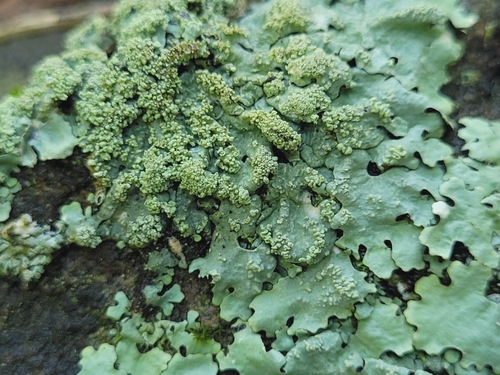
(c) Samuel Brinker, all rights reserved, uploaded by Samuel Brinker
Myelochroa
Sign in to saveMyelochroa is a genus of foliose lichens in the family Parmeliaceae. They are commonly known as axil-bristle lichens. It was created in 1987 to contain species formerly placed in genus Parmelina that had a yellow-orange medulla due to the presence of secalonic acids. Characteristics of the genus include tightly attached thalli with narrow lobes, cilia on the axils, and a rhizinate black lower surface. Chemical characteristics are the production of zeorin and related triterpenoids in the medulla. Myelochroa contains about 30 species, most of which grow on bark. The genus has centres of distribu
Species
Powdery Axil-bristle Lichen
GENUS
- KingdomFungi
- PhylumAscomycota
- ClassLecanoromycetes
- OrderLecanorales
- FamilyParmeliaceae
via GBIF
Museum specimens
- Specimen records
- 584
- With media
- 209
- Family
- Parmeliaceae
- Collections
- US
- Recorded in
- United States, South Africa, Argentina, Eswatini
Wikidata facts
- Instance of
- taxon
- Parent taxon
- Parmeliaceae
- Image
- Myelochroa obsessa.jpg
Show 6 more facts
- taxon name
- Myelochroa
- taxon rank
- genus
- taxonomic type
- Myelochroa aurulenta
- taxon common name
- Axil-bristle lichens
- Commons category
- Myelochroa
- taxon author citation
- (Asahina) Elix & Hale
Sources (2)
via Wikidata · CC0
~4 min read
Encyclopedic overview
5 sectionsContents
- Taxonomy
- Description
- Habitat and distribution
- Species
- References
Myelochroa is a genus of foliose lichens in the family Parmeliaceae. They are commonly known as axil-bristle lichens. It was created in 1987 to contain species formerly placed in genus Parmelina that had a yellow-orange medulla due to the presence of secalonic acids. Characteristics of the genus include tightly attached thalli with narrow lobes, cilia on the axils, and a rhizinate black lower surface. Chemical characteristics are the production of zeorin and related triterpenoids in the medulla. Myelochroa contains about 30 species, most of which grow on bark. The genus has centres of distribution in Asia and North America.
==Taxonomy== Myelochroa was originally circumscribed by Yasuhiko Asahina as a subsection of section Hypotrachyna in genus Parmelia. This taxon was later raised to sectional status by Hale in 1976. It was promoted to generic status in 1987 by John Elix and Mason Hale. Nineteen species were originally placed in Myelochroa, including the type species, M. aurulenta.
Excerpted from Wikipedia’s “Myelochroa” article, available under the CC BY-SA 4.0 licence.