Category
page 1Stem vegetables

Asparagus officinalis
Asparagus (Asparagus officinalis) or garden asparagus is a perennial flowering plant species in the genus Asparagus native to Eurasia. Widely cultivated as a vegetable crop, its young shoots are used as a spring vegetable.

Bambusoideae
Bamboos are a diverse group of mostly evergreen perennial flowering plants making up the subfamily Bambusoideae of the grass family Poaceae. Giant bamboos are the largest members of the grass family, in the case of Dendrocalamus sinicus having individual stalks (culms) reaching a length of , up to in diameter and a weight of up to . The internodes of bamboos can also be of great length. Kinabaluchloa wrayi has internodes up to in length, and Arthrostylidium schomburgkii has internodes up to in length, exceeded in length only by papyrus. By contrast, the stalks of the tiny bamboo Raddiella vane

kohlrabi
Kohlrabi (; pronounced in English; scientific name Brassica oleracea Gongylodes Group), also called German turnip or turnip cabbage, is a biennial vegetable, a low, stout cultivar of wild cabbage. It is a cultivar of the same species as cabbage, broccoli, cauliflower, kale, Brussels sprouts, collard greens, Savoy cabbage, and gai lan.

Arctium
Arctium is a genus of biennial plants commonly known as burdock, family Asteraceae. Native to Europe and Asia, several species have been widely introduced worldwide. Burdock's clinging properties, in addition to providing an excellent mechanism for seed dispersal, led to the invention of the hook-and-loop fastener.

Humulus
Humulus, or hop, is a small genus of flowering plants in the family Cannabaceae. The hop is native to temperate regions of the Northern Hemisphere. Hops are the female flowers (seed cones, strobiles) of the hop species H. lupulus; as a main flavor and aroma ingredient in many beer styles, H. lupulus is widely cultivated for use by the brewing industry.

bamboo shoots
edible shoots of many bamboo species
%20Frambozenrood%20bloeiwijze.jpg)
rhubarb
Rhubarb is the fleshy, edible stalks (petioles) of species and hybrids (culinary rhubarb) of Rheum in the family Polygonaceae, which are cooked and used for food. The plant is a herbaceous perennial that grows from short, thick rhizomes. Historically, different plants have been called "rhubarb" in English. The large, triangular leaves contain high levels of oxalic acid and anthrone glycosides, making them poisonous and therefore inedible. The small flowers are grouped in large compound leafy greenish-white to rose-red inflorescences.

Typha angustifolia
species of plant

Cynara cardunculus
The cardoon (Cynara cardunculus ), also called the artichoke thistle, is a thistle in the family Asteraceae. It is a naturally occurring species that also has many cultivated forms, including the globe artichoke. It is native to the Mediterranean region, where it was domesticated in ancient times and still occurs as a wild plant.

Tragopogon
Tragopogon, also known as goatsbeard or salsify, is a genus of flowering plants in the family Asteraceae. It includes the vegetable known as salsify, as well as a number of common wild flowers.

Reynoutria japonica
species of plant

Zizania
genus of plants, the wild rices

Blitum bonus-henricus
species of plant

celery
Celery ('''Apium graveolens Dulce Group or Apium graveolens var. dulce') is a cultivated plant belonging to the species Apium graveolens'' in the family Apiaceae that has been used as a vegetable since ancient times.

Crithmum maritimum
thumb|Crithmum maritimum
thumb|upright|Rock samphire growing wild on a wall in Biscay, Basque Country, [[Spain]]
thumb|C. maritimum – MHNT

Smilax
Smilax is a genus of about 300–350 species, found in the tropics and subtropics worldwide. They are climbing flowering plants, many of which are woody and/or thorny, in the monocotyledon family Smilacaceae, native throughout the tropical and subtropical regions of the world.
Common names include catbriers, greenbriers, prickly-ivys and smilaxes. Sarsaparilla (also zarzaparrilla, sarsparilla) is a name used specifically for the Neotropical S. ornata as well as a catch-all term in particular for American species. Occasionally, the non-woody species such as the smooth herbaceous greenbrier (S. h
heart of palm
vegetable harvested from the inner core of certain palm trees

Tragopogon porrifolius
species of plant

Ornithogalum pyrenaicum
species of plant
%20Roscoe%2C%201804.jpg)
Zingiber mioga
thumb|Ginger leaves, illustration from the Japanese agricultural encyclopedia Seikei Zusetsu (1804)
or Japanese ginger is the species Zingiber mioga in the family Zingiberaceae. It is a deciduous herbaceous perennial native to Japan, China, and the southern part of Korea. Only its edible flower buds and flavorful shoots are used in cooking. The flower buds are finely shredded and used in Japanese cuisine as a garnish for miso soup, sunomono, and dishes such as roasted eggplant. In Korean cuisine, the flower buds are skewered alternately with pieces of meat and then are pan-fried.
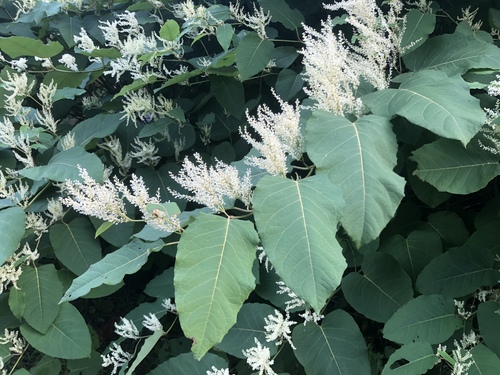
Reynoutria sachalinensis
species of plant
celtuce
Celtuce () (Lactuca sativa var. augustana, angustata, or asparagina), also called stem lettuce, celery lettuce, asparagus lettuce, or Chinese lettuce, is a cultivar of lettuce grown primarily for its thick stem or its leaves, which are known as A-choy. It is used as a vegetable. In China, the family is informally called woju (), which is also the name of a cultivar. It is especially popular in both China and Taiwan, where the stem is interchangeably called wosun () or ().

Chenopodium berlandieri
species of plant

Rheum ribes
species of plant

Zizania latifolia
species of plant
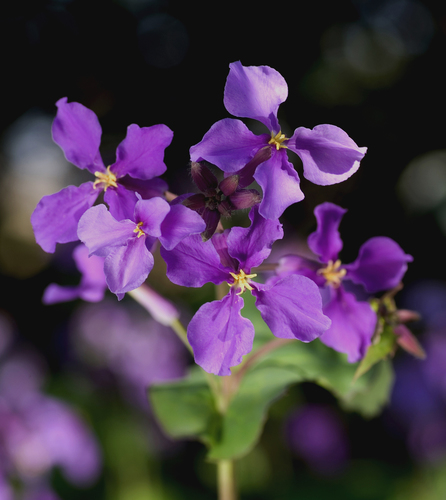
Orychophragmus violaceus
species of plant

nopal
thumb|Mature edible nopal pad
Banana pith
starchy inner core of banana pseudostems