Category
page 1Tajik cuisine

halva

samosa
A samosa () () is a fried Indian pastry with a savoury filling that mostly consists of vegetables like spiced potatoes, onions, and peas, but can include cheese such as paneer, meat or even fish. Its name originates from the Middle Persian word sambosag () (meaning 'triangular pastry'). It is made in different shapes, including triangular, cone, or crescent, depending on the region. Samosas are often accompanied by chutney, and have origins in medieval times or earlier. Sweet versions containing traditional Indian flavours or even chocolate are also made. Samosas are popular snacks in South As

pilaf
Pilaf (), pilav, pilau or plov () is a rice dish, or in some regions, a wheat dish, whose recipe usually involves cooking in stock or broth, adding spices, and other ingredients such as vegetables and meat, and employing some technique for achieving cooked grains that do not adhere.

kefir
thumb|Homemade kefir and kvass served alongside kolach and [[korovai]]

tandoor
upright=1.2|thumb|Modern ceramic wood-fired tandoors

shashlik
Shashlik, or shashlyck ( shashlyk ), is a dish of skewered and grilled cubes of meat, similar to or synonymous with shish kebab. It is known traditionally by various other names in the Caucasus, Eastern Europe and Central Asia, and from the 19th century became popular as shashlik across much of the Russian Empire and nowadays in former Soviet Union republics.

manti
dish
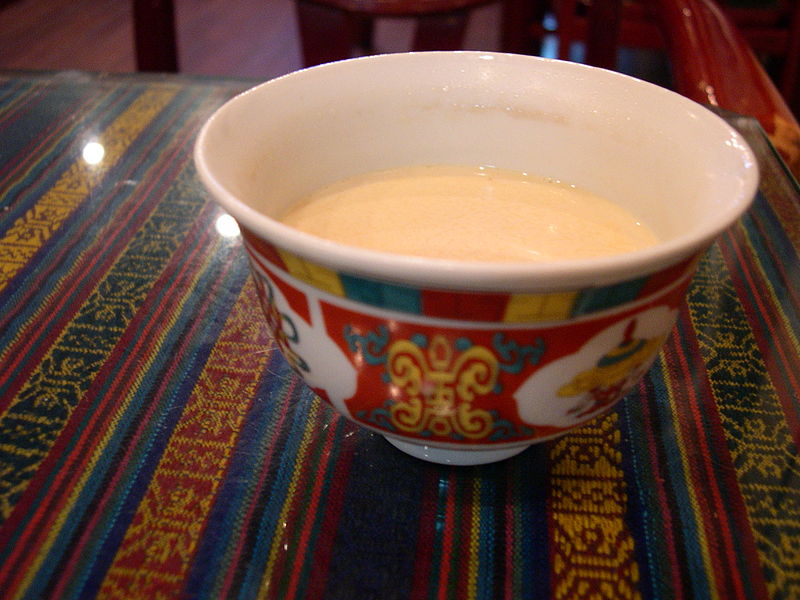
butter tea
South Asian drink mainly consisting of butter churned with tea
baursak
Boortsog, boorsoq, baursak, baursaq, bauyrsaq, borsok or boorsok is a fried dough food found in the cuisines of Central Asia, Idel-Ural, Mongolia and the Middle East. They are shaped into triangles or sometimes spheres. The dough consists of flour, yeast, milk, eggs, butter, salt, sugar, and margarine. Tajik boortsog are often decorated with a criss-cross pattern by pressing the bottom of a small strainer on the dough before it is fried. It has been adopted by Cossack cuisine as "bursak".
çäkçäk
Chak-chak () is a popular fried dough food in Tatarstan, Bashkortostan, Tajikistan, Uzbekistan, Kazakhstan, Kyrgyzstan and other parts of Central Asia.
samsa
pastry from Central Asia
chorba
Chorba, ( ; ) shorwa, shurba, shurpa, shurbah or shorba ( ) is a broad class of stews or rich soups found in national cuisines across North Africa, The Middle East, Iran, Turkey, Southeast Europe, Central Asia, East Africa and South Asia. It is often prepared with added ingredients but is also served alone as a broth or with bread.
Chiburekki
Chebureki ( Cheburek) are deep-fried turnovers with a filling of ground or minced meat and onions. A popular street dish, they are made with a single round piece of dough folded over the filling in a crescent shape. They have become widespread in the former Soviet-aligned countries of Eastern Europe in the 20th century.
.jpg)
Kurt
Kashk, kishk, ( Kašk, ), () qurut, qurt, kurut, kurt, qqet, jameed, shilanch (Tuvan and , , , , , Tajik: қурут, ), chortan ( chort’an), aaruul or khuruud (Mongolian: ааруул or хурууд) is a range of dairy products popular in Iranian cuisine, Caucasian cuisine, and Central Asian cuisine. Kashk is made from strained yogurt, drained buttermilk (in particular, drained qatiq) or drained sour milk by shaping it and letting it dry. It can be made in a variety of forms: rolled into balls, sliced into strips, and formed into chunks.
laghman
Central Asian noodle dish

samanu
thumb|200px|Cooking samanak in Isfara, Tajikistan
Afghan cuisine
culinary traditions of Afghanistan

joshpara
Joshpara is a kind of dumpling popular in Central Asia, South Caucasus and the Middle East. They are made of unleavened wheat dough squares filled with ground meat and condiments.

piti
Armenian dish with meat and chickpeas
belyash
Peremech ( / pərəməç / pärämäç; , tr. beremes; ) is an individual-sized fried dough pastry common in Volga Tatar and Bashkir cuisines. It is made from unleavened or leavened dough and usually filled with ground meat and chopped onion. Originally, finely chopped pre-cooked meat was used as a filling, but later raw ground meat became more common. Alternatively, peremech can be filled with potato or quark.
tandyr nan
type of Central Asian naan
Dastarkhān
A dastarkhān (Persian / Urdu: دسترخوان, , , , , , , , ) or dastarkhwān is the name used across Central Asia and South Asia to refer to the traditional dining space where food is eaten. The term is a word of Persian origin meaning the tablecloth which is spread on the ground, floor, or table as a sanitary surface for food.
Tajik cuisine
culinary traditions of Tajikistan

Khoresht
Khoresh () or khoresht () is a Persian word that refers to Iranian stews, usually slow-cooked and served with rice. Khoresh comes in many varieties, often named after their main ingredients. The word is a substantive of the verb khordan (), "to eat", and literally means "meal".
Dymdama
Dimlama or dymdama is an Uzbek stew made with various combinations of meat, potatoes, onions, vegetables, and sometimes fruits. Meat (lamb or sometimes veal or beef) and vegetables are cut into large pieces and placed in layers in a tightly sealed pot to simmer slowly in their own juices. Vegetables for dimlama may include, in addition to potatoes and onions, carrots, cabbage, eggplants, tomatoes, sweet peppers, spiced with garlic and a variety of herbs and condiments. Dimlama is usually cooked during spring and summer when there is a wide choice of vegetables. It is served on a large plate an
Nisholda
Nisholda, also spelled as nishallo, nishaldo, or nisholda (Persian: نشلا; Bukharian dialect: Нишалло; Tajik: Нишолло ; Uzbek: Nisholda) is a sweet dish that resembles white jam, only thicker. It is popular in Afghan, Iranian, Tajik, and Uzbek cuisines. Nisholda is also a traditional dish among the Bukharan (Central Asian, Samarkand) Jews.
Mastava
Māstāba, or mastava (Cyrillic: Мастава, Tajik: Мастоба), is a traditional Uzbek and Tajik soup. Sometimes it is called "liquid pilaf".

Qurutob
thumb|Qurutob being eaten as part of a meal
Qurutob or kurutob () is a dish of Tajik cuisine. Sometimes described as a "bread salad", it is created using qurut, dried balls of cheese, which are soaked in water; the resulting liquid, salty in flavor, is used as the base of the dish. Strips of fatir, a type of flatbread, are then placed on top. The mixture is served on large plates, and is usually topped with a variety of vegetables, such as onions, cucumbers, tomatoes, or herbs; meat or chili peppers are also sometimes seen as garnishes. Qurutob is a shared dish, meant to be eaten with the hand
Bichak
Bichak is a stuffed baked or fried pastry that comes in different forms (round, triangle, quadrangle) appetizer or meal similar to a turnover, served in Central Asia cuisines including Uzbek cuisine, Tajik cuisine, Afghan cuisine, and Middle Eastern cuisine, most notably in Moroccan cuisine. It is often served during tea or coffee hour. Bichak can be stuffed with pumpkin, veggies, and jam for a sweet taste, or meat and cheese for a savory addition to lunch. Bichak is also popular because it can be prepared in large quantities.
They are traditional for Rosh Hashanah and Sukkot. For kosher dairy
Ashak
Aushak or ashak (Pashto/) is an Afghan dish made of pasta dumplings filled with chives, with a (frequently meaty) tomato sauce, topped with yogurt and dried mint. A time-consuming meal to prepare, it is usually served on holidays or at special gatherings. It is similar to mantu, which is also popular in Afghanistan. In contrast to aushak, mantu have a meat filling.
Shakarap
Shakarap (also spelt shakarob, ; achchiq-chuchuk, achuchuk) is a simple salad originating from Central Asia, which consists of thinly sliced tomatoes and onions, with salt and black pepper. The salad is particularly popular in Tajikistan, Uzbekistan, and Kyrgyzstan.
thumb|202x202px|Plate of shakarap
Kadu bouranee
Afghan and Turkish pumpkin dish
Black Kashk
Qaraqurut ( or , from Turkic: Qara "black" and Qurut "Kashk") is a highly acidic brittle dairy product, made by dehyrating sour whey. It appears eponymously black and is produced in Iran, Afghanistan, Tajikistan and other Central Asian countries. Lighter variants and variants made from other kinds of whey do exist. It is sometimes merely called qārā (Persian: قارا) compare Azeri: قارا, black.