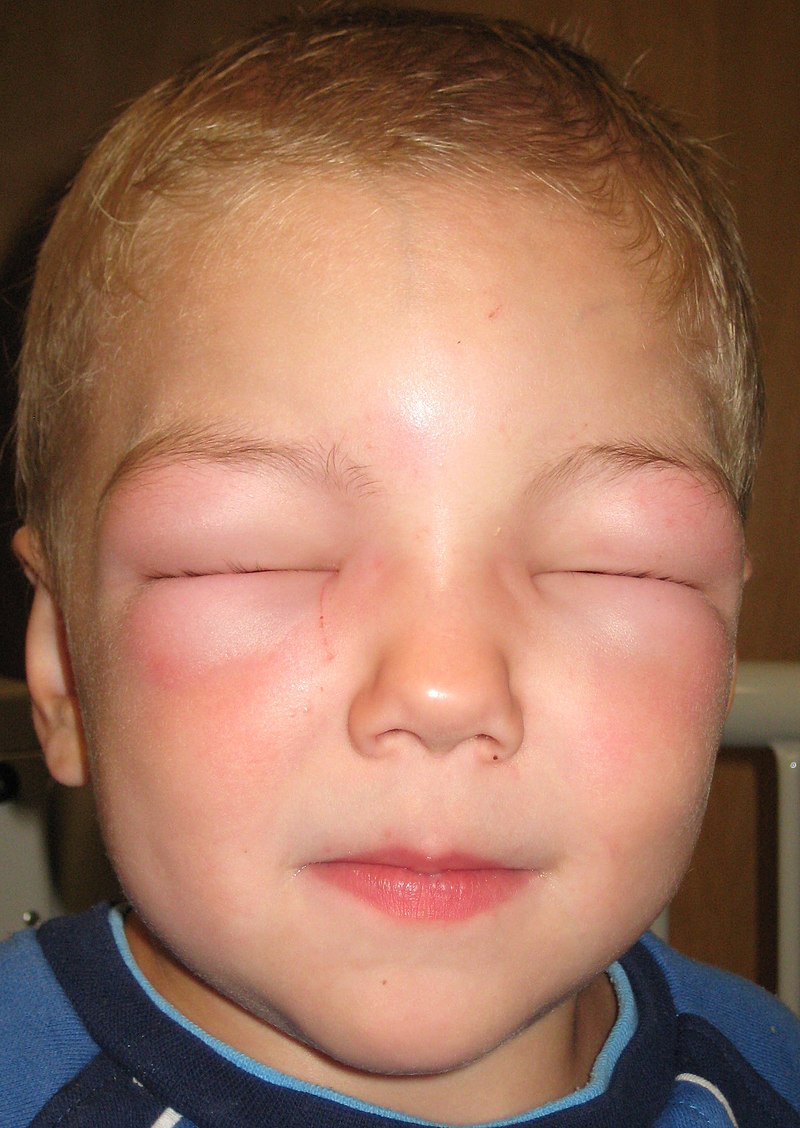
File:Angioedema2010.JPG · Wikimedia Commons · See Wikimedia Commons
angioedema
Sign in to saveAlso known as Angioneurotic oedema, Quincke's edema, angioneurotic edema, giant urticaria, Giant Urticarias, Quincke Edema, Angioedemas, Urticarias, Giant
Key facts
- Medical condition (new).name
- Angioedema
- Medical condition (new).synonyms
- Angioedema, Quincke's edema, angioneurotic edema
- Medical condition (new).image
- Angioedema2010.JPG
- Medical condition (new).caption
- Allergic angioedema: this child is unable to open his eyes due to the swelling.
- Medical condition (new).field
- Allergy and immunology, emergency medicine
- Medical condition (new).symptoms
- Area of swelling
- Medical condition (new).onset
- Minutes to hours
- Medical condition (new).types
- Histamine mediated, bradykinin mediated
- Medical condition (new).risks
- Family history
- Medical condition (new).diagnosis
- Based on symptoms
- Medical condition (new).differential
- Anaphylaxis, abscess, contact dermatitis
- Medical condition (new).treatment
- Intubation, cricothyroidotomy
- Medical condition (new).medication
- Histamine: antihistamines, corticosteroids, epinephrineBradykinin: C1 esterase inhibitor, ecallantide, icatibant, fresh frozen plasma
- Medical condition (new).frequency
- ~100,000 per year (US)
via Wikipedia infobox
Research
11,760 papers- Angioedema without urticaria: Diagnosis and management.Allergy and asthma proceedings · 2025
- Isolated angioedema: A review of classification and update on management.Annals of allergy, asthma & immunology : official publication of the American College of Allergy, Asthma, & Immunology · 2022
- Hereditary Angioedema: A Review.WMJ : official publication of the State Medical Society of Wisconsin · 2022
- Hereditary Angioedema.Immunology and allergy clinics of North America · 2023
- [Angioedema].Der Hautarzt; Zeitschrift fur Dermatologie, Venerologie, und verwandte Gebiete · 2007
via PubMed
Wikidata facts
- Subclass of
- disease
- Image
- Angioedema2010.JPG
Show 6 more facts
- health specialty
- emergency medicine
- NCI Thesaurus ID
- C112175
- Commons category
- Angioedema
- exact match
- purl.obolibrary.org/obo/HP_0100665
- ICD-9-CM
- 995.1
- on focus list of Wikimedia project
- WikiProject Medicine
Sources (8)
via Wikidata · CC0
~14 min read
Encyclopedic overview
16 sectionsContents
- Signs and symptoms
- Pathophysiology
- Diagnosis
- Acquired angioedema
- Hereditary angioedema
- Management
- Allergic
- Drug induced
- Hereditary
- Acquired, HAE types I and II, and nonhistaminergic
- Prophylaxis for HAE
- Epidemiology
- History
- See also
- References
- External links
Angioedema is an area of swelling (edema) of the lower layer of skin and tissue just under the skin or mucous membranes. The swelling may occur in the face, tongue, larynx, abdomen, or arms and legs. Often it is associated with hives, which are swelling within the upper skin. Onset is typically over minutes to hours.
The underlying mechanism typically involves histamine or bradykinin. The version related to histamine is due to an allergic reaction to agents such as insect bites, foods, or medications. The version related to bradykinin may occur due to an inherited problem known as C1 esterase inhibitor deficiency, medications known as angiotensin-converting enzyme inhibitors, or a lymphoproliferative disorder.
Excerpted from Wikipedia’s “angioedema” article, available under the CC BY-SA 4.0 licence.