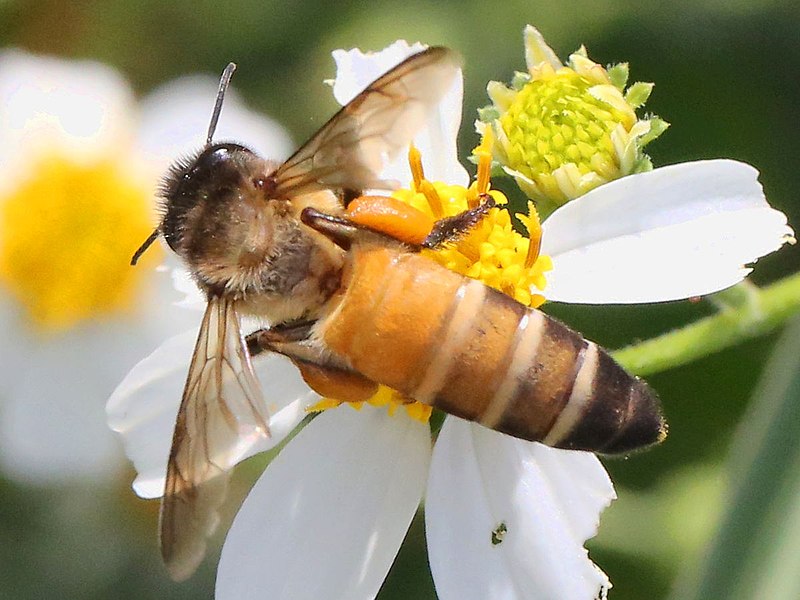
File:Bidens-Apis_dorsata-pollen_baskets.jpg · Wikimedia Commons · See Wikimedia Commons
OverviewAI-generated
*Apis dorsata*, commonly known as the giant honey bee, is a species within the genus *Apis*. It belongs to the family Apidae, order Hymenoptera, class Insecta, phylum Arthropoda, and kingdom Animalia. The species is also referred to by the short name *A. dorsata*.
Records of this taxon are held by institutions including YPM and USNM. Documented occurrences have been noted in Thailand and Myanmar. The species has been referenced by 59 other encyclopedia articles.
Synthesized by Vinony from 22 facts across 5 sources: Wikidata, GBIF, Gbif Occ, iDigBio, Vinony graph. Generated from structured data (not the Wikipedia text) and checked against those facts — may still contain errors.
Species
SPECIES
- KingdomAnimalia
- PhylumArthropoda
- ClassInsecta
- OrderHymenoptera
- FamilyApidae
Die Riesenhonigbiene (Apis dorsata) ist die zweitgrößte Vertreterin der acht in Asien vorkommenden Arten der Gattung der Honigbienen. Das Verbreitungsgebiet ist Indien (Assam) und Südostasien. Die eng verwandte Kliffhonigbiene als größte bekannte Art der Honigbienen, mit der Apis dorsata die Untergattung Megapis (Ashmead 1904) bildet, wird von anderen Wissenschaftlern als Unterart (Rasse) der Riesenhonigbiene eingestuft. Inhaltsverzeichnis 1 Taxonomie 2 Beschreibung 3 Jahreszyklus 4 Feinde 5 Menschen und Riesenhonigbiene 6 Literatur 7 Weblinks 8 Einzelnachweise Taxonomie Die taxonomische Eingliederung der Riesenhonigbiene, ihrer Unterarten und insbesondere der Status der Kliffhonigbiene ist schwierig und zwischen verschiedenen Wissenschaftlern umstritten. Nach einer grundlegenden Veröffentlichung von Michael S. Engel (1999)[1] handelt es sich bei der Kliffhonigbiene nicht um eine eigenständige Art, sondern nur um eine Unterart (Rasse) von Apis dorsata. Engel identifiziert neben der Kliffhonigbiene Apis dorsata laboriosa folgende weitere Unterarten der Riesenhonigbiene: Apis dorsata dorsata (verbreitet in Indien) Apis dorsata binghami Cockerell (Indonesische Risenhonigbiene, verbrei
via GBIF
Museum specimens
- Specimen records
- 460
- With media
- 23
- Family
- Apidae
- Collections
- YPM, USNM
- Recorded in
- Thailand, Myanmar
Wikidata facts
Show 6 more facts
- taxon name
- Apis dorsata
- Commons category
- Apis dorsata
- taxon rank
- species
- Commons gallery
- Apis dorsata
- taxon common name
- 大蜜蜂
- short name
- A. dorsata
Sources (1)
via Wikidata · CC0
~16 min read
Encyclopedic overview
Apis dorsata, the rock bee or giant honey bee, is a honey bee of South and Southeast Asia. They are typically around 17–20 mm (0.7–0.8 in) long and nests are mainly built in exposed places far off the ground, like on tree limbs, under cliff overhangs, and under buildings. These social bees are known for their aggressive defense strategies and vicious behavior when disturbed. Though the species is not domesticated, indigenous peoples have traditionally used it as a source of honey and beeswax, a practice known as honey hunting.
Taxonomy and phylogeny
Excerpted from Wikipedia’s “Apis dorsata” article, available under the CC BY-SA 4.0 licence.