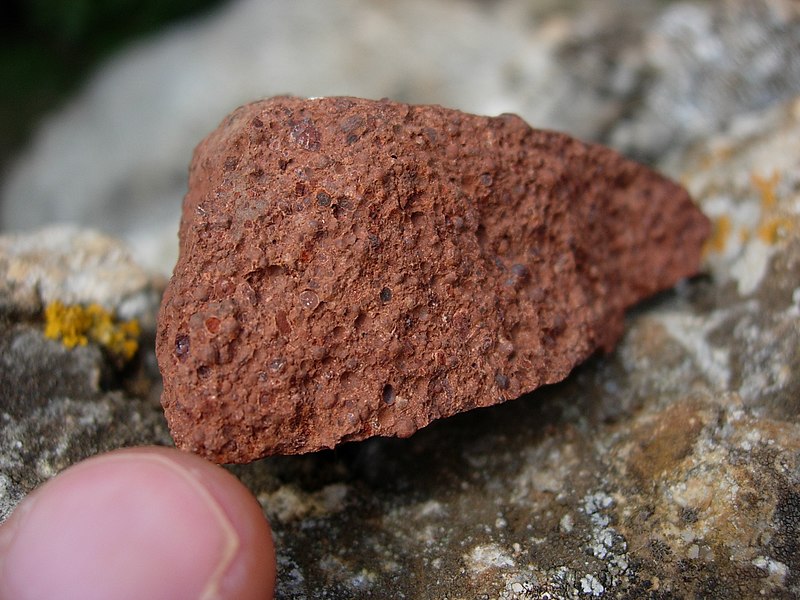
File:Bauxite_hérault.JPG · Wikimedia Commons · See Wikimedia Commons
bauxite
Sign in to savethumb|Reddish-brown bauxite thumb|Bauxite with Penny (United States coin)|US penny for comparison thumb|QEMSCAN mineral maps of bauxite ore-forming [[pisoliths]]
Bauxite is a reddish-brown mineral ore that serves as the primary source of aluminum, one of the most widely used metals in modern industry. It matters because extracting aluminum from bauxite enables the production of countless products, from aircraft and automobiles to everyday items like aluminum foil and cans.
AI-generated from the Wikipedia summary — may contain errors.
Wikidata facts
- Subclass of
- ore
- Has part
- ilmenite
- Named after
- Les Baux-de-Provence
- Image
- Bauxite.jpg
Show 5 more facts
- OpenStreetMap tag
- resource=bauxite
- Commons category
- Bauxite
- MCN code
- 3802.90.50
- Mohs' hardness
- 8.8
- on focus list of Wikimedia project
- Wikipedia:Vital articles/Level/4
Sources (6)
via Wikidata · CC0
~14 min read
Encyclopedic overview
16 sectionsContents
- Formation
- Production and reserves
- Aluminium production
- Maritime safety
- Source of gallium
- Socio-ecological impacts
- Red mud
- Conflicts
- Guinea
- Ghana
- Vietnam
- India
- See also
- References
- Further reading
- External links
thumb|Reddish-brown bauxite thumb|Bauxite with Penny (United States coin)|US penny for comparison thumb|QEMSCAN mineral maps of bauxite ore-forming [[pisoliths]]
Bauxite () is a sedimentary rock with a relatively high aluminium content. It is the world's main source of aluminium and gallium. Bauxite consists mostly of the aluminium minerals gibbsite (), boehmite (γ-AlO(OH)), and diaspore (α-AlO(OH)), mixed with the two iron oxides goethite (FeO(OH)) and hematite (), the aluminium clay mineral kaolinite () and small amounts of anatase () and ilmenite ( or ). Bauxite appears dull in luster and is reddish-brown, white, or tan.
Excerpted from Wikipedia’s “bauxite” article, available under the CC BY-SA 4.0 licence.
Gallery (287)
Available in 78 languages
- Español
- Français
- Deutsch
- 中文
- 日本語
- Русский
- Português
- Italiano
- العربية
- हिन्दी
- Afrikaans
- Armenian
- Asturian
- Azerbaijani
- Bahasa Indonesia
- Bangla
- Basque
- Belarusian
Show 59 more
- Bosnian
- Bulgarian
- Catalan
- Croatian
- Czech
- dag
- Danish
- Esperanto
- Estonian
- Finnish
- Galician
- Georgian
- Greek
- Hebrew
- Hungarian
- Icelandic
- Ido
- Irish
- Javanese
- Kannada
- Kazakh
- Kyrgyz
- Latvian
- Lithuanian
- Low German
- Macedonian
- Malagasy
- Malay
- Malayalam
- Mongolian
- Nederlands
- Norwegian
- Norwegian Nynorsk
- Occitan
- Oromo
- Polski
- Romanian
- Scots
- Serbian
- Serbian (Latin)
- simple
- Sindhi
- Slovak
- Slovenian
- Svenska
- Swahili
- Tajik
- Tamil
- Tiếng Việt
- Tulu
- Türkçe
- Ukrainian
- Uzbek
- Western Panjabi
- Wu Chinese
- zh_yue
- Zulu
- فارسی
- 한국어
via Wikidata sitelinks · CC0