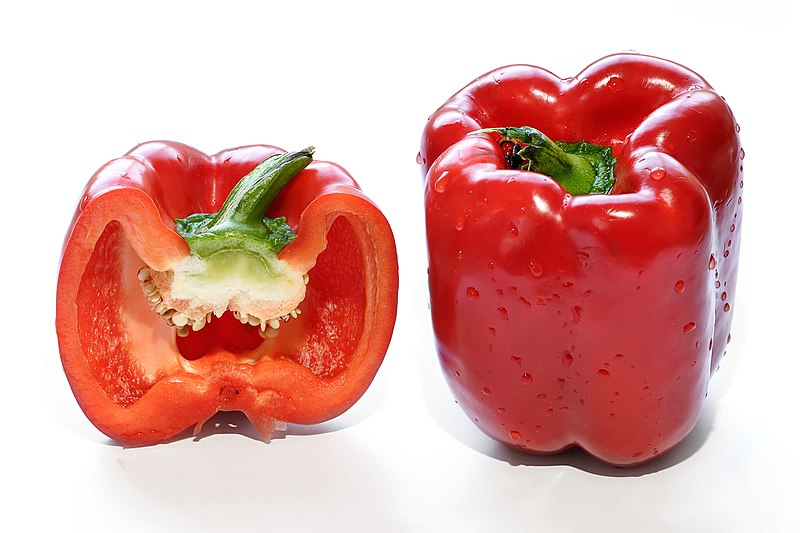
File:Red_capsicum_and_cross_section.jpg · Wikimedia Commons · See Wikimedia Commons
Capsicum
Sign in to saveAlso known as pepper, bell pepper
Capsicum () is a genus of flowering plants in the nightshade family Solanaceae, native to the Americas, cultivated worldwide for their edible fruit, which are generally known as "peppers" or "capsicum". Chili peppers grow on five species of Capsicum. Sweet or bell peppers and some chili peppers are Capsicum annuum, making it the most cultivated species in the genus.
OverviewAI-generated
Capsicum is a genus within the family Solanaceae, classified under the order Solanales and class Magnoliopsida. It is an accepted taxon of useful plants and allergens, described by Linnaeus in 1753. The genus serves as the source for chili pepper, bell pepper, capsaicin, and paprika, and has uses as a vegetable. Common names include pepper and 辣椒属.
Observations of the genus total 26,326, with 119,207 recorded occurrences. Media records number 399, and 1,429 records are held by institutions including ECOSUR, IBUNAM, INECOL, UACH, and FCN-UAQ in Mexico. The subject is referenced by 611 other encyclopedia articles and appears in 7,416 PubMed queries.
Synthesized by Vinony from 50 facts across 9 sources: Wikidata, GBIF, PubMed, iNaturalist, Gbif Occ, Plants of the World, WoRMS, iDigBio, Vinony graph. Generated from structured data (not the Wikipedia text) and checked against those facts — may still contain errors.
Species
chili pepper
Capsicum
GENUS
- KingdomPlantae
- PhylumTracheophyta
- ClassMagnoliopsida
- OrderSolanales
- FamilySolanaceae
Piments à Cachi, Province de Salta (Argentine) La fleur Capsicum séché dans un marché de Funchal à Madère au Portugal. Mars 2020. Capsicum est un genre de plantes de la famille des Solanacées (famille de la tomate et du tabac). C'est le nom générique des piments. On trouve par exemple l'espèce Capsicum frutescens, ou poivre de jardin courant, dont les variétés vont du doux au fort. Le fruit est une baie dont les graines sont contenues dans un péricarpe ayant la forme d'une gousse ou d'une cloche. Le genre Capsicum comprenant quarante espèces et quelque 300 variétés de cultivo (cultivars) de plantes produisant des baies charnues. Les cinq espèces les plus importantes, qui sont les seules domestiquées et cultivées, de piments sont Capsicum annuum, Capsicum baccatum, Capsicum chinense, Capsicum frutescens et Capsicum pubescens. Pour le consommateur, la famille des piments produit les poivrons, le paprika et les piments. Les piments ont différentes formes et tailles, mais ils appartiennent tous au genre Capsicum. Ils sont cultivés ou poussent de façon sauvage au Mexique, aux États-Unis, en Amérique du Sud, aux Caraïbes, en Afrique, en Inde, en Chine et Asie du Sud-Est, etc .
via GBIF · Kew POWO
Museum specimens
- Specimen records
- 1,429
- With media
- 399
- Family
- Solanaceae
- Collections
- ECOSUR, IBUNAM, INECOL, UACH, FCN-UAQ
- Recorded in
- Mexico
Research
7,416 papers- A comprehensive update on Capsicum proteomics: Advances and future prospects.ReviewJournal of proteomics · 2022Momo J, Kumar A, Islam K et al.DOI: 10.1016/j.jprot.2022.104578
- Capsicum--production, technology, chemistry, and quality. Part III. Chemistry of the color, aroma, and pungency stimuli.ReviewCritical reviews in food science and nutrition · 1986Govindarajan VSDOI: 10.1080/10408398609527437
- Biological Properties, Bioactive Constituents, and Pharmacokinetics of Some Capsicum spp. and Capsaicinoids.ReviewInternational journal of molecular sciences · 2020Batiha GE, Alqahtani A, Ojo OA et al.DOI: 10.3390/ijms21155179
- Capsicum--production, technology, chemistry, and quality. Part IV. Evaluation of quality.ReviewCritical reviews in food science and nutrition · 1987Govindarajan VS, Rajalakshmi D, Chand NDOI: 10.1080/10408398709527453
- Capsicum SIZ1 contributes to ABA-induced SUMOylation in pepper.Plant science : an international journal of experimental plant biology · 2022Lei S, Wang Q, Chen Y et al.DOI: 10.1016/j.plantsci.2021.111099
- Transcriptional Regulation of Ripening in Chili Pepper Fruits (Capsicum spp.).ReviewInternational journal of molecular sciences · 2021Villa-Rivera MG, Ochoa-Alejo NDOI: 10.3390/ijms222212151
- Apocarotenoids profiling in different Capsicum species.Food chemistry · 2021Zoccali M, Giuffrida D, Salafia F et al.DOI: 10.1016/j.foodchem.2020.127595
- Capsicum--production, technology, chemistry, and quality. Part V. Impact on physiology, pharmacology, nutrition, and metabolism; structure, pungency, pain, and desensitization sequences.ReviewCritical reviews in food science and nutrition · 1991Govindarajan VS, Sathyanarayana MNDOI: 10.1080/10408399109527536
via PubMed
Wikidata facts
- Instance of
- taxon
- Subclass of
- useful plant
- Parent taxon
- Capsiceae
- Image
- Capsicum annuum Bluete.jpg
- Has use
- vegetable
Show 10 more facts
- taxon rank
- genus
- Commons category
- Capsicum
- taxon name
- Capsicum
- topic's main category
- Category:Capsicum
- Commons gallery
- Capsicum
- described by source
- Encyclopædia Britannica 11th edition
- taxon common name
- 辣椒属
- NCI Thesaurus ID
- C75665
- taxon author citation
- L.
via Wikidata · CC0
~20 min read
Encyclopedic overview
17 sectionsContents
- History
- Etymology and names
- Phylogeny
- Growing conditions
- Species and varieties
- Species list
- Formerly placed here
- Genetics
- Breeding
- Capsaicin
- Cuisine
- GRAS
- Synonyms and common names
- Pictures of common cultivars
- See also
- References
- External links
Capsicum () is a genus of flowering plants in the nightshade family Solanaceae, native to the Americas, cultivated worldwide for their edible fruit, which are generally known as "peppers" or "capsicum". Chili peppers grow on five species of Capsicum. Sweet or bell peppers and some chili peppers are Capsicum annuum, making it the most cultivated species in the genus.
==History== Capsicum is native to South America and Central America. These plants have been evolving for 17 million years. It was domesticated and cultivated at least since 3000 BC, as evidenced by remains of chili peppers found in pottery from Puebla and Oaxaca.
Excerpted from Wikipedia’s “Capsicum” article, available under the CC BY-SA 4.0 licence.
Gallery (26)
Available in 94 languages
- Español
- Français
- Deutsch
- 中文
- 日本語
- Русский
- Português
- Italiano
- العربية
- हिन्दी
- Albanian
- Amharic
- ami
- Aragonese
- Armenian
- azb
- Azerbaijani
- Bahasa Indonesia
Show 75 more
- Basque
- Bavarian
- Belarusian
- Bhojpuri
- Bosnian
- Catalan
- Cebuano
- Chuvash
- Croatian
- Czech
- dag
- Danish
- Egyptian Arabic
- Esperanto
- Estonian
- Filipino
- Finnish
- Galician
- Georgian
- Greek
- Guarani
- Hebrew
- Hungarian
- Ingush
- Irish
- Kannada
- Kara-Kalpak
- Kashmiri
- Kashubian
- Kurdish
- Ladino
- Latin
- Latvian
- Lithuanian
- Luxembourgish
- Malagasy
- Malayalam
- Mazanderani
- nah
- Neapolitan
- Nederlands
- Nepali
- Northern Frisian
- Norwegian
- nrm
- Occitan
- Ossetic
- Polski
- Punjabi
- Quechua
- Romanian
- Scots
- Scottish Gaelic
- Serbian
- Serbian (Latin)
- Sicilian
- simple
- Sindhi
- Svenska
- Swahili
- Tamil
- Tibetan
- Tiếng Việt
- Türkçe
- Ukrainian
- Upper Sorbian
- Urdu
- Uyghur
- Uzbek
- Venetian
- Waray
- Wu Chinese
- zh_yue
- فارسی
- 한국어
via Wikidata sitelinks · CC0