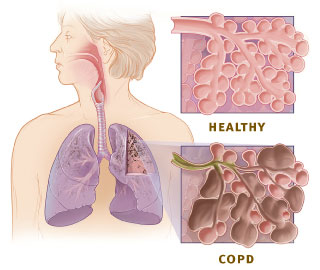
File:Copd_versus_healthy_lung.jpg · Wikimedia Commons · See Wikimedia Commons
chronic obstructive pulmonary disease
Sign in to saveAlso known as COPD, chronic obstructive airway disease, chronic obstructive airways disease NOS, chronic obstructive lung disease, chronic obstructive airways disease NOS disorder, chronic obstructive lung disease disorder, COLD, COLD (chronic obstructive lung disease)
lung disease involving long-term poor airflow
OverviewAI-generated
Chronic obstructive pulmonary disease is a medical condition classified under the International Classification of Primary Care 2 with the identifier R95. In the National Cancer Institute Thesaurus, it is designated as C3199. The condition is also identified in the ICD-9-CM system by the codes 496 and the range 490-496.99.
The subject has an exact match in the Disease Ontology, referenced by the identifiers DOID_3083 and HP_0006510. It is associated with the Commons category "Chronic obstructive pulmonary disease." PubMed contains 113,621 records related to this topic. Additionally, the Vinony graph indicates that the subject is referenced by 1,541 other encyclopedia articles.
Synthesized by Vinony from 8 facts across 3 sources: Wikidata, PubMed, Vinony graph. Generated from structured data (not the Wikipedia text) and checked against those facts — may still contain errors.
Research
113,621 papers- Chronic Obstructive Pulmonary Disease.ReviewCritical care nursing quarterly · 2016Hattab Y, Alhassan S, Balaan M et al.DOI: 10.1097/CNQ.0000000000000105
- Definition, Causes, Pathogenesis, and Consequences of Chronic Obstructive Pulmonary Disease Exacerbations.ReviewClinics in chest medicine · 2020Ritchie AI, Wedzicha JADOI: 10.1016/j.ccm.2020.06.007
- Analyses of Factors Associated with Acute Exacerbations of Chronic Obstructive Pulmonary Disease: A Review.ReviewInternational journal of chronic obstructive pulmonary disease · 2023Qian Y, Cai C, Sun M et al.DOI: 10.2147/COPD.S433183
- Chronic Obstructive Pulmonary Disease (COPD).American journal of respiratory and critical care medicine · 2019Lareau SC, Fahy B, Meek P et al.DOI: 10.1164/rccm.1991P1
- Macrophage Polarization and Functions in Pathogenesis of Chronic Obstructive Pulmonary Disease.ReviewInternational journal of molecular sciences · 2024Kim GD, Lim EY, Shin HSDOI: 10.3390/ijms25115631
- Management of chronic obstructive pulmonary disease.ReviewBritish journal of hospital medicine (London, England : 2005) · 2021Katzenberg G, Deacon A, Aigbirior J et al.DOI: 10.12968/hmed.2020.0561
- Chronic Obstructive Pulmonary Disease, Part 2: A Review of Pharmacotherapy Options.ReviewThe Senior care pharmacist · 2023Naberhaus TDOI: 10.4140/TCP.n.2023.266
- Phenotypes of Asthma-Chronic Obstructive Pulmonary Disease Overlap.ReviewImmunology and allergy clinics of North America · 2022Adrish M, Anand MP, Hanania NADOI: 10.1016/j.iac.2022.04.009
via PubMed
Wikidata facts
- Subclass of
- disease
- Image
- Centrilobular emphysema 865 lores.jpg
Show 13 more facts
- medical examination
- spirometry
- possible treatment
- symptomatic treatment
- Commons category
- Chronic obstructive pulmonary disease
- ICPC 2 ID
- R95
- NCI Thesaurus ID
- C3199
- health specialty
- pulmonology
- genetic association
- FTO
- on focus list of Wikimedia project
- WikiProject Medicine
- ICD-9-CM
- 490-496.99
- exact match
- purl.obolibrary.org/obo/HP_0006510
- risk factor
- smoking
- symptoms and signs
- wheeze
- has cause
- dust
Sources (14)
via Wikidata · CC0
~40 min read
Encyclopedic overview
Chronic obstructive pulmonary disease (COPD) is a long-term lung condition that makes it progressively harder to breathe. It occurs when the airways and lung tissue become damaged, leading to reduced airflow and less efficient oxygen exchange in the lungs. COPD develops gradually over time, and while it cannot currently be cured, treatments and lifestyle changes can help control symptoms and slow disease progression. Early diagnosis and treatment are recommended.
The condition includes two related lung problems: chronic bronchitis and emphysema. Chronic bronchitis involves ongoing inflammation of the airways, causing excess mucus production, coughing, and chest discomfort. Emphysema involves damage to the small air sacs in the lungs, which reduces the lungs' ability to transfer oxygen into the bloodstream. Many people with COPD experience shortness of breath, persistent cough, wheezing, and reduced exercise tolerance. Symptoms can become more severe during acute flare-ups, which can be triggered by viral and bacterial infections and exposure to irritants. People with COPD generally display a combination of these symptoms, and are likely to have additional health issues.
Excerpted from Wikipedia’s “chronic obstructive pulmonary disease” article, available under the CC BY-SA 4.0 licence.
Gallery (12)
Available in 103 languages
- Español
- Français
- Deutsch
- 中文
- 日本語
- Русский
- Português
- Italiano
- العربية
- हिन्दी
- abstract
- Afrikaans
- Albanian
- Albanian
- Aragonese
- Armenian
- Assamese
- Asturian
Show 84 more
- azb
- Azerbaijani
- Bahasa Indonesia
- Bangla
- Bashkir
- Basque
- bat_smg
- Bavarian
- be_x_old
- Belarusian
- Bosnian
- Bulgarian
- Catalan
- Central Kurdish
- Croatian
- Czech
- Danish
- Esperanto
- Estonian
- Fiji Hindi
- Filipino
- Finnish
- Galician
- gpe
- Greek
- Hausa
- Hebrew
- Hungarian
- hyw
- Icelandic
- Ido
- Irish
- Kannada
- Kazakh
- Lao
- Latin
- Latvian
- Lithuanian
- Lombard
- Low German
- Macedonian
- Malagasy
- Malay
- Malayalam
- Nederlands
- Nepali
- Northern Sami
- Norwegian
- Norwegian Nynorsk
- Occitan
- Odia
- Pashto
- Piedmontese
- Polski
- Punjabi
- Romanian
- Scots
- Serbian
- Serbian (Latin)
- simple
- Sindhi
- Sinhala
- Slovak
- Slovenian
- Svenska
- Swahili
- Tajik
- Tamil
- Tatar
- Telugu
- Tiếng Việt
- Türkçe
- Ukrainian
- Urdu
- Waray
- Welsh
- Western Frisian
- Wu Chinese
- Yiddish
- zh_min_nan
- zh_yue
- فارسی
- ไทย
- 한국어
via Wikidata sitelinks · CC0