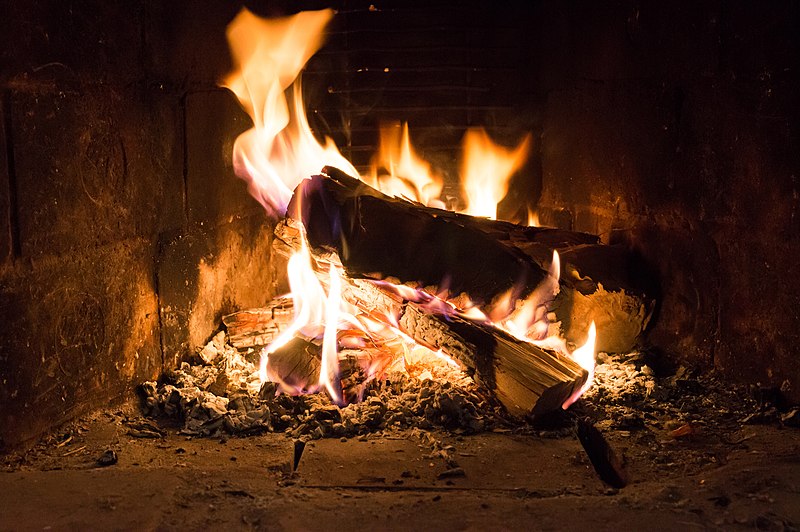
File:Fire,_Fireplace,_Rostov-on-Don,_Russia.jpg · Wikimedia Commons · See Wikimedia Commons
combustion
Sign in to saveAlso known as burning, combusting, burn, combust, combustion reaction
thumb|The flames caused as a result of a [[fuel undergoing combustion (burning)]] thumb|Regenerative thermal oxidiser|Air pollution abatement equipment provides combustion control for [[industrial processes.]] Combustion, or burning, is a high-temperature exothermic redox chemical reaction between a fuel (the reductant) and an oxidant, usually atmospheric oxygen, that produces oxidized, often gaseous products, in a mixture termed as smoke. Combustion does not always result in fire, because a flame is only visible when substances undergoing combustion vaporize, but when it does, a flame is a ch
Combustion, or burning, is a chemical reaction where a fuel combines with oxygen at high temperatures to produce heat and gaseous products like smoke. It matters because combustion powers everything from engines and heating systems to industrial processes, though it also requires control to manage air pollution and safety risks.
AI-generated from the Wikipedia summary — may contain errors.
Wikidata facts
- Subclass of
- exothermic reaction
- Image
- Fire, Fireplace, Rostov-on-Don, Russia.jpg
Show 7 more facts
- topic's main category
- Category:Combustion
- Commons category
- Combustion
- facet of
- thermal energy
- has effect
- smoke
- exact match
- valpal.info/parameters/burn
- uses
- oxidizing agent
- on focus list of Wikimedia project
- Wikipedia:Vital articles/Level/4
via Wikidata · CC0
~30 min read
Encyclopedic overview
28 sectionsContents
- Types
- Complete and incomplete
- Complete
- Incomplete
- Problems associated with incomplete combustion
- Environmental problems
- Human health problems
- Smoldering
- Spontaneous
- Turbulent
- Micro-gravity
- Micro-combustion
- Chemical equations
- Stoichiometric combustion of a hydrocarbon in oxygen
- Stoichiometric combustion of a hydrocarbon in air
- Trace combustion products
- Incomplete combustion of a hydrocarbon in oxygen
- Liquid fuels
- Gaseous fuels
- Solid fuels
- Combustion management
- Reaction mechanism
- Kinetic modelling
- Temperature
- Instabilities
- See also
- References
- Further reading
thumb|The flames caused as a result of a [[fuel undergoing combustion (burning)]] thumb|Regenerative thermal oxidiser|Air pollution abatement equipment provides combustion control for [[industrial processes.]] Combustion, or burning, is a high-temperature exothermic redox chemical reaction between a fuel (the reductant) and an oxidant, usually atmospheric oxygen, that produces oxidized, often gaseous products, in a mixture termed as smoke. Combustion does not always result in fire, because a flame is only visible when substances undergoing combustion vaporize, but when it does, a flame is a characteristic indicator of the reaction. While activation energy must be supplied to initiate combustion (e.g., using a lit match to light a fire), the heat from a flame may provide enough energy to make the reaction self-sustaining. The study of combustion is known as combustion science.
Combustion is often a complicated sequence of elementary radical reactions. Solid fuels, such as wood and coal, first undergo endothermic pyrolysis to produce gaseous fuels whose combustion then supplies the heat required to produce more of them. Combustion is often hot enough that incandescent light in the form of either glowing or a flame is produced. A simple example can be seen in the combustion of hydrogen and oxygen into water vapor, a reaction which is commonly used to fuel rocket engines. This reaction releases 242kJ/mol of heat and reduces the enthalpy accordingly (at constant temperature and pressure): 2H_2(g){+}O_2(g)\rightarrow 2H_2O\uparrow
Excerpted from Wikipedia’s “combustion” article, available under the CC BY-SA 4.0 licence.
Gallery (18)
Available in 91 languages
- Español
- Français
- Deutsch
- 中文
- 日本語
- Русский
- Português
- Italiano
- العربية
- हिन्दी
- Afrikaans
- Albanian
- ami
- Armenian
- Asturian
- Azerbaijani
- Bahasa Indonesia
- Bangla
Show 72 more
- Basque
- Belarusian
- Betawi
- Bosnian
- Bulgarian
- Catalan
- Central Kurdish
- Chuvash
- Croatian
- Czech
- Danish
- Esperanto
- Estonian
- Filipino
- Finnish
- Galician
- Georgian
- Greek
- Haitian Creole
- Hebrew
- Hungarian
- Icelandic
- Ido
- Ingush
- Irish
- Kabyle
- Kannada
- Kazakh
- Kyrgyz
- Latvian
- Limburgish
- Lingua Franca Nova
- Lithuanian
- Malay
- Nederlands
- Newari
- Northern Sami
- Norwegian
- Norwegian Nynorsk
- Occitan
- Pashto
- Polski
- Punjabi
- Quechua
- Romanian
- Serbian
- Serbian (Latin)
- Sicilian
- simple
- Slovak
- Slovenian
- Svenska
- Tamil
- tay
- Tiếng Việt
- Türkçe
- Ukrainian
- Urdu
- Waray
- Welsh
- Wolof
- Wu Chinese
- Yakut
- Yiddish
- Yoruba
- zh_classical
- zh_min_nan
- zh_yue
- Zulu
- فارسی
- ไทย
- 한국어
via Wikidata sitelinks · CC0