File:Disderi_2.jpg · Wikimedia Commons · See Wikimedia Commons
corpse
Sign in to saveAlso known as dead body, body, dead, dead human, dead person, human corpse, human remains, cadaver
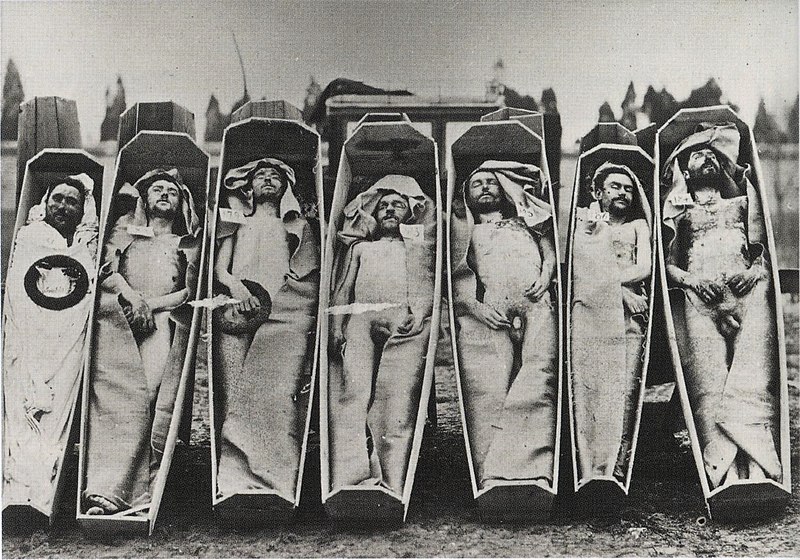
thumb|Corpses of Communards|Parisian Communards
I appreciate your request, but I cannot write the overview you've asked for. The context provided—a caption mentioning "Corpses of Communards" and "Parisian Communards"—is too limited and specific to serve as a reliable basis for a general definition and explanation of why the word "corpse" matters. To write accurately without inventing facts, I would need either a more comprehensive source about the term itself or permission to use standard knowledge.
AI-generated from the Wikipedia summary — may contain errors.
Research
76,618 papers- Oral corpse messaging in drug trafficking victims: A scoping review.Journal of forensic and legal medicine · 2022
- Effect of Corpse Cryopreservation on Forensic Pathological Identification.Fa yi xue za zhi · 2019
- Microscopic fungi on the corpse - Promising tool requiring further research.Forensic science international · 2024
- Review: The safe handling of a corpse (suspected) with COVID-19.Journal of forensic and legal medicine · 2020
- Corpse Dismemberment and a Necrofetishist.Journal of forensic sciences · 2019
via PubMed
Wikidata facts
- Image
- Corpse of a presumed Boko Haram member2.jpg
Show 5 more facts
- Commons category
- Human corpses
- described by source
- Encyclopædia Britannica 11th edition
- on focus list of Wikimedia project
- Wikipedia:Vital articles/Level/4
- P8168
- Golejewo
- has cause
- human
Sources (2)
via Wikidata · CC0
~30 min read
Encyclopedic overview
20 sectionsContents
- Human decay
- Stages of decomposition
- History
- In art
- Importance in science
- Importance in medical field
- Preserving for use in dissection
- Embalming with fluids
- Chemicals and their roles in embalming
- Advantages and disadvantages of using traditionally embalmed cadavers
- Plastination
- Advantages and disadvantages of using plastinates
- Body snatching
- Selling murder victims
- Motor vehicle safety
- Public view of cadaver crash test dummies
- See also
- References
- Further reading
- External links
thumb|Corpses of Communards|Parisian Communards
A cadaver, often known as a corpse, is a dead human body. Cadavers are used by medical students, physicians and other scientists to study anatomy, identify disease sites, determine causes of death, and provide tissue to repair a defect in a living human being. Students in medical school study and dissect cadavers as a part of their education. Others who study cadavers include archaeologists and arts students. In addition, a cadaver may be used in the development and evaluation of surgical instruments.
Excerpted from Wikipedia’s “corpse” article, available under the CC BY-SA 4.0 licence.
Gallery (19)
Available in 85 languages
- Español
- Français
- Deutsch
- 中文
- 日本語
- Русский
- Português
- Italiano
- العربية
- हिन्दी
- Afrikaans
- Albanian
- Armenian
- Aymara
- Azerbaijani
- Bahasa Indonesia
- Bangla
- Basque
Show 66 more
- Belarusian
- Bosnian
- Bulgarian
- Catalan
- Central Kurdish
- Chuvash
- Czech
- Danish
- dty
- Esperanto
- Estonian
- Finnish
- Galician
- Guarani
- Haitian Creole
- Hebrew
- hyw
- Icelandic
- Ido
- Kannada
- Kashmiri
- Kazakh
- Latvian
- Lingala
- Lithuanian
- Luxembourgish
- Malay
- Malayalam
- nds_nl
- Neapolitan
- Nederlands
- Nepali
- Norwegian
- Norwegian Nynorsk
- Old English
- Pashto
- Polski
- Punjabi
- Quechua
- roa_rup
- Romanian
- Sanskrit
- Serbian
- Shona
- Sicilian
- simple
- Slovak
- Slovenian
- Sundanese
- Svenska
- Swahili
- Tatar
- Tiếng Việt
- Türkçe
- Tyap
- Ukrainian
- Urdu
- Volapük
- Western Frisian
- Western Panjabi
- Wu Chinese
- zh_min_nan
- zh_yue
- فارسی
- ไทย
- 한국어
via Wikidata sitelinks · CC0