File:Covalent_bond_hydrogen.svg · Wikimedia Commons · See Wikimedia Commons
covalent bond
Sign in to savechemical bond that involves the sharing of electron pairs between atoms
A covalent bond is a chemical connection between atoms where they share electrons with each other. This type of bonding is important because it allows atoms to combine and form molecules, which make up most of the materials we encounter in everyday life.
AI-generated from the Wikipedia summary — may contain errors.
Wikidata facts
- Subclass of
- chemical bond
- Image
- Covalent.png
Show 2 more facts
- on focus list of Wikimedia project
- Wikipedia:Vital articles/Level/4
- Commons category
- Covalent bond
Sources (2)
via Wikidata · CC0
~20 min read
Encyclopedic overview
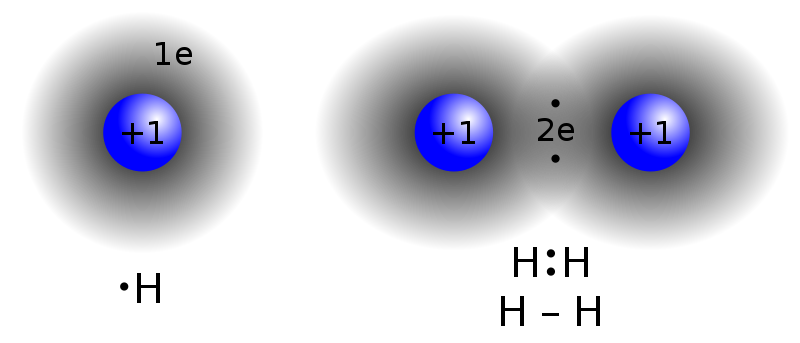
A covalent bond forming H2 (right) where two hydrogen atoms share the two electrons
A covalent bond is a chemical bond that involves the sharing of electrons to form electron pairs between atoms. These electron pairs are known as shared pairs or bonding pairs. The stable balance of attractive and repulsive forces between atoms, when they share electrons, is known as covalent bonding. For many molecules, the sharing of electrons allows each atom to attain the equivalent of a full valence shell, corresponding to a stable electronic configuration. In organic chemistry, covalent bonding is much more common than ionic bonding, where atoms are separate and merely associated by electrostatic attraction.
Excerpted from Wikipedia’s “covalent bond” article, available under the CC BY-SA 4.0 licence.
Gallery (6)
Available in 95 languages
- Español
- Français
- Deutsch
- 中文
- 日本語
- Русский
- Português
- Italiano
- العربية
- हिन्दी
- Afrikaans
- Albanian
- Aragonese
- Armenian
- Asturian
- Azerbaijani
- Bahasa Indonesia
- Bangla
Show 76 more
- Basque
- Belarusian
- Bosnian
- Bulgarian
- Burmese
- Catalan
- cdo
- Central Kurdish
- Chuvash
- Croatian
- Czech
- Danish
- Esperanto
- Estonian
- Finnish
- Galician
- Georgian
- Greek
- Haitian Creole
- Hebrew
- Hungarian
- Irish
- Javanese
- Kabyle
- Kara-Kalpak
- Kazakh
- Khmer
- Latvian
- Lithuanian
- Macedonian
- Malay
- Malayalam
- Manipuri
- Manx
- Marathi
- Mingrelian
- Mongolian
- Nederlands
- Northern Sami
- Norwegian
- Norwegian Nynorsk
- Occitan
- Polski
- Punjabi
- Romanian
- Rusyn
- Scots
- Serbian
- Serbian (Latin)
- Shona
- simple
- Sinhala
- skr
- Slovak
- Slovenian
- Sundanese
- Svenska
- Tamil
- Tatar
- Tiếng Việt
- Türkçe
- Ukrainian
- Urdu
- Uzbek
- Welsh
- Western Panjabi
- Wu Chinese
- Yakut
- Yiddish
- Yoruba
- zh_classical
- zh_min_nan
- zh_yue
- فارسی
- ไทย
- 한국어
via Wikidata sitelinks · CC0