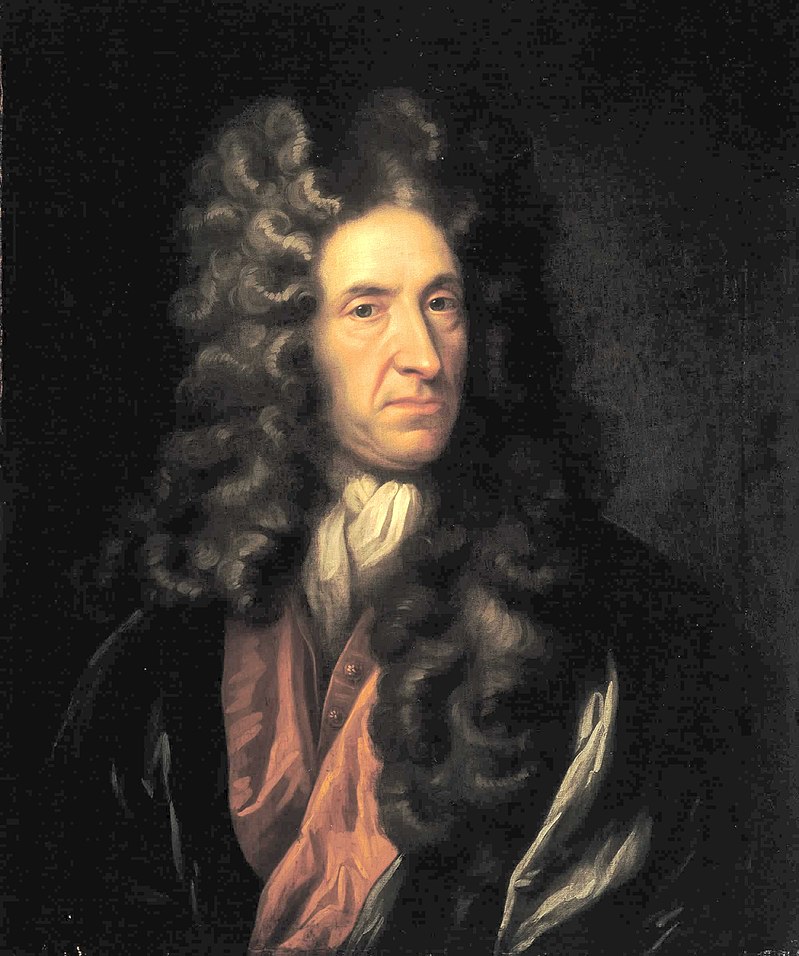
File:Daniel_Defoe_Kneller_Style.jpg · Wikimedia Commons · See Wikimedia Commons
Daniel Defoe
Sign in to saveAlso known as Daniel Foe, D. Defoe
English trader, writer, and journalist (1660–1731)
Daniel Defoe was an English writer, journalist, and trader who lived from 1660 to 1731 and became known for his work in literature and news writing during a transformative period in English publishing. He matters because he was a pioneering figure in developing the novel as a literary form and in establishing journalism as a profession in England.
AI-generated from the Wikipedia summary — may contain errors.
Film & TV
London, England
Daniel Defoe (/dɪˈfoʊ/; c. 1660 – 24 April 1731), born Daniel Foe, was an English trader, writer, journalist, pamphleteer and spy. He is most famous for his novel Robinson Crusoe, which is second only to the Bible in its number of translations. He has been seen as one of the earliest proponents of the English novel, and helped to popularize the form in Britain with others such as Aphra Behn and…
via TMDB
Wikidata facts
- Instance of
- human
- Given name
- Daniel
- Gender
- male
- Citizenship
- United Kingdom
- Place of birth
- London
- Place of death
- Moorfields
- Occupation
- publisher
- Languages spoken
- English language
- Native language
- English language
- Religion
- Presbyterianism
- Notable work
- A Journal of the Plague Year
- Image
- Daniel Defoe Kneller Style.jpg
- Said to be same as
- Charles Johnson
Show 17 more facts
- Commons category
- Daniel Defoe
- date of death
- 1731-00-00
- date of birth
- 1660-00-00
- topic's main category
- Category:Daniel Defoe
- Commons Creator page
- Daniel Defoe
- ethnic group
- English people
- name in native language
- Daniel Defoe
- birth name
- Daniel Foe
- Commons gallery
- Daniel Defoe
- P8168
- Anastasiya Kuzmina
- place of burial
- Bunhill Fields Burial Ground
- writing language
- English language
- start of work period
- 1700-00-00
- has works in the collection
- Stedelijk Museum Amsterdam
- date of burial or cremation
- 1731-04-26
- on focus list of Wikimedia project
- Wikipedia:Vital articles/Level/4
- P12749
- Franz Egenieff
Sources (8)
via Wikidata · CC0
Works in European collections
36 objects attributed to Daniel Defoe, held across European museums, libraries & archives · via Europeana
Aventuras de Robinson Crusoe : novela escrita en inglés por Daniel Foe
Robinson Crusoe
The fortunes and the misfortunes of the famous Moll Flanders
The history and remarkable life of the truly honorable colonel Jack
La vie et les avantures surprenantes de Robinson Crusoe

Life and adventure of Robinson Crusoe

Robinson Crusoe 's of Aeltern’s wonderful destinies on his travels to water and land, especially during his twenty-eight years on a desert island on the east coast of South America: with copper

The life and adventures of Robinson Crusoe

Serious and important reflections of Des Robinson Crusoe, Which he and he made the astonishing events of his life: Beheading his face From the world of angels; as well as with curious copper, along with a staten Land-Charte, on which all of the author’s travels are drawn

"Living and the whole of Robinson Crusoe: Which among others suffered a shipwreck due to storm on the American coast, and the outflow of the big straw Oroonoko to an uninhabited insulin... 2, Other Theil, who travels back after his insulin, and his new gethane travels,...

Life and the extraordinary events of the Robinson Crusoe of York: New from the English of the fun-tenth edition. 2
Robinson dans son ile ou abrege des aventures de Robinson
Adventures of Robinson Crusoe
The adventures of Robinson Crusoe
The life and strange adventures of Robinson Crusoe complete in three parts. Part 1. 1
Untitled
Untitled

Untitled

Untitled
Untitled
Untitled
Untitled
Untitled
Untitled
Untitled

Untitled

Untitled
Untitled
Untitled
Untitled

Untitled

Untitled

Untitled

Untitled

Untitled

Untitled
~37 min read
Encyclopedic overview
Daniel Defoe (/dɪˈfoʊ/ c. 1660 – 24 April 1731) was an English writer, journalist, merchant and spy. He is famous for his novels Robinson Crusoe (1719), Moll Flanders (1722) and Roxana: The Fortunate Mistress (1724). He has been seen as one of the earliest proponents of the English novel, and helped to popularise the form in Britain with others such as Aphra Behn and Samuel Richardson.
Before the end of 1719, Robinson Crusoe had already run through four editions, and it has gone on to become one of the most widely published books in history, spawning so many imitations that its name is used to define a genre, the Robinsonade. Defoe also wrote many political tracts, was often in trouble with the authorities, and spent a period in prison. Intellectuals and political leaders paid attention to his fresh ideas and sometimes consulted him.
Excerpted from Wikipedia’s “Daniel Defoe” article, available under the CC BY-SA 4.0 licence.
Gallery (8)
Available in 103 languages
- Español
- Français
- Deutsch
- 中文
- 日本語
- Русский
- Português
- Italiano
- العربية
- हिन्दी
- Afrikaans
- Albanian
- Aragonese
- Armenian
- Assamese
- Asturian
- azb
- Azerbaijani
Show 84 more
- Bahasa Indonesia
- Bangla
- Bashkir
- Basque
- be_x_old
- Belarusian
- Bosnian
- Breton
- Bulgarian
- Catalan
- Chuvash
- Croatian
- Czech
- Danish
- Egyptian Arabic
- Esperanto
- Estonian
- Faroese
- Fiji Hindi
- Filipino
- Finnish
- Galician
- Georgian
- Greek
- Haitian Creole
- Hebrew
- Hungarian
- Icelandic
- Ido
- Irish
- Javanese
- Kannada
- Kazakh
- Kurdish
- Kyrgyz
- Latin
- Latvian
- Lingala
- Lithuanian
- Macedonian
- Malagasy
- Malay
- Malayalam
- Marathi
- Mazanderani
- Mingrelian
- Mongolian
- Nederlands
- Norwegian
- Norwegian Nynorsk
- Occitan
- Piedmontese
- Polski
- Punjabi
- Quechua
- Romanian
- Rusyn
- Serbian
- Serbian (Latin)
- simple
- Sinhala
- Slovak
- Slovenian
- Svenska
- Tajik
- Talysh
- Tamil
- Tatar
- Tiếng Việt
- Türkçe
- Turkmen
- Ukrainian
- Urdu
- Uzbek
- Waray
- Welsh
- Western Frisian
- Western Panjabi
- Wu Chinese
- Zaza
- zh_yue
- فارسی
- ไทย
- 한국어
via Wikidata sitelinks · CC0