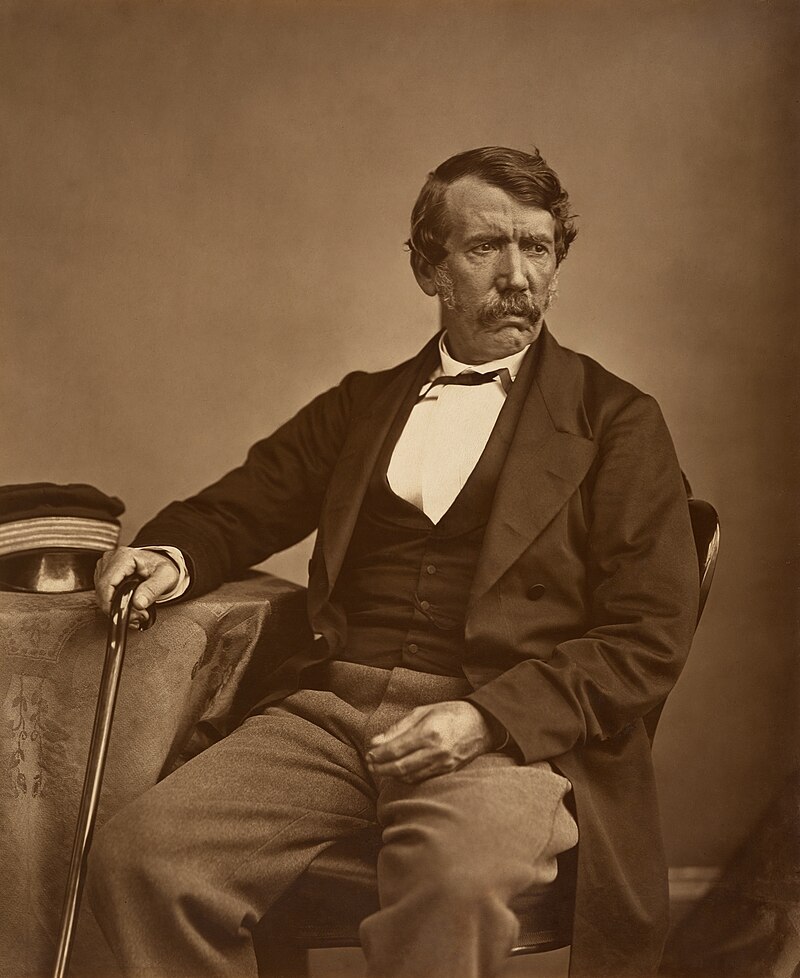
File:David_Livingstone_by_Thomas_Annan.jpg · Wikimedia Commons · See Wikimedia Commons
David Livingstone
Sign in to saveScottish missionary and explorer (1813-1873)
David Livingstone was a Scottish missionary and explorer who traveled through Africa in the mid-1800s, combining religious work with geographical discovery. He remains a significant historical figure whose legacy involves both his contributions to mapping African geography and the complex questions about colonialism and missionary activity that his work represents.
AI-generated from the Wikipedia summary — may contain errors.
Wikidata facts
- Instance of
- human
- Given name
- David
- Gender
- male
- Citizenship
- United Kingdom
- Place of birth
- Blantyre
- Spouse
- Mary Livingstone
- Occupation
- missionary
- Educated at
- University of Glasgow
- Languages spoken
- English language
- Religion
- Congregational churches
- Image
- David Livingstone by Thomas Annan.jpg
- Number of children
- 6
Show 15 more facts
- place of burial
- Westminster Abbey
- Commons category
- David Livingstone
- date of birth
- 1813-03-19
- date of death
- 1873-05-01
- cause of death
- malaria
- member of
- Royal Society
- topic's main category
- Category:David Livingstone
- manner of death
- natural causes
- Commons gallery
- David Livingstone
- writing language
- English language
- name in native language
- David Livingstone
- on focus list of Wikimedia project
- Wikipedia:Vital articles/Level/4
- P8168
- Black Tower
- P12749
- Hermann Baumann
- Commons Creator page
- David Livingstone
Sources (11)
via Wikidata · CC0
Works in European collections
36 objects attributed to David Livingstone, held across European museums, libraries & archives · via Europeana




~40 min read
Encyclopedic overview
David Livingstone (/ˈlɪvɪŋstən/; 19 March 1813 – 1 May 1873) was a Scottish doctor, Congregationalist, pioneer Christian missionary with the London Missionary Society, and an explorer in Africa. Livingstone was married to Mary Moffat Livingstone, from the prominent 18th-century Moffat missionary family. Livingstone came to have a mythic status as a Protestant missionary martyr, working-class "rags-to-riches" inspirational story, scientific investigator and explorer, imperial reformer, anti-slavery crusader, and advocate of British commercial and colonial expansion. As a result, he became one of the most popular British heroes of the late 19th-century Victorian era.
Livingstone's fame as an explorer and his obsession with learning the sources of the Nile was founded on the belief that if he could solve that age-old mystery, his fame would give him the influence to end the East African Arab–Swahili slave trade. "The Nile sources", he told a friend, "are valuable only as a means of opening my mouth with power among men. It is this power [with] which I hope to remedy an immense evil." His subsequent exploration of the central African watershed was the culmination of the classic period of European geographical discovery and colonial penetration of Africa. At the same time, his missionary travels, "disappearance" and eventual death in Africa—and subsequent glorification as a posthumous national hero in 1874—led to the founding of several major central African Christian missionary initiatives carried forward in the era of the European "Scramble for Africa", during which almost all of Africa fell under European rule for decades.
Excerpted from Wikipedia’s “David Livingstone” article, available under the CC BY-SA 4.0 licence.
Gallery (12)
On the map
Available in 88 languages
- Español
- Français
- Deutsch
- 中文
- 日本語
- Русский
- Português
- Italiano
- العربية
- हिन्दी
- Afrikaans
- Albanian
- Amharic
- Armenian
- Asturian
- Azerbaijani
- Bahasa Indonesia
- Bangla
Show 69 more
- Basque
- be_x_old
- Belarusian
- Breton
- Bulgarian
- Burmese
- Catalan
- Croatian
- Czech
- Danish
- Egyptian Arabic
- Esperanto
- Estonian
- Filipino
- Finnish
- Galician
- Georgian
- gpe
- Greek
- Hebrew
- Hungarian
- Icelandic
- Ido
- Irish
- kbp
- Kotava
- Kyrgyz
- Latin
- Latvian
- Ligurian
- Lithuanian
- Macedonian
- Malagasy
- Malay
- Malayalam
- Manx
- Marathi
- Mongolian
- Nederlands
- Norwegian
- Norwegian Nynorsk
- Occitan
- Polski
- Romanian
- Scottish Gaelic
- Serbian
- Serbian (Latin)
- simple
- Slovak
- Slovenian
- Svenska
- Swahili
- Tamil
- Tiếng Việt
- Tumbuka
- Türkçe
- Ukrainian
- Urdu
- Uzbek
- Waray
- Welsh
- Western Frisian
- Western Panjabi
- Wu Chinese
- zh_min_nan
- zh_yue
- فارسی
- ไทย
- 한국어
via Wikidata sitelinks · CC0