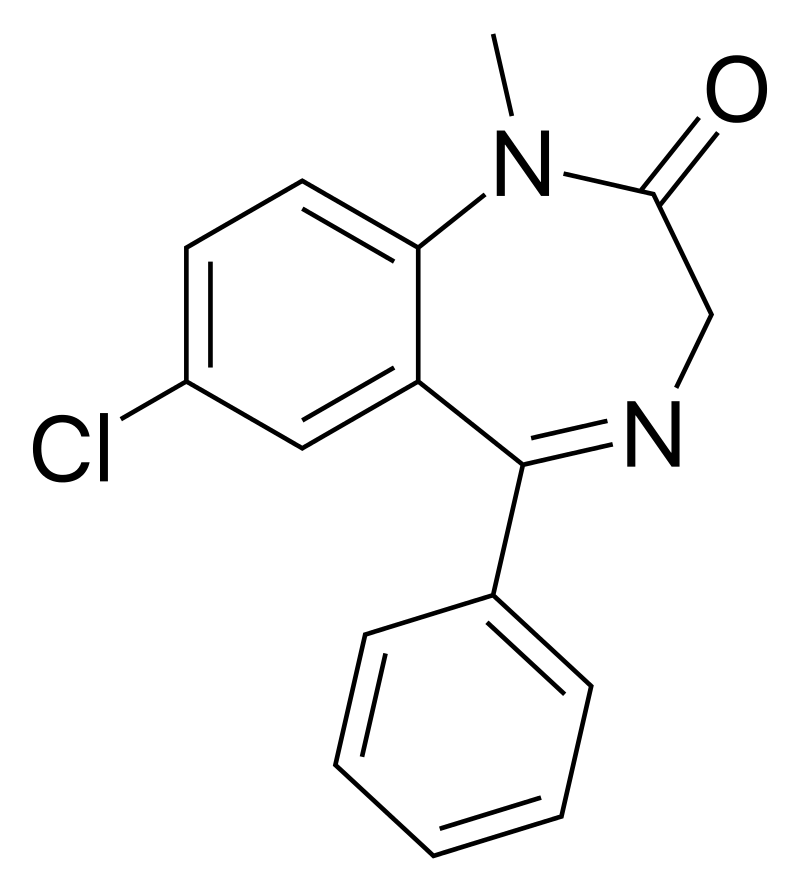
File:Diazepam_structure.svg · Wikimedia Commons · See Wikimedia Commons
Diazepam
Sign in to saveAlso known as Diastat®, LA-III, Valium®, WY-3467, Methyl diazepinone, 7-chloro-1,3-dihydro-1-methyl-5-phenyl-2H-1,4-benzodiazepin-2-one
organische Verbindung, Arzneistoff
OverviewAI-generated
Diazepam is a chemical compound with the formula C₁₆H₁₃ClN₂O. Its IUPAC name is 7-chloro-1-methyl-5-phenyl-3H-1,4-benzodiazepin-2-one. The stylized name for the substance is diazePAM.
The compound has a mass of 284.072 and a weight of 284.74. It possesses a charge of 0, an xlogp of 3, and a tpsa of 32.7. Diazepam has 0 hydrogen bond donors and 2 hydrogen bond acceptors. The defined daily dose is 10.
The subject is referenced by 1,913 other encyclopedia articles. A query for diazepam in PubMed yields a count of 28056.
Synthesized by Vinony from 19 facts across 4 sources: Wikidata, PubChem, PubMed, Vinony graph. Generated from structured data (not the Wikipedia text) and checked against those facts — may still contain errors.
Key facts
- Drug.Verifiedfields
- changed
- Drug.Watchedfields
- changed
- Drug.verifiedrevid
- 443634166
- Drug.image
- Diazepam structure.svg
- Drug.image_class
- skin-invert-image
- Drug.width
- 200
- Drug.image2
- Diazepam-from-xtal-3D-balls.png
- Drug.image_class2
- bg-transparent
- Drug.tradename
- Valium, others
- Drug.MedlinePlus
- a682047
- Drug.DailyMedID
- Diazepam
- Drug.pregnancy_AU
- C
- Drug.dependency_liability
- High
- Drug.addiction_liability
- Moderate
- Drug.routes_of_administration
- Oral, intramuscular, intravenous, rectal, intranasal, buccal
- Drug.class
- Benzodiazepine
- Drug.ATC_prefix
- N05
- Drug.ATC_suffix
- BA01
via Wikipedia infobox
Chemical data
- Formula
- C16H13ClN2O
- Molecular weight
- 284.74 g/mol
- IUPAC name
- 7-chloro-1-methyl-5-phenyl-3H-1,4-benzodiazepin-2-one
- SMILES
- CN1C(=O)CN=C(C2=C1C=CC(=C2)Cl)C3=CC=CC=C3
- InChIKey
- AAOVKJBEBIDNHE-UHFFFAOYSA-N
- XLogP
- 3
- Polar surface area
- 32.7 Ų
- H-bond donors
- 0
- H-bond acceptors
- 2
- Formal charge
- 0
via PubChem
Drug data · ChEMBL
- Max clinical phase
- Approved
- Molecule type
- Small molecule
- First approval
- 1963
- Admin. routes
- oral, parenteral, topical
- Indications
- epilepsy, Seizure, anxiety, pain
via ChEMBL · EBI
Research
28,056 papers- Comparison of the actions of diazepam and lorazepam.British journal of anaesthesia · 1979Dundee JW, McGowan WA, Lilburn JK et al.DOI: 10.1093/bja/51.5.439
- Diazepam in the Elderly: Looking Back, Ahead, and at the Evidence.Journal of clinical psychopharmacology · 2020Greenblatt DJ, Harmatz JS, Shader RIDOI: 10.1097/JCP.0000000000001213
- Diazepam and breathlessness.Lancet (London, England) · 1980
- Diazepam in the treatment of organophosphorus ester pesticide poisoning.ReviewToxicological reviews · 2003Marrs TCDOI: 10.2165/00139709-200322020-00002
- Safety and efficacy of diazepam autoinjector for the management of epilepsy.ReviewExpert review of neurotherapeutics · 2015Verrotti A, Milioni M, Zaccara GDOI: 10.1586/14737175.2015.1003043
- Diazepam (Valium): its dependency liability.ReviewThe Journal of psychology · 1990Murray JBDOI: 10.1080/00223980.1990.10543259
- Diazepam and breast-feeding.Lancet (London, England) · 1972Erkkola R, Kanto JDOI: 10.1016/s0140-6736(72)90954-3
- [Diazepam in obstetrics].ReviewDuodecim; laaketieteellinen aikakauskirja · 1973Erkkola R, Kanto J
via PubMed
Wikidata facts
- Subclass of
- alkaloid
- Mass
- 284.072
- Manufacturer
- Pfizer
- Image
- Diazepam structure.svg
- Has use
- medication
Show 12 more facts
- Commons category
- Diazepam
- route of administration
- enteral administration
- chemical formula
- C₁₆H₁₃ClN₂O
- canonical SMILES
- CN1C(=O)CN=C(C2=C1C=CC(=C2)Cl)C3=CC=CC=C3
- found in taxon
- Physalis angulata
- subject has role
- benzodiazepine drug
- has characteristic
- bitterness
- stylized name
- diazePAM
- defined daily dose
- 10
- legal status (medicine)
- boxed warning
- significant drug interaction
- loxapine
- World Health Organisation international non-proprietary name
- diazepamum
Sources (12)
via Wikidata · CC0
Article · Deutsch
Diazepam, in Deutschland von 1963 bis 2015 als Valium (in der DDR bis 1990 als Faustan) vermarktet, ist ein psychoaktiv wirksamer Arzneistoff aus der Gruppe der Benzodiazepine mit relativ langer Halbwertszeit von 20 bis 50 Stunden. Valium erreichte in der Bevölkerung einen hohen Bekanntheitsgrad – ähnlich wie Aspirin – und galt als Rosa Brille auf Rezept. Diazepam ist angezeigt zur Behandlung von Angstzuständen, zur Therapie epileptischer Anfälle und zur Prämedikation vor chirurgischen und diagnostischen Eingriffen. Da es bei einer Langzeittherapie mit Diazepam zu einer psychischen und körperlichen Abhängigkeit kommen kann, wird der Wirkstoff vorrangig in der Akuttherapie – das heißt nicht länger als vier bis sechs Wochen – eingesetzt. Diazepam ist in der Liste der unentbehrlichen Medikamente der Weltgesundheitsorganisation (WHO) gelistet.
Abstract from DBpedia / Wikipedia · CC BY-SA