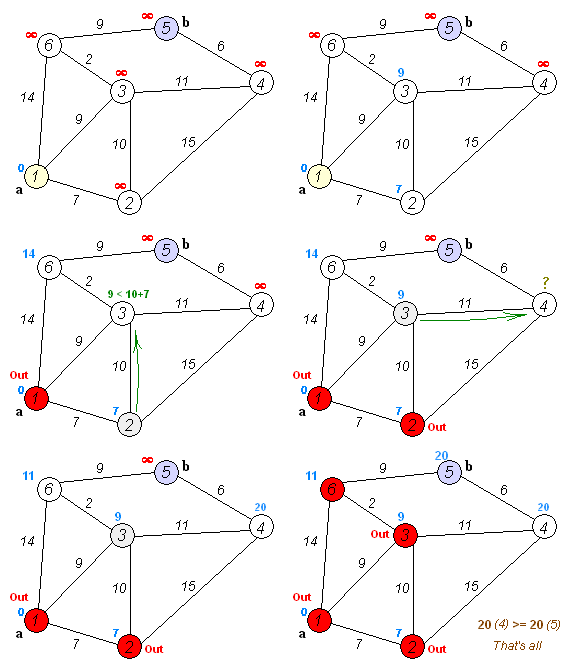
File:Dijkstra_Animation.gif · Wikimedia Commons · See Wikimedia Commons
AI overview
Dijkstra's algorithm is a method for finding the shortest path between points in a network or graph by systematically exploring nearby connections and gradually expanding outward. It matters because it's widely used in real-world applications like GPS navigation, network routing, and mapping services where finding efficient routes quickly is important.
AI-generated from the Wikipedia summary — may contain errors.
Key facts
- Class
- Search algorithm , Greedy algorithm , Dynamic programming
- Data structure
- Graph , Usually used with priority queue or heap for optimization
- Worst case performance
- Θ ( | E | + | V | log | V | ) {\displaystyle \Theta (|E|+|V|\log |V|)}
via Wikipedia infobox
Wikidata facts
- Instance of
- algorithm
- Named after
- Edsger W. Dijkstra
- Based on
- breadth-first search
- Image
- Dijkstra Animation.gif
Show 8 more facts
- derivative work
- link-state routing protocol
- Commons category
- Dijkstra's algorithm
- Stack Exchange tag
- stackoverflow.com/tags/dijkstra
- Commons gallery
- Dijkstra's algorithm
- discoverer or inventor
- Edsger W. Dijkstra
- uses
- priority queue
- time of discovery or invention
- 1959-00-00
- maintained by WikiProject
- WikiProject Mathematics
via Wikidata · CC0