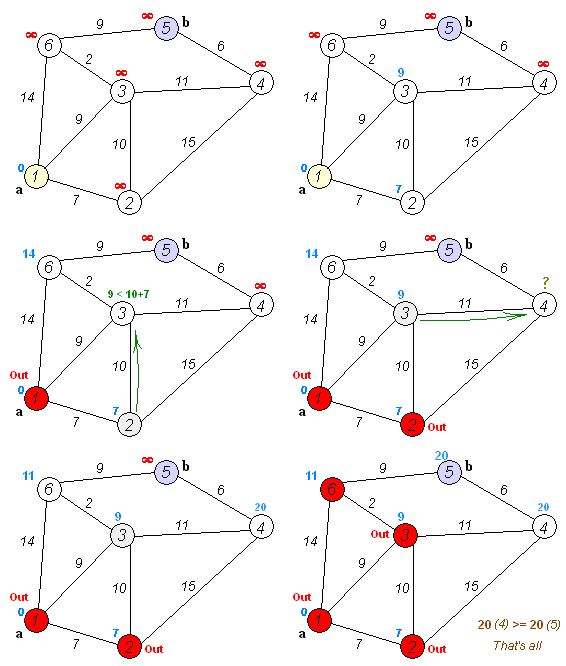
File:Dijkstra_Animation.gif · Wikimedia Commons · See Wikimedia Commons
Dijkstra's algorithm is a method for finding the shortest path between points in a network or graph by systematically exploring nearby connections and gradually expanding outward. It matters because it's widely used in real-world applications like GPS navigation, network routing, and mapping services where finding efficient routes quickly is important.
AI-generated from the Wikipedia summary — may contain errors.
Key facts
- Class
- Search algorithm , Greedy algorithm , Dynamic programming
- Data structure
- Graph , Usually used with priority queue or heap for optimization
- Worst case performance
- Θ ( | E | + | V | log | V | ) {\displaystyle \Theta (|E|+|V|\log |V|)}
via Wikipedia infobox
Wikidata facts
- Instance of
- algorithm
- Named after
- Edsger W. Dijkstra
- Based on
- breadth-first search
- Image
- Dijkstra Animation.gif
Show 8 more facts
- derivative work
- link-state routing protocol
- Commons category
- Dijkstra's algorithm
- Stack Exchange tag
- stackoverflow.com/tags/dijkstra
- Commons gallery
- Dijkstra's algorithm
- discoverer or inventor
- Edsger W. Dijkstra
- uses
- priority queue
- time of discovery or invention
- 1959-00-00
- maintained by WikiProject
- WikiProject Mathematics
via Wikidata · CC0
Article · 日本語
ダイクストラ法(だいくすとらほう、英: Dijkstra's algorithm)はグラフ理論における辺の重みが非負数の場合の単一始点最短経路問題を解くための最良優先探索によるアルゴリズムである。辺の重みに負数を含む場合はベルマン-フォード法などが使える。辺の重みが全て同一の非負数の場合は幅優先探索が速く、線形時間で最短路を計算可能である。また、無向グラフで辺の重みが正整数の場合は、Thorupのアルゴリズムによって線形時間での計算が可能であるが、実用性はあまり高くない。
Abstract from DBpedia / Wikipedia · CC BY-SA