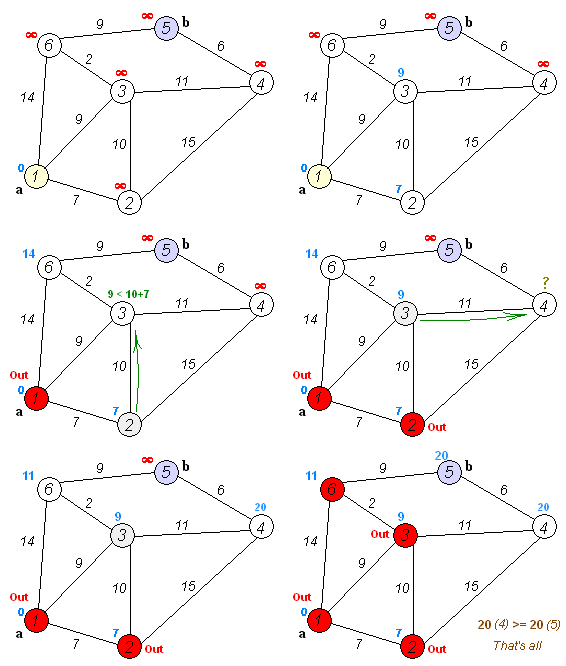
File:Dijkstra_Animation.gif · Wikimedia Commons · See Wikimedia Commons
algorithme de Dijkstra
Sign in to saveAlso known as Dijkstra algorithm
algorithme de recherche dans un graphe
Dijkstra's algorithm is a method for finding the shortest path between points in a network or graph by systematically exploring nearby connections and gradually expanding outward. It matters because it's widely used in real-world applications like GPS navigation, network routing, and mapping services where finding efficient routes quickly is important.
AI-generated from the Wikipedia summary — may contain errors.
Key facts
- Class
- Search algorithm , Greedy algorithm , Dynamic programming
- Data structure
- Graph , Usually used with priority queue or heap for optimization
- Worst case performance
- Θ ( | E | + | V | log | V | ) {\displaystyle \Theta (|E|+|V|\log |V|)}
via Wikipedia infobox
Wikidata facts
- Instance of
- algorithm
- Named after
- Edsger W. Dijkstra
- Based on
- breadth-first search
- Image
- Dijkstra Animation.gif
Show 8 more facts
- derivative work
- link-state routing protocol
- Commons category
- Dijkstra's algorithm
- Stack Exchange tag
- stackoverflow.com/tags/dijkstra
- Commons gallery
- Dijkstra's algorithm
- discoverer or inventor
- Edsger W. Dijkstra
- uses
- priority queue
- time of discovery or invention
- 1959-00-00
- maintained by WikiProject
- WikiProject Mathematics
via Wikidata · CC0
Article · Français
En théorie des graphes, l'algorithme de Dijkstra (prononcé [dɛɪkstra]) sert à résoudre le problème du plus court chemin. Il permet, par exemple, de déterminer un plus court chemin pour se rendre d'une ville à une autre connaissant le réseau routier d'une région. Plus précisément, il calcule des plus courts chemins à partir d'une source vers tous les autres sommets dans un graphe orienté pondéré par des réels positifs. On peut aussi l'utiliser pour calculer un plus court chemin entre un sommet de départ et un sommet d'arrivée. L'algorithme porte le nom de son inventeur, l'informaticien néerlandais Edsger Dijkstra, et a été publié en 1959. Cet algorithme est de complexité polynomiale. Plus précisément, pour sommets et arcs, le temps est en , voire en .
Abstract from DBpedia / Wikipedia · CC BY-SA