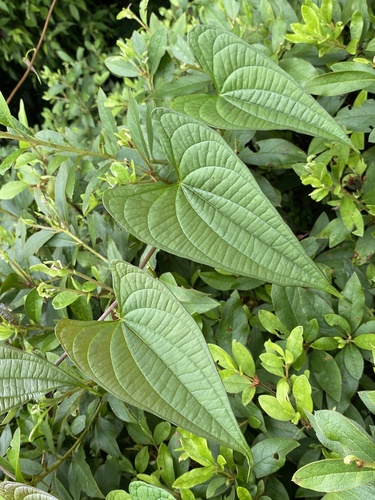
Dioscorea japonica
Also known as Japanese Potato, Japanese Mountain Yam, satsuma imo, kotobuki, yamaimo
especie de planta
Species
SPECIES
- KingdomPlantae
- PhylumTracheophyta
- ClassLiliopsida
- OrderDioscoreales
- FamilyDioscoreaceae
Native toAssam, China South-Central, China Southeast, Japan, Korea, Taiwan
Observations1,265
Observations recorded6,270
Tubers vertical, long cylindric, to 3 cm in diam.; cork yellowish brown; transverse section white or yellowish white. Stem twining to right, green, sometimes light purplish red. Bulblets often present. Leaves alternate basally on stem, opposite distally on stem, simple; petiole 1.5--4(--6) cm; leaf blade drying yellowish green to light brownish, broadly ovate basally on stem, usually triangular-lanceolate to linear distally on stem, 3--12(--19) × 1--6(--18) cm, membranous or papery, glabrous, basal veins 5--9, base sagittate or hastate to cordate or ± truncate, margin entire, apex acute to long acuminate. Male spikes 3--5 together, rarely solitary, ± erect or ascending, 2--8 cm; rachis straight, occasionally slightly zigzagged at apex. Male flowers: perianth greenish white or light yellow, lobes purple spotted, ovate or ovate-elliptic, to 2 × 1.5 mm, inner ones smaller than outer; stamens 6. Female spikes solitary or 2 or 3 together, 6--20 cm. Female flowers: staminodes 6. Capsule not reflexed, pale brown with darker, linear freckles, oblate, 1.5--2(--2.5) cm, base truncate, apex emarginate; wings 0.7--1.5(--2) cm wide, margin dark. Seeds inserted near middle of capsule, D-shaped,
Article · Español
El ñame del Japón o yamaimo (Dioscorea japonica) es un tipo de ñame ( Dioscorea ) que se utiliza para la alimentación. El Jinenjo, también llamado ñame silvestre está relacionado con la variedad de ñame japonés que se utiliza como ingrediente en el soba.
Abstract from DBpedia / Wikipedia · CC BY-SA