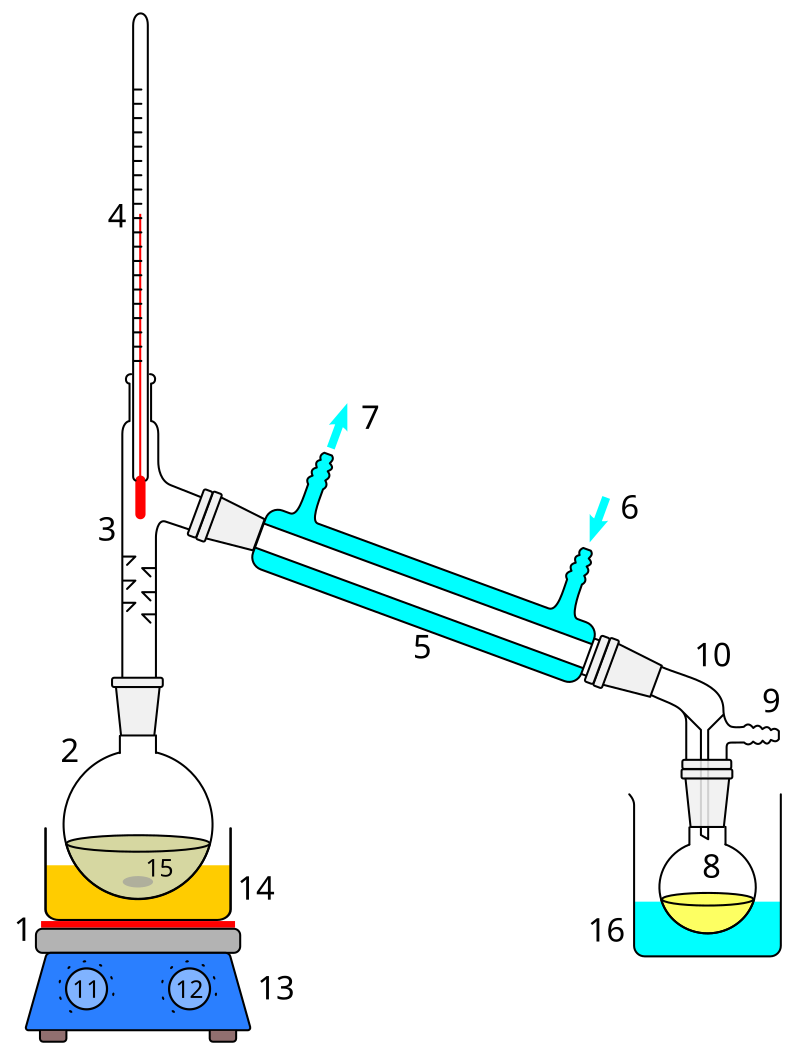
File:Simple_distillation_apparatus.svg · Wikimedia Commons · See Wikimedia Commons
Distillation is a process that separates liquid mixtures by heating them until they boil, then cooling and condensing the vapors back into liquid form in a separate container, allowing different components to be collected based on their different boiling points. This technique matters because it allows people to purify liquids or separate mixtures into their individual components, which is useful in laboratories and industrial settings.
AI-generated from the Wikipedia summary — may contain errors.
Research
43,123 papers- The advent of thermoplasmonic membrane distillation.ReviewChemical Society reviews · 2022Santoro S, Avci AH, Politano A et al.DOI: 10.1039/d0cs00097c
- Membrane distillation assisting food production processes of thermally sensitive food liquid items: a review.ReviewCritical reviews in food science and nutrition · 2024Gontarek-Castro E, Castro-Muñoz RDOI: 10.1080/10408398.2022.2163223
- Distillation for in situ recovery of volatile fermentation products.ReviewTrends in biotechnology · 2025Straathof AJJ, Janković T, Kiss AADOI: 10.1016/j.tibtech.2024.12.009
- Challenges and advancements in membrane distillation crystallization for industrial applications.ReviewEnvironmental research · 2023Zhang X, Koirala R, Pramanik B et al.DOI: 10.1016/j.envres.2023.116577
- Membrane distillation crystallization technology for zero liquid discharge and resource recovery: Opportunities, challenges and futuristic perspectives.ReviewThe Science of the total environment · 2022Yadav A, Labhasetwar PK, Shahi VKDOI: 10.1016/j.scitotenv.2021.150692
- Solar distillation meets the real world: a review of solar stills purifying real wastewater and seawater.ReviewEnvironmental science and pollution research international · 2022Arunkumar T, Sathyamurthy R, Denkenberger D et al.DOI: 10.1007/s11356-022-18720-2
- Decoupled Classifier Knowledge Distillation.PloS one · 2025Wang H, Dong M, Zhu G et al.DOI: 10.1371/journal.pone.0314267
- Importance-aware adaptive dataset distillation.Neural networks : the official journal of the International Neural Network Society · 2024Li G, Togo R, Ogawa T et al.DOI: 10.1016/j.neunet.2024.106154
via PubMed
Wikidata facts
- Subclass of
- separation process
- Has part
- condensation
- Location
- distillery
- Image
- Vacuum Column.jpg
Show 9 more facts
- Commons category
- Distillation
- topic's main category
- Category:Distillation
- start time
- 0300-00-00
- discoverer or inventor
- Zosimos of Panopolis
- different from
- reduction
- studied by
- thermodynamics
- P8168
- Abancourt
- on focus list of Wikimedia project
- Wikipedia:Vital articles/Level/4
- topic has template
- Template:Distillation
via Wikidata · CC0
Article · Deutsch
Destillation (lateinisch destillatio, von destillare „herabtröpfeln, herabtropfen“, von stilla „Tropfen“) ist ein thermisches Trennverfahren, um verdampfbare Flüssigkeiten zu gewinnen oder Lösungsmittel von schwer verdampfbaren Stoffen abzutrennen und anschließend durch Kondensation aufzufangen. Die Destillation hat gegenüber anderen Trennverfahren den Vorteil, dass in der Regel keine weiteren Stoffe wie Adsorbentien oder Lösungsmittel hinzugefügt werden müssen. Bei der Destillation wird zunächst das Ausgangsgemisch zum Sieden gebracht. Der entstehende Dampf, der sich aus den verschiedenen flüchtigen Komponenten der zu trennenden Lösung zusammensetzt, wird in einem Kondensator durch Abkühlen wieder verflüssigt. Im Labormaßstab wird oft der Liebigkühler verwendet. Im Anschluss wird das flüssige Kondensat aufgefangen. Typische Anwendungen der Destillation sind das Brennen von Alkohol und das Destillieren (die Rektifikation) von Erdöl in der Raffinerie oder auch die Herstellung von destilliertem Wasser. Idealerweise soll sich die Flüssigkeit beim Destillieren nicht zersetzen. Bei der sogenannten „trockenen Destillation“ ist dies anders: dabei werden nicht-verdampfbare feste Stoffe in kleinere Moleküle zerlegt. So erhält man z. B. bei der trockenen Destillation von Holz den „Holzgeist“ (Methanol). Zwar wird hier eine verdampfbare Flüssigkeit durch Kondensation gewonnen, aber nach der heutigen Theorie liegt hier keine destillative Trennung vor. Daher nennt man dieses Verfahren besser Thermolyse oder Pyrolyse.
Abstract from DBpedia / Wikipedia · CC BY-SA
Gallery (42)
Available in 85 languages
- Español
- Français
- Deutsch
- 中文
- 日本語
- Русский
- Português
- Italiano
- العربية
- हिन्दी
- Afrikaans
- Armenian
- Asturian
- Bahasa Indonesia
- Bangla
- Basque
- be_x_old
- Belarusian
Show 66 more
- Bosnian
- Bulgarian
- Catalan
- Chuvash
- Croatian
- Czech
- Danish
- Egyptian Arabic
- Esperanto
- Estonian
- Filipino
- Finnish
- Galician
- Georgian
- Greek
- Haitian Creole
- Hebrew
- Hungarian
- Irish
- Javanese
- Kannada
- Kazakh
- Kyrgyz
- Latin
- Latvian
- Lithuanian
- Lombard
- Low German
- Luxembourgish
- Macedonian
- Malay
- Malayalam
- Marathi
- Mongolian
- Moroccan Arabic
- Nederlands
- Norwegian
- Norwegian Nynorsk
- Occitan
- Polski
- Punjabi
- Romanian
- Serbian
- Serbian (Latin)
- simple
- Sinhala
- Slovak
- Slovenian
- Sundanese
- Svenska
- Swahili
- Tamil
- Tatar
- Tiếng Việt
- Türkçe
- Ukrainian
- Urdu
- Uzbek
- Welsh
- Wu Chinese
- zh_classical
- zh_min_nan
- zh_yue
- فارسی
- ไทย
- 한국어
via Wikidata sitelinks · CC0