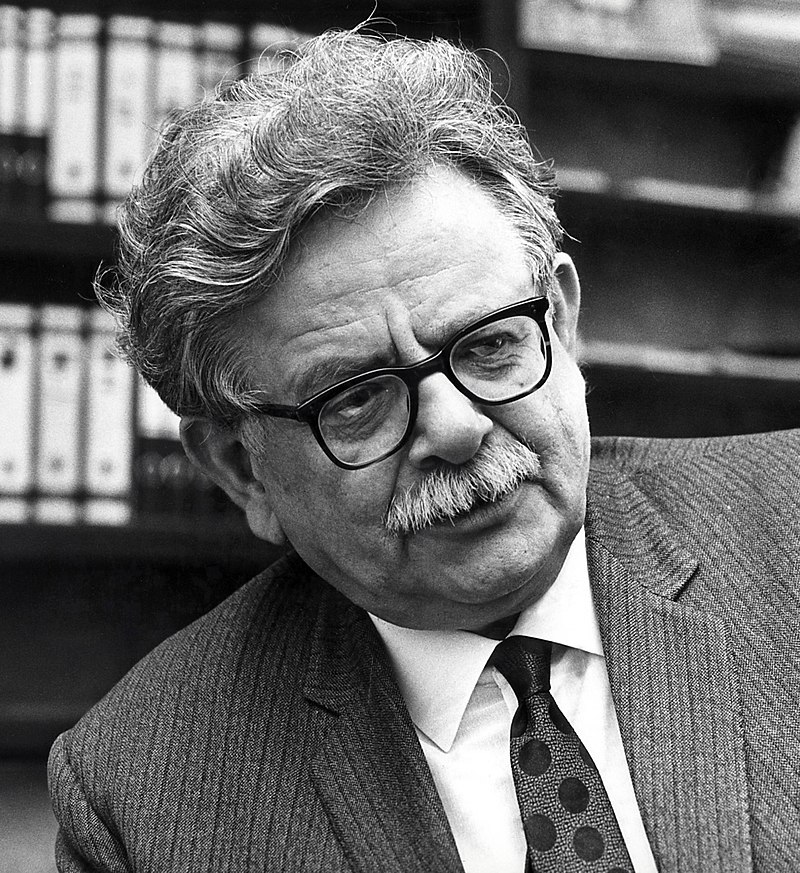
File:Elias_Canetti_2.jpg · Wikimedia Commons · See Wikimedia Commons
Elias Canetti
Sign in to saveAlso known as Elías Canetti
Bulgarian-born Swiss and British Jewish modernist novelist, playwright, memoirist, and non-fiction writer (1905–1994)
Elias Canetti was a Bulgarian-born writer who became a major figure in twentieth-century literature through his novels, plays, memoirs, and essays, working across multiple genres and languages throughout his life in Switzerland and Britain. His work matters because it represents an important modernist voice that explored complex themes of human behavior and society, earning him international recognition as one of the significant literary figures of his era.
AI-generated from the Wikipedia summary — may contain errors.
Nobel Prize
- The Nobel Prize in Literature1981
“for writings marked by a broad outlook, a wealth of ideas and artistic power”
Wikidata facts
- Instance of
- human
- Given name
- Elias
- Gender
- male
- Citizenship
- Bulgaria
- Place of birth
- Ruse
- Place of death
- Zurich
- Sibling
- Georges Canetti
- Occupation
- novelist
- Educated at
- University of Vienna
- Languages spoken
- English language
- Native language
- Bulgarian
- Award
- Pour le Mérite
- Field of work
- novel
- Image
- Elias Canetti 2.jpg
- Work location
- Vienna
Show 14 more facts
- place of burial
- Fluntern Cemetery
- Commons category
- Elias Canetti
- date of birth
- 1905-07-25
- date of death
- 1994-08-14
- member of
- Bavarian Academy of Fine Arts
- topic's main category
- Category:Elias Canetti
- nominated for
- Neustadt International Prize for Literature
- has works in the collection
- Tate
- writing language
- German
- name in native language
- Elias Canetti
- archives at
- Zentralbibliothek Zürich
- Academia.edu profile URL
- www.academia.edu/People/Elias_Canetti
- P8168
- Cent
- P12674
- Vöhringen
via Wikidata · CC0
Works in European collections
8 objects attributed to Elias Canetti, held across European museums, libraries & archives · via Europeana


~11 min read
Encyclopedic overview
Elias Canetti (Bulgarian: Елиас Канети; 25 July 1905 – 14 August 1994; /kəˈnɛti, kɑː-/; German: [eˈliːas kaˈnɛti]) was a German-language writer, known as a modernist novelist, playwright, memoirist, and nonfiction writer.
Born in Ruse, Bulgaria, to a Sephardic Jewish family, he later lived in England, Austria, Germany, and Switzerland. He won the 1981 Nobel Prize in Literature, "for writings marked by a broad outlook, a wealth of ideas and artistic power".
Excerpted from Wikipedia’s “Elias Canetti” article, available under the CC BY-SA 4.0 licence.
Gallery (5)
Available in 88 languages
- Español
- Français
- Deutsch
- 中文
- 日本語
- Русский
- Português
- Italiano
- العربية
- हिन्दी
- Albanian
- Aragonese
- Armenian
- azb
- Azerbaijani
- Bahasa Indonesia
- Basque
- be_x_old
Show 69 more
- Belarusian
- Bosnian
- Breton
- Bulgarian
- Catalan
- Croatian
- Czech
- Danish
- Egyptian Arabic
- Esperanto
- Estonian
- Finnish
- Galician
- Georgian
- Greek
- Hakka Chinese
- Hebrew
- Hungarian
- Icelandic
- Ido
- Iloko
- Irish
- Javanese
- Kazakh
- Kotava
- Kurdish
- Ladino
- Latin
- Latvian
- Lithuanian
- Luxembourgish
- Macedonian
- Malay
- Malayalam
- Mazanderani
- Mingrelian
- Mirandese
- Nederlands
- Norwegian
- Norwegian Nynorsk
- Occitan
- Polski
- Punjabi
- Quechua
- Romanian
- Scots
- Scottish Gaelic
- Serbian
- Serbian (Latin)
- simple
- Slovak
- Slovenian
- Svenska
- Swahili
- Tatar
- Tiếng Việt
- Türkçe
- Ukrainian
- Urdu
- Uzbek
- Welsh
- Western Frisian
- Western Panjabi
- Wu Chinese
- Yoruba
- zh_min_nan
- zh_yue
- فارسی
- 한국어
via Wikidata sitelinks · CC0