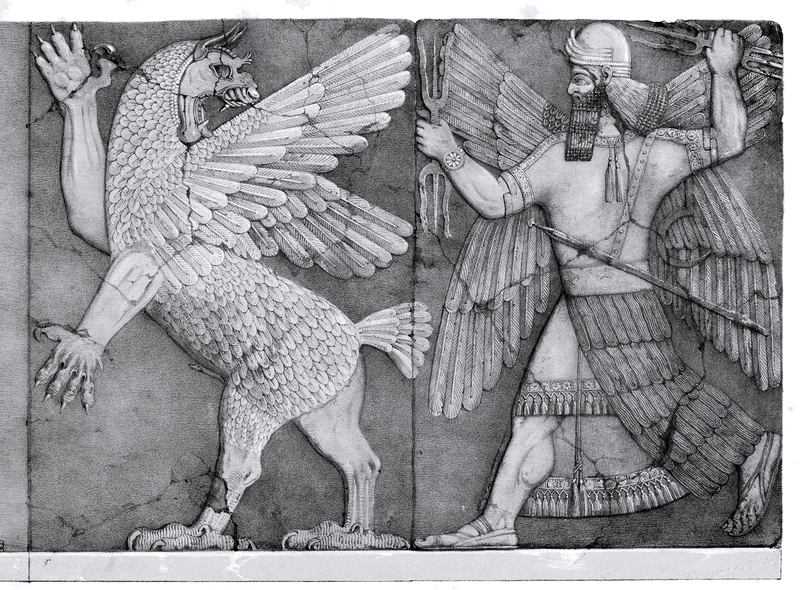
File:Chaos_Monster_and_Sun_God.png · Wikimedia Commons · See Wikimedia Commons
Enûma Eliš
Sign in to saveAlso known as Enuma Elish, Enuma Elis, Enuma Ellis, Enuma Eliš
Babylonian creation myth
"Enûma Eliš" is an ancient Babylonian poem that tells the story of how the world was created through a series of divine conflicts among gods. The text matters because it is one of the oldest known creation myths and provides crucial insight into how the ancient Babylonians understood the origins of the cosmos and the role of their chief god Marduk.
AI-generated from the Wikipedia summary — may contain errors.
Wikidata facts
- Instance of
- literary work
- Subclass of
- creation myth
- Part of
- Babylonian mythology
- Genre
- creation myth
- Country of origin
- Babylonia
- Main subject
- creation myth
Show 4 more facts
- topic's main category
- Category:Enūma Eliš
- time period
- ancient Near East
- culture
- Babylonia
- language of work or name
- Akkadian
Sources (1)
via Wikidata · CC0
~38 min read
Encyclopedic overview
Enūma Eliš (Akkadian Cuneiform: 𒂊𒉡𒈠𒂊𒇺, also spelled "Enuma Elish"), meaning "When on High", is a Babylonian creation myth (named after its opening words) from the late 2nd millennium BCE and the only complete surviving account of ancient near eastern cosmology. It was recovered by English archaeologist Austen Henry Layard in 1849 (in fragmentary form) in the ruined Library of Ashurbanipal at Nineveh (Mosul, Iraq). A form of the myth was first published by English Assyriologist George Smith in 1876; active research and further excavations led to near completion of the texts and improved translation.
Enūma Eliš has about a thousand lines and is recorded in Akkadian on seven clay tablets, each holding between 115 and 170 lines of Sumero-Akkadian cuneiform script. Most of Tablet V has never been recovered, but, aside from this lacuna, the text is almost complete.
Excerpted from Wikipedia’s “Enûma Eliš” article, available under the CC BY-SA 4.0 licence.