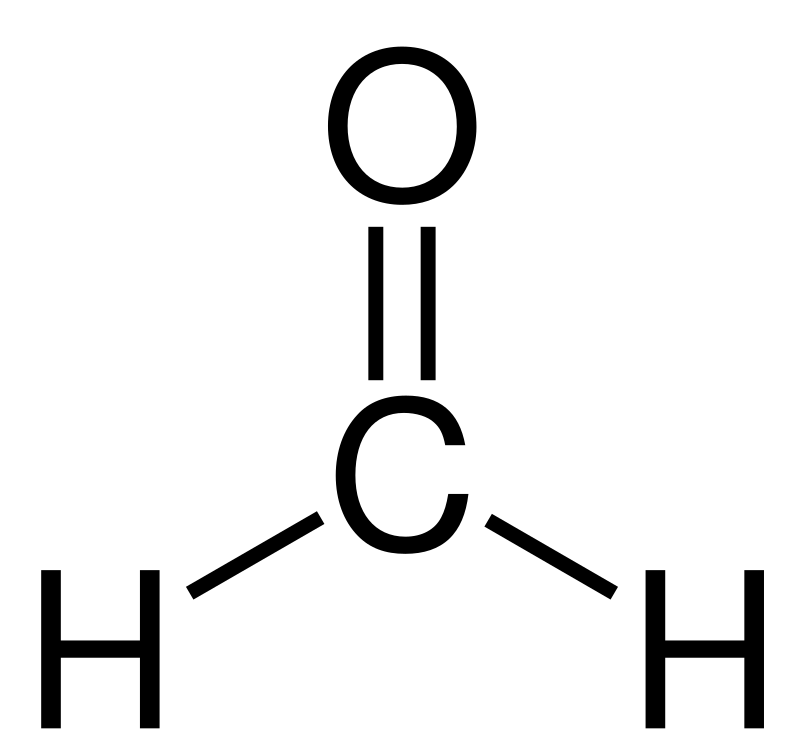
File:Structural_formula_of_formaldehyde.svg · Wikimedia Commons · See Wikimedia Commons
méthanal
Sign in to saveAlso known as Formic aldehyde, Formaline, Fannoform, Chlodithane, Formalith, Methaldehyde, Formalina, Chlodithan
formaldéhyde
OverviewAI-generated
Formaldehyde is a chemical compound with the formula CH₂O. Its structure is represented by the canonical SMILES notation C=O. The substance has a molecular mass of 30.011 and a density of 0.8153. It possesses an electric dipole moment of 2.332 and an ionization energy of 10.88. The standard enthalpy of formation is recorded as -115.9.
The compound melts at -134 and -92, and boils at -6 and -19.1. Its vapor pressure is 1. Formaldehyde is flammable, with a lower flammable limit of 7 and an upper flammable limit of 73. Exposure limits include a time-weighted average of 0.92, a ceiling limit of 0.123, and a short-term limit of 2.46. The level immediately dangerous to life or health is 24.6. It has zero hydrogen bond donors and one acceptor.
Synthesized by Vinony from 32 facts across 4 sources: Wikidata, PubChem, PubMed, Vinony graph. Generated from structured data (not the Wikipedia text) and checked against those facts — may still contain errors.
Chemical data
- Formula
- CH2O
- Molecular weight
- 30.026 g/mol
- IUPAC name
- formaldehyde
- SMILES
- C=O
- InChIKey
- WSFSSNUMVMOOMR-UHFFFAOYSA-N
- XLogP
- 1.2
- Polar surface area
- 17.1 Ų
- H-bond donors
- 0
- H-bond acceptors
- 1
- Formal charge
- 0
via PubChem
Drug data · ChEMBL
- Molecule type
- Small molecule
via ChEMBL · EBI
Research
41,871 papers- Formaldehyde.ReviewJournal of applied toxicology : JAT · 1983Farooqui MYDOI: 10.1002/jat.2550030510
- Formaldehyde stress.ReviewScience China. Life sciences · 2010He R, Lu J, Miao JDOI: 10.1007/s11427-010-4112-3
- Formaldehyde toxicity.ReviewArchives of pathology & laboratory medicine · 1979Loomis TA
- What are the DNA lesions underlying formaldehyde toxicity?ReviewDNA repair · 2024Benedict B, Kristensen SM, Duxin JPDOI: 10.1016/j.dnarep.2024.103667
- Formaldehyde: evidence of carcinogenicity.ReviewAmerican Industrial Hygiene Association journal · 1981Blackwell M, Kang H, Thomas A et al.
- Relationship between formaldehyde exposure, respiratory irritant effects and cancers: a review of reviews.ReviewPublic health · 2023La Torre G, Vitello T, Cocchiara RA et al.DOI: 10.1016/j.puhe.2023.03.009
- Formaldehyde in brain: an overlooked player in neurodegeneration?ReviewJournal of neurochemistry · 2013Tulpule K, Dringen RDOI: 10.1111/jnc.12356
- Formaldehyde Exposure of Aquaculture Workers in Korea.Journal of agromedicine · 2024Lee WJ, Kim KYDOI: 10.1080/1059924X.2024.2339513
via PubMed
Wikidata facts
- Has part
- carbon
- Mass
- 30.011
Show 19 more facts
- Commons category
- Formaldehyde
- chemical formula
- CH₂O
- time-weighted average exposure limit
- 0.02
- canonical SMILES
- C=O
- NIOSH Pocket Guide ID
- 0293
- ceiling exposure limit
- 0.123
- immediately dangerous to life or health
- 24.6
- melting point
- -92
- boiling point
- -19.1
- vapor pressure
- 1
- lower flammable limit
- 7
- upper flammable limit
- 73
- ionization energy
- 10.87
- short-term exposure limit
- 2.46
- found in taxon
- Escherichia coli
- standard enthalpy of formation
- -115.9
- density
- 0.8153
- on focus list of Wikimedia project
- Wikipedia:Vital articles/Level/4
- electric dipole moment
- 2.332
Sources (8)
via Wikidata · CC0
Article · Français
Le méthanal ou formaldéhyde ou aldéhyde formique est un composé organique de la famille des aldéhydes, de formule chimique CH2O. C'est le membre le plus simple de cette famille. À température ambiante, c'est un gaz inflammable. Synthétisé pour la première fois par le Russe Alexandre Boutlerov en 1859, il fut formellement identifié par l'Allemand August Wilhelm von Hofmann en 1867. Le formaldéhyde est un gaz ubiquitaire, principalement issu de la combustion incomplète de substances contenant du carbone. Il est donc présent dans la fumée de feux de forêt, dans les rejets de centrales électriques thermiques, d'incinérateurs, de raffineries, de chaudières industrielles et dans les gaz d'échappement de véhicules automobiles, et dans la fumée du tabac. Il est aussi produit dans l'atmosphère sous l'action des rayons solaires et du dioxygène sur le méthane atmosphérique ainsi que sur d'autres hydrocarbures ; les processus de décomposition de matières organiques (végétaux ou cadavre) en produisent aussi. Dans l'air intérieur, il est notamment émis par divers types de colles. L'air intérieur en contient généralement plus que l'air extérieur. De faibles quantités de méthanal sont produites par le métabolisme de la plupart des organismes, dont l'organisme humain. Le formaldéhyde fait aussi partie des molécules détectées dans le milieu interstellaire.
Abstract from DBpedia / Wikipedia · CC BY-SA
Gallery (25)
Available in 73 languages
- Español
- Français
- Deutsch
- 中文
- 日本語
- Русский
- Português
- Italiano
- العربية
- हिन्दी
- Afrikaans
- Armenian
- Asturian
- azb
- Azerbaijani
- Bahasa Indonesia
- Bangla
- Basque
Show 54 more
- be_x_old
- Belarusian
- Bosnian
- Bulgarian
- Burmese
- Catalan
- Croatian
- Czech
- Danish
- Esperanto
- Estonian
- Finnish
- Galician
- Georgian
- Greek
- Hebrew
- Hungarian
- Ido
- Irish
- Javanese
- Kazakh
- Kyrgyz
- Latin
- Latvian
- Ligurian
- Lithuanian
- Macedonian
- Malay
- Malayalam
- Nederlands
- Norwegian
- Polski
- Romanian
- Scots
- Serbian
- Serbian (Latin)
- simple
- Slovak
- Slovenian
- Sundanese
- Svenska
- Tamil
- Telugu
- Tiếng Việt
- Türkçe
- Ukrainian
- Urdu
- Uzbek
- Waray
- Wu Chinese
- zh_yue
- فارسی
- ไทย
- 한국어
via Wikidata sitelinks · CC0