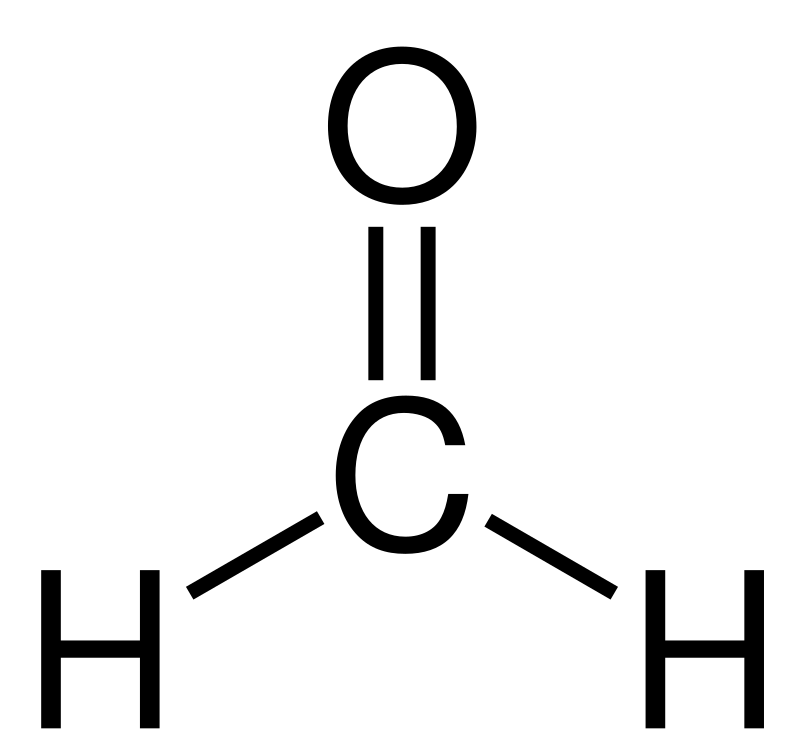
File:Structural_formula_of_formaldehyde.svg · Wikimedia Commons · See Wikimedia Commons
formaldehyd
Sign in to saveAlso known as Formic aldehyde, Formaline, Fannoform, Chlodithane, Formalith, Methaldehyde, Formalina, Chlodithan
związek chemiczny
OverviewAI-generated
Formaldehyde is a chemical compound with the formula CH₂O. Its structure is represented by the canonical SMILES notation C=O. The substance has a molecular mass of 30.011 and a density of 0.8153. It possesses an electric dipole moment of 2.332 and an ionization energy of 10.88. The standard enthalpy of formation is recorded as -115.9.
The compound melts at -134 and -92, and boils at -6 and -19.1. Its vapor pressure is 1. Formaldehyde is flammable, with a lower flammable limit of 7 and an upper flammable limit of 73. Exposure limits include a time-weighted average of 0.92, a ceiling limit of 0.123, and a short-term limit of 2.46. The level immediately dangerous to life or health is 24.6. It has zero hydrogen bond donors and one acceptor.
Synthesized by Vinony from 32 facts across 4 sources: Wikidata, PubChem, PubMed, Vinony graph. Generated from structured data (not the Wikipedia text) and checked against those facts — may still contain errors.
Chemical data
- Formula
- CH2O
- Molecular weight
- 30.026 g/mol
- IUPAC name
- formaldehyde
- SMILES
- C=O
- InChIKey
- WSFSSNUMVMOOMR-UHFFFAOYSA-N
- XLogP
- 1.2
- Polar surface area
- 17.1 Ų
- H-bond donors
- 0
- H-bond acceptors
- 1
- Formal charge
- 0
via PubChem
Drug data · ChEMBL
- Molecule type
- Small molecule
via ChEMBL · EBI
Research
41,871 papers- Formaldehyde.ReviewJournal of applied toxicology : JAT · 1983Farooqui MYDOI: 10.1002/jat.2550030510
- Formaldehyde stress.ReviewScience China. Life sciences · 2010He R, Lu J, Miao JDOI: 10.1007/s11427-010-4112-3
- Formaldehyde toxicity.ReviewArchives of pathology & laboratory medicine · 1979Loomis TA
- What are the DNA lesions underlying formaldehyde toxicity?ReviewDNA repair · 2024Benedict B, Kristensen SM, Duxin JPDOI: 10.1016/j.dnarep.2024.103667
- Formaldehyde: evidence of carcinogenicity.ReviewAmerican Industrial Hygiene Association journal · 1981Blackwell M, Kang H, Thomas A et al.
- Relationship between formaldehyde exposure, respiratory irritant effects and cancers: a review of reviews.ReviewPublic health · 2023La Torre G, Vitello T, Cocchiara RA et al.DOI: 10.1016/j.puhe.2023.03.009
- Formaldehyde in brain: an overlooked player in neurodegeneration?ReviewJournal of neurochemistry · 2013Tulpule K, Dringen RDOI: 10.1111/jnc.12356
- Formaldehyde Exposure of Aquaculture Workers in Korea.Journal of agromedicine · 2024Lee WJ, Kim KYDOI: 10.1080/1059924X.2024.2339513
via PubMed
Wikidata facts
- Has part
- carbon
- Mass
- 30.011
Show 19 more facts
- Commons category
- Formaldehyde
- chemical formula
- CH₂O
- time-weighted average exposure limit
- 0.02
- canonical SMILES
- C=O
- NIOSH Pocket Guide ID
- 0293
- ceiling exposure limit
- 0.123
- immediately dangerous to life or health
- 24.6
- melting point
- -92
- boiling point
- -19.1
- vapor pressure
- 1
- lower flammable limit
- 7
- upper flammable limit
- 73
- ionization energy
- 10.87
- short-term exposure limit
- 2.46
- found in taxon
- Escherichia coli
- standard enthalpy of formation
- -115.9
- density
- 0.8153
- on focus list of Wikimedia project
- Wikipedia:Vital articles/Level/4
- electric dipole moment
- 2.332
Sources (8)
via Wikidata · CC0
Article · Polski
Aldehyd mrówkowy, formaldehyd, E240 (nazwa systematyczna: metanal), HCHO – organiczny związek chemiczny, pierwszy w szeregu homologicznym aldehydów. Został odkryty przez rosyjskiego chemika Aleksandra Butlerowa w 1859 roku. W handlu najczęściej spotyka się jego 35–40% roztwór w wodzie, zwany formaliną. Produktem kondensacji formaldehydu jest polioksymetylen (zwany także paraformaldehydem). Formaldehyd powstaje podczas niepełnego spalania substancji zawierających węgiel (na przykład podczas wędzenia pokarmów bogatych w białka). Przemysłowo otrzymuje się go przez utlenianie i odwodornianie, na katalizatorze tlenkowym (molibdeniany żelaza lub bizmutu) albo srebrowym, metanolu. Dobrze rozpuszcza się w wodzie, do stężenia około 40% (wagowo). Działa silnie bakteriobójczo oraz denaturująco na białka.
Abstract from DBpedia / Wikipedia · CC BY-SA
Gallery (25)
Available in 73 languages
- Español
- Français
- Deutsch
- 中文
- 日本語
- Русский
- Português
- Italiano
- العربية
- हिन्दी
- Afrikaans
- Armenian
- Asturian
- azb
- Azerbaijani
- Bahasa Indonesia
- Bangla
- Basque
Show 54 more
- be_x_old
- Belarusian
- Bosnian
- Bulgarian
- Burmese
- Catalan
- Croatian
- Czech
- Danish
- Esperanto
- Estonian
- Finnish
- Galician
- Georgian
- Greek
- Hebrew
- Hungarian
- Ido
- Irish
- Javanese
- Kazakh
- Kyrgyz
- Latin
- Latvian
- Ligurian
- Lithuanian
- Macedonian
- Malay
- Malayalam
- Nederlands
- Norwegian
- Polski
- Romanian
- Scots
- Serbian
- Serbian (Latin)
- simple
- Slovak
- Slovenian
- Sundanese
- Svenska
- Tamil
- Telugu
- Tiếng Việt
- Türkçe
- Ukrainian
- Urdu
- Uzbek
- Waray
- Wu Chinese
- zh_yue
- فارسی
- ไทย
- 한국어
via Wikidata sitelinks · CC0