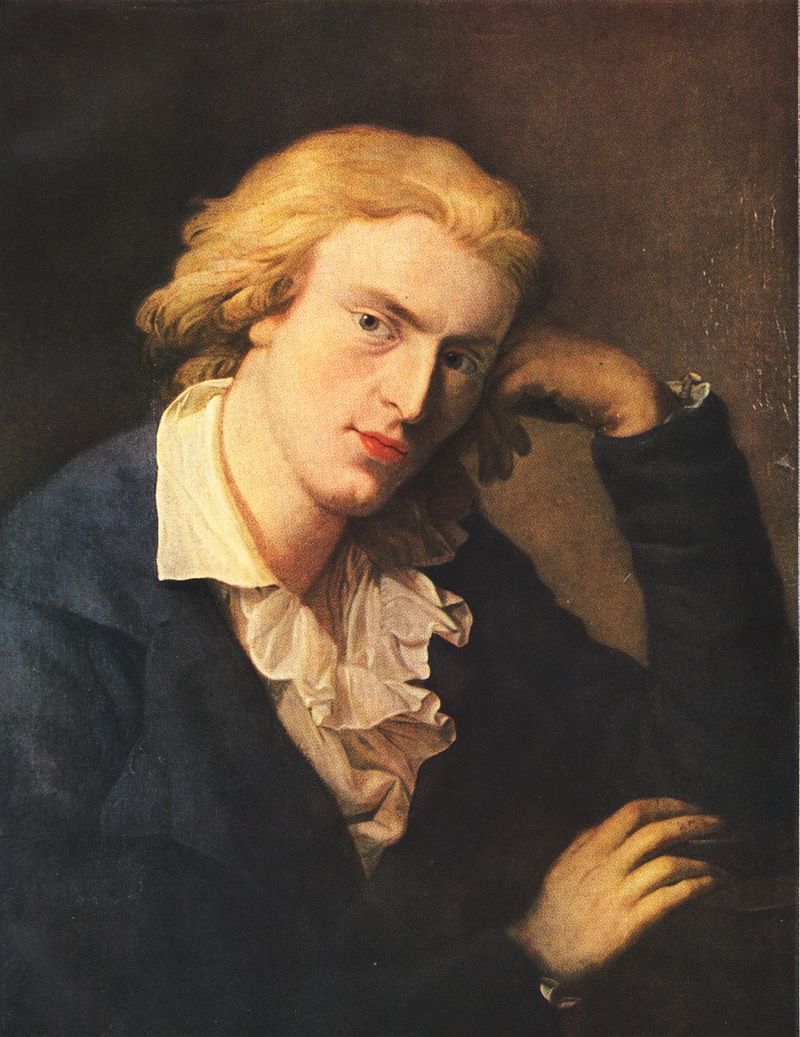
File:Anton_Graff_-_Friedrich_Schiller.jpg · Wikimedia Commons · See Wikimedia Commons
Friedrich Schiller
Sign in to saveAlso known as Schillerean, Johann Christian Friedrich von Schiller, Johann C. F. Schiller, Johann Christoph Friedrich Schiller, Schiller, Fridrikh Shiller, Fridrikh Shiler, F. Shiller
German playwright, poet, philosopher and historian (1759–1805)
Friedrich Schiller was a German writer and thinker of the late 1700s who made major contributions to drama, poetry, philosophy, and historical writing. His works helped shape modern German literature and continue to be widely performed and studied today.
AI-generated from the Wikipedia summary — may contain errors.
Person · Open Library
- Works
- 53
Top works
- Commissiones litterarias, etc
- Dissertatio inauguralis iuridica de jure collectarum provincialium
- Geobild '85
- Keramik des Altertums
- Dante, ein offenes Buch
via Open Library + Wikidata
Film & TV
Marbach am Neckar, Germany
Friedrich Schiller was born on Nov. 10, 1759, in Marbach, Germany. His father was an army doctor. Growing up in a very poor environment, Schiller eventually managed to get the support of a wealthy duke that enabled him to study medicine. He served as a military doctor first, but through the efforts of Johann Wolfgang von Goethe he finally went to Jena and Weimar, where he died on the May 9, 1805.…
via TMDB
Wikidata facts
- Instance of
- human
- Given name
- Friedrich
- Gender
- male
- Citizenship
- Saxe-Weimar
- Place of birth
- Marbach am Neckar
- Place of death
- Weimar
- Spouse
- Charlotte von Lengefeld
- Father
- Johann Kaspar Schiller
- Sibling
- Christophine Reinwald
- Occupation
- librettist
- Educated at
- Friedrich Schiller University Jena
- Languages spoken
- German
- Religion
- Lutheranism
- Notable work
- The Maid of Orleans
- Doctoral advisor
- Johann Wolfgang Döbereiner
- Field of work
- literature
- Genre
- ballad
- Movement
- Weimar Classicism
- Image
- Friedrich Schiller by Ludovike Simanowiz.jpg
- Work location
- Weimar
- Significant event
- ennoblement
Show 25 more facts
- Commons category
- Friedrich Schiller
- place of burial
- Weimarer Fürstengruft
- cause of death
- tuberculosis
- date of birth
- 1759-11-10
- date of death
- 1805-05-09
- topic's main category
- Category:Friedrich Schiller
- Commons gallery
- Friedrich Schiller
- medical condition
- tuberculosis
- Commons Creator page
- Friedrich Schiller
- birth name
- Johann Christoph Friedrich Schiller
- manner of death
- natural causes
- influenced by
- Johann Wolfgang von Goethe
- ethnic group
- Germans
- short name
- Friedrich Schiller
- P6482
- Friedrich Schiller
- writing language
- German
- name in native language
- Johann Christoph Friedrich von Schiller
- start of work period
- 1789-00-00
- P8168
- Crohn's disease
- has works in the collection
- Memoria Chilena
- end of work period
- 1805-01-01
- on focus list of Wikimedia project
- Wikipedia:Vital articles/Level/4
- P12674
- Saint Rita of Cascia
- P12749
- Franz-Josef Overbeck
Sources (9)
via Wikidata · CC0
Works in European collections
36 objects attributed to Friedrich Schiller, held across European museums, libraries & archives · via Europeana

The Song of the Bell
Schiller-Marsch [Música notada] :]marche triomphale

Prosaische Schriften der ersten und zweiten Periode.

Nachrichten von Schillers Leben. Gedichte der ersten und zweiten Periode.

La Morte Di Wallenstein. Versione Di Franesco Vergani Di G.

Opere, trad. da Carlo Rusconi

Turandot. Prinzessin von China. Ein tragicomisches Mährchen nach Gozzi.

Wilhelm Tell. Game.

Cabal and Love

Maria Stuart

Infant of Spain

About naive and sentimental poetry

The Ghost

Geschichte des Abfalls der vereinigten Niederlande.

Geschichte des dreißigjährigen Krieges.

Vermischte prosaische Aufsätze.

Maria Stuarda tragedia traduzione del Cav. A. Maffei

La sposa di Messina ovvero i fratelli nemici, tragedia con cori. Recata dal Tedesco in versi Italiani d'Antonio Caimi.

Maria Stuart. A game of mourning.

The Bride of Messina or the enemy brothers. A game of mourning with choirs.

Anthologie auf das Jahr 1782. Mit einer einleitenden Abhandlung über das Dämonische etc. neu hrsg. von Eduard Bülow

Il visionario ossiano memorie del conte di +++; trad. dal Tedesco.

Briefe an A. W. Schlegel aus den Jahren 1795 -1801 u. 1797-1824 nebst einem Briefe Schlegel's an Schiller.

Exchange of letters between Schiller and Goethe in 1794-1805

Briefwechsel mit Körner.

History of the waste of the united Netherlands by the Spanish government

Wallenstein, a dramatic poem.

La Congiura Di Fiesco In Genova

About naive and sentimental poetry

About naive and sentimental poetry

History of the Thirty Years' War

Don Carlo, Infante di Spagna, poema drammatico, traduzione del Cavaliere Andrea Maffei

Maria Stuarda, tragedia ... traduzione del Cavaliere Andrea Maffei

Guglielmo Tell, tragedia ... traduzione del Cavaliere Andrea Maffei

Wallenstein, poema drammatico in tre parti, traduzione del Cavaliere Andrea Maffei

La Vergine d'Orleans tragedia romantica ... traduzione del Cavaliere Andrea Maffei
~28 min read
Encyclopedic overview
Johann Christoph Friedrich von Schiller ( German: [ˈjoːhan ˈkʁɪstɔf ˈfʁiːdʁɪç fɔn ˈʃɪlɐ], short: [ˈfʁiːdʁɪç ˈʃɪlɐ] ; 10 November 1759 – 9 May 1805) was a German playwright, poet, philosopher and historian. Schiller is considered to be one of Germany's most important classical playwrights.
He was born in Marbach to a devoutly Protestant family. Initially intended for the priesthood, in 1773 he entered a military academy in Stuttgart and ended up studying medicine. His first play, The Robbers, was written at this time and proved very successful. After a brief stint as a regimental doctor, he left Stuttgart and eventually wound up in Weimar. In 1789, he became professor of History and Philosophy at the University of Jena, where he wrote historical works.
Excerpted from Wikipedia’s “Friedrich Schiller” article, available under the CC BY-SA 4.0 licence.
Gallery (13)
Available in 115 languages
- Español
- Français
- Deutsch
- 中文
- 日本語
- Русский
- Português
- Italiano
- العربية
- हिन्दी
- Afrikaans
- Albanian
- Albanian
- Amharic
- Aragonese
- Armenian
- Asturian
- Aymara
Show 96 more
- azb
- Azerbaijani
- Bahasa Indonesia
- Basque
- Bavarian
- be_x_old
- Belarusian
- Bosnian
- Breton
- Bulgarian
- Burmese
- Catalan
- Central Kurdish
- Cornish
- Croatian
- Czech
- Danish
- Egyptian Arabic
- eml
- Esperanto
- Estonian
- Faroese
- Finnish
- Galician
- Georgian
- Greek
- Haitian Creole
- Hawaiian
- Hebrew
- Hungarian
- hyw
- Icelandic
- Ido
- Interlingua
- Interlingue
- Irish
- Javanese
- Kara-Kalpak
- Kazakh
- Khmer
- Kikuyu
- Kotava
- Kurdish
- Kyrgyz
- Latin
- Latvian
- Lithuanian
- Low German
- Luxembourgish
- Macedonian
- Malagasy
- Malayalam
- Mazanderani
- Mingrelian
- Mongolian
- Nederlands
- Norwegian
- Norwegian Nynorsk
- Novial
- Occitan
- Oromo
- Palatine German
- Piedmontese
- Polski
- Pontic
- Punjabi
- Quechua
- Romanian
- Samoan
- Saterland Frisian
- Scots
- Serbian
- Serbian (Latin)
- Sicilian
- simple
- Slovak
- Slovenian
- Svenska
- Tamil
- Tiếng Việt
- Türkçe
- Ukrainian
- Upper Sorbian
- Uzbek
- Volapük
- Waray
- Welsh
- Western Frisian
- Western Mari
- Wu Chinese
- Yiddish
- Yoruba
- zh_yue
- فارسی
- ไทย
- 한국어
via Wikidata sitelinks · CC0