Encyclopedia of Life · EOL (see source)
Geocapromys
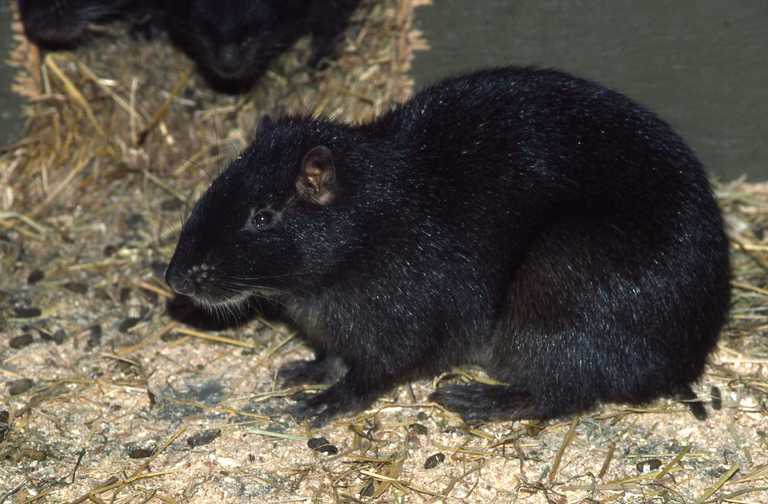
Sign in to saveGeocapromys is a genus of rodent belonging to the hutia subfamily and are currently only found on the Bahamas and Jamaica. However, they formerly ranged throughout the Caribbean, from Cuba to the Cayman Islands to even islands off mainland Central America.
Species
GENUS
- KingdomAnimalia
- PhylumChordata
- ClassMammalia
- OrderRodentia
- FamilyCapromyidae
地硬毛鼠属(学名:Geocapromys)是啮齿目硬毛鼠科中的一属,包含以下种:[1] 布氏硬毛鼠(Geocapromys brownii) †古巴兔子(Geocapromys columbianus) 巴哈马硬毛鼠(Geocapromys ingrahami) †胸甲硬毛鼠(Geocapromys thoracatus) 参考资料 ^ 中国生物多样性信息中心动物学分部[永久失效連結],2013年4月6日查阅。 取自“https://zh.wikipedia.org/w/index.php?title=地硬毛鼠屬&oldid=47305065” 分类:地硬毛鼠屬 隐藏分类: 自2017年12月带有失效链接的条目 条目有永久失效的外部链接 本地相关图片与维基数据相同
via GBIF
Museum specimens
- Specimen records
- 399
- Family
- Capromyidae
- Collections
- UF, USNM
- Recorded in
- British West Indies, Jamaica, Bahamas
Wikidata facts
- Instance of
- taxon
- Parent taxon
- Capromyinae
- Image
- Geocapromys brownii Harvard University small.jpg
Show 5 more facts
- taxon name
- Geocapromys
- Commons category
- Geocapromys
- taxon rank
- genus
- topic's main category
- Category:Geocapromys
- temporal range start
- Pleistocene
Sources (1)
via Wikidata · CC0
~2 min read
Encyclopedic overview
3 sectionsContents
- Systematics
- Phylogeny
- References
Geocapromys is a genus of rodent belonging to the hutia subfamily and are currently only found on the Bahamas and Jamaica. However, they formerly ranged throughout the Caribbean, from Cuba to the Cayman Islands to even islands off mainland Central America.
==Systematics== The genus Geocapromys comprises five recent species, three of which are extinct. G. brownii, the Jamaican hutia, which is also known as the Jamaican coney or Brown's hutia, is another extant species endemic to Jamaica. Geocapromys ingrahami, the Bahamian hutia or Ingraham's hutia, is an extant species of hutia native to the Bahamas. G. thoracatus, the Little Swan Island hutia, was a third species which was found only on Little Swan Island, off northeastern Honduras. It became extinct in 1955, wiped out by storms and introduced predators. Some scientists consider it a subspecies of G. brownii. G. columbianus, the Cuban coney, was endemic to Cuba, where it went extinct shortly after human colonization. G. caymanensis, the Cayman hutia, was endemic to the Cayman Islands, where it went extinct shortly after human colonization. In addition, there are two species, G. megas and G. pleistocenicus, which are known only from fossil remains.
Excerpted from Wikipedia’s “Geocapromys” article, available under the CC BY-SA 4.0 licence.