
File:Heat_pump_unit.webp · Wikimedia Commons · See Wikimedia Commons
heat pump
Sign in to savedevice that transfers thermal energy in the opposite direction of spontaneous heat transfer
A heat pump is a device that moves heat from one place to another, working against the natural tendency of heat to flow from hot to cold areas. This matters because it can efficiently heat or cool buildings by relocating existing thermal energy rather than generating new heat, making it a more energy-efficient alternative to traditional heating and cooling systems.
AI-generated from the Wikipedia summary — may contain errors.
Described at
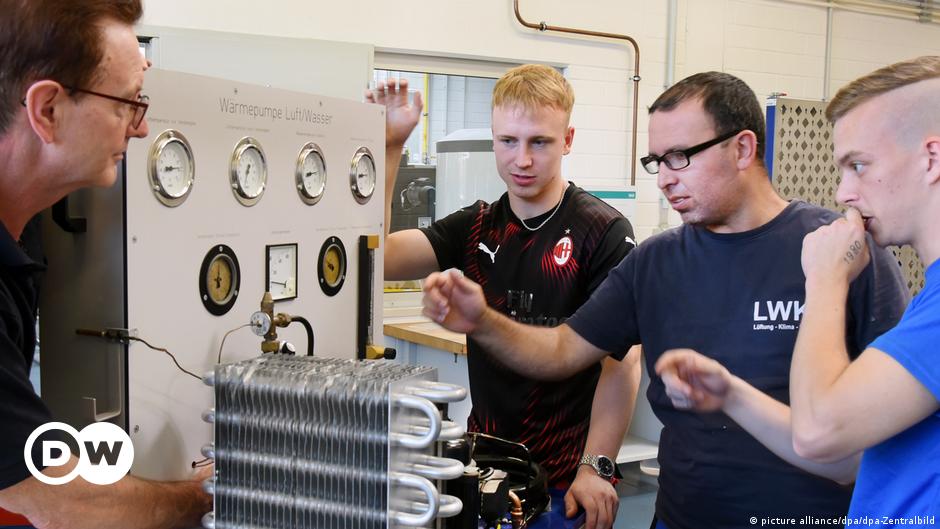
How do heat pumps work?
Heat pumps are being touted as a climate-friendly option to keep homes warm as people look for alternatives to oil and gas. DW explains the mysteries behind them.
dw.com →Around half of Germany's homes are heated by natural gas and a quarter with oil. As the country transitions away from fossil fuels in the face of the climate crisis, many are looking for alternatives. Heat pumps are one technology being widely discussed. But how do they work exactly? A heat pump extracts warmth from outside air, the ground or a nearby source of water to generate heat using something called evaporative cooling. You’ll know how satisfying it is putting a cold cloth on your skin in sweltering temperatures. It's the same effect. The cold water evaporates, becomes gaseous and you cool down. Here's the science behind it: The transition from water to vapor requires a lot of energy. To change state, the water molecules draw that energy from their surroundings, in this case warm skin. That process brings about the cooling effect. Conversely, much of this energy is released as heat back into the air once the evaporated water becomes liquid again. Heat pumps, fridges, and air conditioners all exploit these transitions. Refrigerators cool down on the inside and get warm on the outside. For heat pumps it’s the opposite. Heat from the ground or air, for example, warms the refrigerant, which then evaporates in the circuit. A compressor squeezes the molecules of the refrigerant gas together, further increasing its temperature. When it then liquifies again, it releases the extra heat into the heating system. That means heat pumps can be used to warm or cool a home, office, or any other indoor space. While there are different kinds of heat pumps, they all work on the same principle of extracting thermal energy from the environment. Water heat pumps can use groundwater or water from rivers or lakes. Air-source ones run on regular air pulled in from outside or hot exhaust air produced at industrial sites or data centers. For geothermal heat pumps, probes are drilled 100 meters (328 feet) or more into the ground, depending on the density of the rock. The deeper the borehole into the ground, the warmer it gets. Groundwater heat pumps are more efficient, but also more expensive. The air-source variety work almost anywhere but can be noisy. Even on cold winter days, there's enough thermal energy underground, in the air or groundwater to heat a building. In Scandinavia, for instance, many people heat with air-source heat pumps even during severe winters. These extract heat energy from the air at temperatures as low as minus 20 Celsius. Still, they require more energy to operate in the cold and work better in warmer weather. Heat pumps are also kitted out with heating rods that use electricity, as a backup. While most of the energy is taken from the environment, the devices do require additional power to run the electric motor for the compressor, pumps and fans. In good conditions, one kilowatt-hour of drive electricity can generate around six kilowatt-hours of heat. An 80-square meter insulated apartment needs less than 1,000 kilowatt hours of electricity per year. Heat pumps are more efficient in new insulated buildings, especially ones with underfloor heating and large radiators. In older homes in Germany, air-source heat pumps generate about three kilowatt-hours of heat from one kilowatt-hour of electricity, according to a study by the Freiburg-based Fraunhofer Institute for Solar Energy Systems. Using groundwater as the energy source generated, on average, four times as much heat in comparison. In principle, heat pumps can generate temperatures of more than 70 degrees Celsius. That means they can also heat uninsulated houses with old radiators. But the device's electricity consumption would then be significantly higher. Solar energy from your roof is cheaper than from the power grid and is also climate friendly. But solar modules generate much less electricity in colder conditions. So more would be needed to produce the same amount of electricity during the winter heating season. Or you would have to buy additional
Excerpt from a page describing this subject · 30,083 chars · not written by Vinony
Wikidata facts
- Subclass of
- heat engine
- Image
- Outunit of heat pump.jpg
Show 6 more facts
- described by source
- Armenian Soviet Encyclopedia
- Commons category
- Heat pumps
- topic's main category
- Category:Heat pumps
- uses
- thermodynamics
- on focus list of Wikimedia project
- WikiProject Climate change
Sources (3)
via Wikidata · CC0
~38 min read
Encyclopedic overview
External heat exchanger of an air-source heat pump for both heating and cooling Mitsubishi Electric heat pump interior air handler wall unit
A heat pump is a device that uses mechanical or thermal energy to transfer heat from one space to another. The mechanical heat pump uses electric power to transfer heat by compression. Specifically, it transfers thermal energy by means of a heat pump and refrigeration cycle, cooling one space and warming the other. Heat pumps driven by thermal energy are known as absorption heat pumps.
Excerpted from Wikipedia’s “heat pump” article, available under the CC BY-SA 4.0 licence.
Gallery (12)
Available in 60 languages
- Español
- Français
- Deutsch
- 中文
- 日本語
- Русский
- Português
- Italiano
- العربية
- हिन्दी
- Armenian
- Bahasa Indonesia
- Basque
- Bavarian
- Bosnian
- Bulgarian
- Catalan
- Central Kurdish
Show 41 more
- Croatian
- Czech
- Danish
- Esperanto
- Estonian
- Finnish
- Georgian
- Greek
- Haitian Creole
- Hebrew
- Hungarian
- Icelandic
- Kazakh
- Latin
- Latvian
- Lombard
- Macedonian
- Mongolian
- Nederlands
- Nepali
- Norwegian
- Norwegian Nynorsk
- Polski
- Romanian
- Serbian
- Serbian (Latin)
- simple
- Slovak
- Slovenian
- Svenska
- Tamil
- Tiếng Việt
- Türkçe
- Ukrainian
- Urdu
- Uzbek
- Yiddish
- zh_yue
- فارسی
- ไทย
- 한국어
via Wikidata sitelinks · CC0