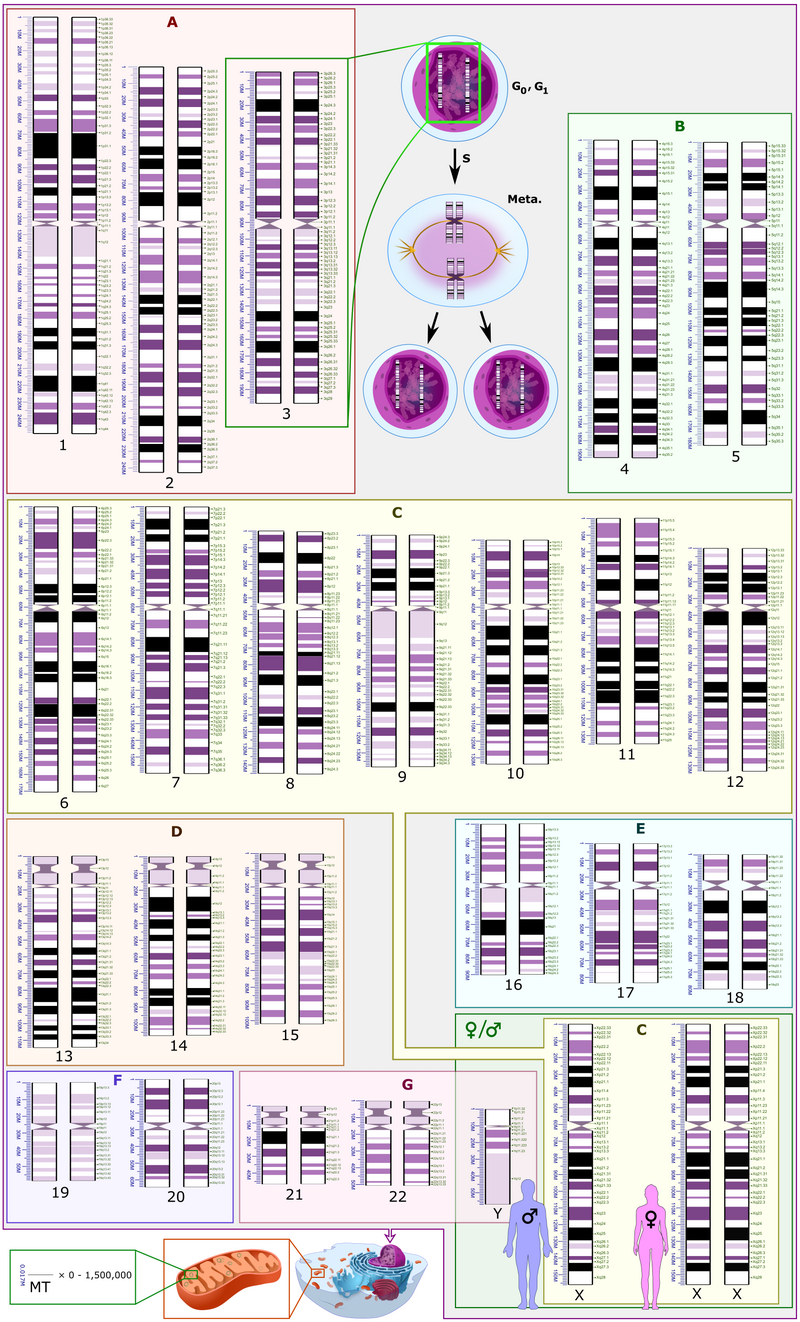
File:Human_karyotype_with_bands_and_sub-bands.png · Wikimedia Commons · See Wikimedia Commons
human genome
Sign in to saveAlso known as genome, human
complete set of nucleic acid sequence for humans
Your human genome is the complete set of DNA instructions that make up your body, written in a chemical language of four basic molecules. Understanding it matters because it helps scientists learn how genes work, why people develop certain diseases, and how to develop new treatments.
AI-generated from the Wikipedia summary — may contain errors.
Research
261,690 papers- Ethics of Human Genome Editing.ReviewAnnual review of medicine · 2019Coller BSDOI: 10.1146/annurev-med-112717-094629
- Human Genome Project: Twenty-five years of big biology.Nature · 2015Green ED, Watson JD, Collins FSDOI: 10.1038/526029a
- The human genome.Science (New York, N.Y.) · 2021Zahn LMDOI: 10.1126/science.abm1359
- The International Human Genome Project.ReviewHuman molecular genetics · 2021Birney EDOI: 10.1093/hmg/ddab198
- Finishing the euchromatic sequence of the human genome.Nature · 2004International Human Genome Sequencing ConsortiumDOI: 10.1038/nature03001
- Impact of the Microbiome on the Human Genome.ReviewTrends in parasitology · 2019Jeyakumar T, Beauchemin N, Gros PDOI: 10.1016/j.pt.2019.07.015
- The Human Genome Project: lessons from large-scale biology.Science (New York, N.Y.) · 2003Collins FS, Morgan M, Patrinos ADOI: 10.1126/science.1084564
- Human Genome Editing and a Global Socio-bioethics Approach.ReviewThe Hastings Center report · 2020Nie JBDOI: 10.1002/hast.1200
via PubMed
Wikidata facts
- Subclass of
- genome
- Has part
- human Y chromosome
- Image
- Human karyotype with bands and sub-bands.png
Show 6 more facts
- chromosome count
- 46
- ploidy
- diploidy
- Commons category
- Human genome
- found in taxon
- Homo sapiens
- genome size
- 3234830000
- topic has template
- Template:Chromosomes
Sources (2)
via Wikidata · CC0
~38 min read
Encyclopedic overview
The human genome is a complete set of DNA sequences for each of the 22 autosomes and the two distinct sex chromosomes (X and Y). A small DNA molecule is found within individual mitochondria. These are usually treated separately as the nuclear genome and the mitochondrial genome.
Human genomes include both genes and various other types of functional DNA elements. The latter is a diverse category that includes regulatory DNA scaffolding regions, telomeres, centromeres, and origins of replication. In addition, there are large numbers of transposable elements, inserted viral DNA, non-functional pseudogenes and simple, highly repetitive sequences. Introns make up a large percentage of the human genome.
Excerpted from Wikipedia’s “human genome” article, available under the CC BY-SA 4.0 licence.