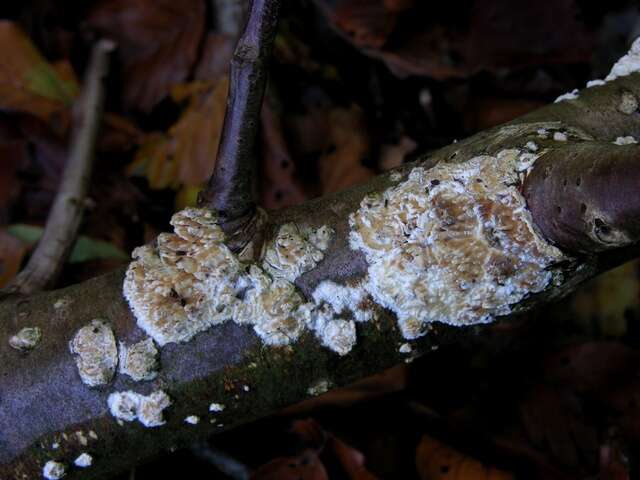
Encyclopedia of Life · EOL (see source)
Hymenochaetales
Sign in to saveThe Hymenochaetales are an order of fungi in the class Agaricomycetes. The order in its current sense is based on molecular research and not on any unifying morphological characteristics. According to one 2008 estimate, the Hymenochaetales contain around 600 species worldwide, mostly corticioid fungi and poroid fungi, but also including several clavarioid fungi and agarics. Species of economic importance include wood decay fungi in the genera Phellinus and Inonotus sensu lato, some of which may cause losses in forestry. Therapeutic properties are claimed for Inonotus obliquus ("chaga") and Phe
Species
ORDER
- KingdomFungi
- PhylumBasidiomycota
- ClassAgaricomycetes
- OrderHymenochaetales
锈革孔菌目(学名:Hymenochaetales),又称刺革菌目,是伞菌纲的一目。这一目是基于分子系统发生学而非形态学特征的。2008年的一项估计显示该目下共包括约600个物种[1],其中大多为皮壳菌和多孔菌,但也有一些为珊瑚菌与伞菌。 该目中,一些广义上属木层孔菌属与纤孔菌属的木腐菌有致病性,导致了森林的丧失。白桦茸[2]与桑黄(裂蹄木层孔菌,Phellinus linteus)[3]则宣称有药用价值。 参考资料 ^ Kirk PM, Cannon PF, Minter DW, Stalpers JA. Dictionary of the Fungi 10th. Wallingford: CABI. 2008: 116. ISBN 978-0-85199-826-8. ^ Mizuno T. Antitumor and hypoglycemic activities of polysaccharides from the sclerotia and mycelia of Inonotus obliquus. International Journal of Medicinal Mushrooms. 1999, 1 (1): 301–316. ^ Zhu T, Kim SH, Chen CY. A medicinal mushroom: Phellinus linteus. Current Medicinal Chemistry. 2008, 15 (13): 1330–5. PMID 18537612. doi:10.2174/092986708784534929.[永久失效連結] 这是一篇與真菌類相關的小作品。你可以通过编辑或修订扩充其内容。 查 论 编 取自“https://zh.wikipedia.org/w/index.php?title=锈革孔菌目&oldid=51988510” 分类:锈革孔菌目 隐藏分类: 自2018年11月带有失效链接的条目 条目有永久失效的外部链接 物种微格式条目 含有拉丁語的條目 全部小作品 真菌類小作品
via GBIF
Museum specimens
- Specimen records
- 8
- With media
- 1
- Family
- Hymenochaetales
- Collections
- UCSC, MEL, FLAS, ARIZ, UC
- Recorded in
- United States, Australia, Chile, French Polynesia, Canada
Wikidata facts
- Instance of
- taxon
- Parent taxon
- Agaricomycetes
- Image
- Inonotus tamaricis 01.JPG
Show 4 more facts
- Commons category
- Hymenochaetales
- taxon rank
- order
- taxon name
- Hymenochaetales
- topic's main category
- Category:Hymenochaetales
Sources (2)
via Wikidata · CC0
~4 min read
Encyclopedic overview
8 sectionsContents
- Taxonomy
- History
- Current status
- Habitat and distribution
- Economic importance
- Genera ''incertae sedis''
- References
- External links
The Hymenochaetales are an order of fungi in the class Agaricomycetes. The order in its current sense is based on molecular research and not on any unifying morphological characteristics. According to one 2008 estimate, the Hymenochaetales contain around 600 species worldwide, mostly corticioid fungi and poroid fungi, but also including several clavarioid fungi and agarics. Species of economic importance include wood decay fungi in the genera Phellinus and Inonotus sensu lato, some of which may cause losses in forestry. Therapeutic properties are claimed for Inonotus obliquus ("chaga") and Phellinus linteus, both of which are now commercially marketed.
==Taxonomy== ===History=== The order was proposed in 1977 to recognize the family Hymenochaetaceae at a higher taxonomic rank. As originally conceived, species within the Hymenochaetales had several morphological features in common, notably brown or brownish basidiocarps (fruit bodies) that turn black in alkali, hyphae lacking clamp connections, and the presence (in most species) of characteristic setae (thick-walled, thorn-shaped cystidia, visible under a hand lens).
Excerpted from Wikipedia’s “Hymenochaetales” article, available under the CC BY-SA 4.0 licence.