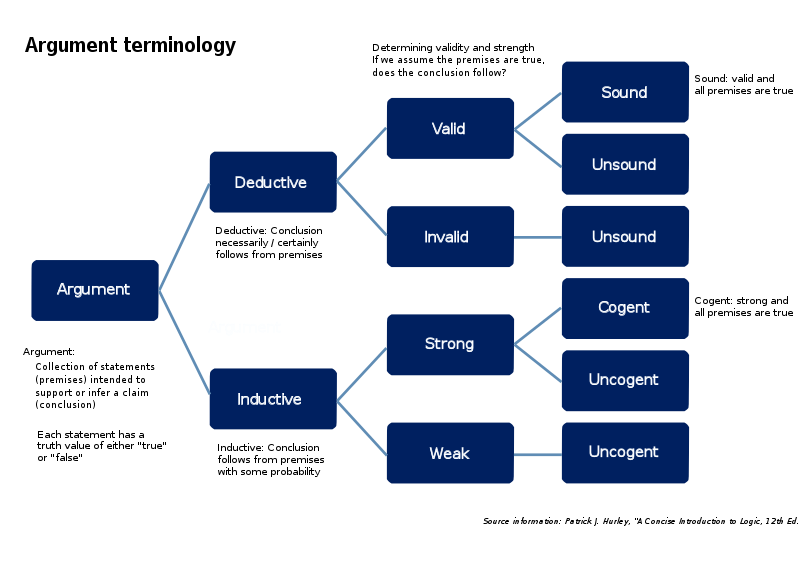
File:Argument_terminology_used_in_logic_(en).svg · Wikimedia Commons · See Wikimedia Commons
Also known as induction, inductive logic, inductive analysis, solving a problem starting with what you know already
個別的・特殊的な事例から一般的・普遍的な規則・法則を見出そうとする論理的推論の方法
Inductive reasoning is a method where you observe many specific examples and use those observations to develop a general rule or principle that explains them. It matters because it's how we often learn patterns from experience and form working theories about how the world works, though conclusions reached this way aren't guaranteed to be true.
AI-generated from the Wikipedia summary — may contain errors.
Wikidata facts
Show 5 more facts
- topic's main category
- Category:Inductive reasoning
- Commons category
- Inductive reasoning
- opposite of
- deductive reasoning
- different from
- magnetic flux density
- has characteristic
- generalization
via Wikidata · CC0
Article · 日本語
帰納(きのう、英: Induction、希: επαγωγή(エパゴーゲー))とは、個別的・特殊的な事例から一般的・普遍的な規則・法則を見出そうとする論理的推論の方法のこと。演繹においては前提が真であれば結論も必然的に真であるが、帰納においては前提が真であるからといって結論が真であることは保証されない。 なお数学的帰納法・構造的帰納法・整礎帰納法・完全帰納法・・超限帰納法などの帰納法は、名前と違い帰納ではなく演繹である。
Abstract from DBpedia / Wikipedia · CC BY-SA
Available in 66 languages
- Español
- Français
- Deutsch
- 中文
- 日本語
- Русский
- Português
- Italiano
- العربية
- हिन्दी
- Albanian
- Armenian
- Azerbaijani
- Bahasa Indonesia
- Basque
- Bosnian
- Bulgarian
- Catalan
Show 47 more
- Central Kurdish
- Croatian
- Czech
- Danish
- Esperanto
- Estonian
- Finnish
- Galician
- Ganda
- Greek
- Hebrew
- Hungarian
- Icelandic
- Kazakh
- Kikuyu
- Latvian
- Lithuanian
- Macedonian
- Mazanderani
- Mongolian
- Nederlands
- Norwegian
- Pashto
- Polski
- Romanian
- Scots
- Serbian
- Serbian (Latin)
- simple
- Slovak
- Slovenian
- Svenska
- Tajik
- Tamil
- Tatar
- Tiếng Việt
- Türkçe
- Turkmen
- Ukrainian
- Urdu
- Uzbek
- Western Panjabi
- Wu Chinese
- zh_yue
- فارسی
- ไทย
- 한국어
via Wikidata sitelinks · CC0