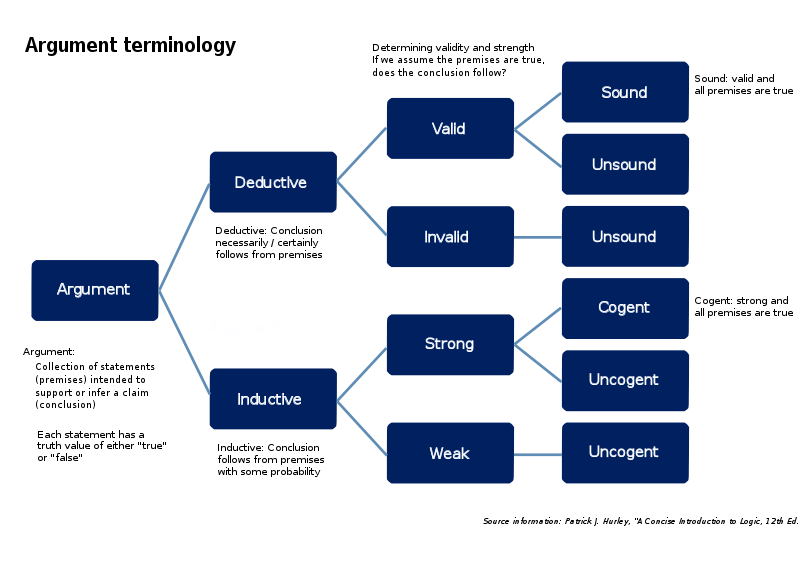
File:Argument_terminology_used_in_logic_(en).svg · Wikimedia Commons · See Wikimedia Commons
归纳推理
Sign in to saveAlso known as induction, inductive logic, inductive analysis, solving a problem starting with what you know already
method of reasoning in which a body of observations is synthesized to hypothesize a general principle
Inductive reasoning is a method where you observe many specific examples and use those observations to develop a general rule or principle that explains them. It matters because it's how we often learn patterns from experience and form working theories about how the world works, though conclusions reached this way aren't guaranteed to be true.
AI-generated from the Wikipedia summary — may contain errors.
Wikidata facts
Show 5 more facts
- topic's main category
- Category:Inductive reasoning
- Commons category
- Inductive reasoning
- opposite of
- deductive reasoning
- different from
- magnetic flux density
- has characteristic
- generalization
via Wikidata · CC0
Article · 中文
归纳法或归纳推理(Inductive reasoning),有时叫做归纳逻辑,是论证的前提支持结论但不确保结论的推理过程。它基于对特殊的代表(token)的有限观察,把性质或关系归结到类型;或基于对反复再现的现象的模式(pattern)的有限观察,公式表达规律。例如,使用归纳法在如下特殊的命题中: * 冰是冷的。 * 弹子球在击打球杆的时候移动。 推断出普遍的命题如: * 所有冰都是冷的。 * 所有弹子球都在击打球杆的时候移动。
Abstract from DBpedia / Wikipedia · CC BY-SA
Available in 66 languages
- Español
- Français
- Deutsch
- 中文
- 日本語
- Русский
- Português
- Italiano
- العربية
- हिन्दी
- Albanian
- Armenian
- Azerbaijani
- Bahasa Indonesia
- Basque
- Bosnian
- Bulgarian
- Catalan
Show 47 more
- Central Kurdish
- Croatian
- Czech
- Danish
- Esperanto
- Estonian
- Finnish
- Galician
- Ganda
- Greek
- Hebrew
- Hungarian
- Icelandic
- Kazakh
- Kikuyu
- Latvian
- Lithuanian
- Macedonian
- Mazanderani
- Mongolian
- Nederlands
- Norwegian
- Pashto
- Polski
- Romanian
- Scots
- Serbian
- Serbian (Latin)
- simple
- Slovak
- Slovenian
- Svenska
- Tajik
- Tamil
- Tatar
- Tiếng Việt
- Türkçe
- Turkmen
- Ukrainian
- Urdu
- Uzbek
- Western Panjabi
- Wu Chinese
- zh_yue
- فارسی
- ไทย
- 한국어
via Wikidata sitelinks · CC0