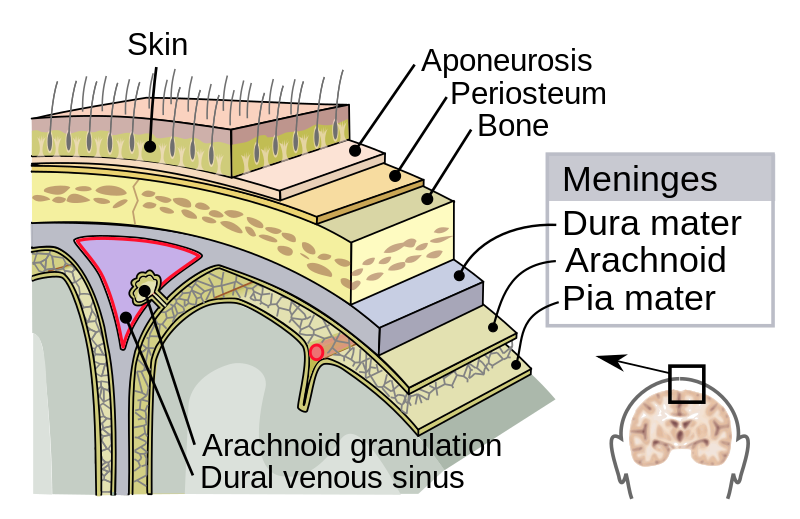
File:Meninges-en.svg · Wikimedia Commons · See Wikimedia Commons
meningitis
Sign in to saveAlso known as meninx inflammation, meninxitis, spinal meningitis
Meningitis () is acute or chronic inflammation of the protective membranes covering the brain and spinal cord, collectively called the meninges. The most common symptoms are fever, intense headache, vomiting, neck stiffness, and occasionally photophobia. Other symptoms include confusion or altered consciousness, nausea, and an inability to tolerate loud noises. Young children often exhibit only nonspecific symptoms, such as irritability, drowsiness, or poor feeding. A non-blanching rash (a rash that does not fade when a glass is rolled over it) may also be present.
OverviewAI-generated
Meningitis is a medical condition classified under the NCI Thesaurus ID C26828 and the ICPC 2 ID N71. It is categorized in the ICD-9-CM system with codes 322 and 322.9. The subject is associated with the Commons category "Meningitis" and has exact matches in external ontologies, including DOID:9471 and HP:0001287.
The condition is the subject of 147,552 PubMed articles based on the query meningitis. It is referenced by 2,131 other encyclopedia articles. The number of deaths attributed to meningitis is 379,000.
Synthesized by Vinony from 10 facts across 3 sources: Wikidata, PubMed, Vinony graph. Generated from structured data (not the Wikipedia text) and checked against those facts — may still contain errors.
Key facts
- Medical condition.name
- Meningitis
- Medical condition.image
- Meninges-en.svg
- Medical condition.caption
- Meninges of the central nervous system: dura mater, arachnoid mater, and pia mater
- Medical condition.field
- Infectious disease, neurology
- Medical condition.symptoms
- Fever, headache, neck stiffness
- Medical condition.complications
- Deafness, epilepsy, hydrocephalus, cognitive deficits
- Medical condition.causes
- Bacterial, viral, fungal, parasitic, non-infectious, and other
- Medical condition.diagnosis
- Lumbar puncture
- Medical condition.differential
- Encephalitis, sepsis, brain tumor, lupus, Lyme disease, seizures, neuroleptic malignant syndrome, naegleriasis
- Medical condition.prevention
- Vaccination
- Medical condition.medication
- Antibiotics, antivirals, steroids
- Medical condition.frequency
- 7.7 million (2019)
- Medical condition.deaths
- 236,000 (2019)
via Wikipedia infobox
Research
147,552 papersvia PubMed
Wikidata facts
- Instance of
- symptom or sign
- Image
- Meninges-en.svg
- Number of deaths
- 379000
Show 18 more facts
- possible treatment
- pharmacotherapy
- afflicts
- human
- disease transmission process
- droplet infection
- Commons category
- Meningitis
- symptoms and signs
- vomiting
- topic's main category
- Category:Meningitis
- NCI Thesaurus ID
- C26828
- health specialty
- infectious diseases
- ICPC 2 ID
- N71
- drug or therapy used for treatment
- DL-ofloxacin
- on focus list of Wikimedia project
- Wikipedia:Vital articles/Level/4
- exact match
- purl.obolibrary.org/obo/HP_0001287
- ICD-9-CM
- 322.9
- maintained by WikiProject
- WikiProject Medicine
- anatomical location
- meninges
- medical examination
- viral culture
- described by source
- Encyclopædia Britannica 11th edition
Sources (9)
via Wikidata · CC0
~44 min read
Encyclopedic overview
31 sectionsContents
- Signs and symptoms
- Clinical features
- Early complications
- Causes
- Bacterial
- Viral
- Fungal
- Parasitic
- Non-infectious
- Mechanism
- Diagnosis
- Lumbar puncture
- Postmortem
- Prevention
- Bacterial
- Vaccination
- Antibiotics
- Management
- Bacterial meningitis
- Antibiotics
- Fluid therapy
- Steroids
- Adjuvant therapies
- Viral meningitis
- Fungal meningitis
- Prognosis
- Epidemiology
- History
- See also
- References
- External links
Meningitis () is acute or chronic inflammation of the protective membranes covering the brain and spinal cord, collectively called the meninges. The most common symptoms are fever, intense headache, vomiting, neck stiffness, and occasionally photophobia. Other symptoms include confusion or altered consciousness, nausea, and an inability to tolerate loud noises. Young children often exhibit only nonspecific symptoms, such as irritability, drowsiness, or poor feeding. A non-blanching rash (a rash that does not fade when a glass is rolled over it) may also be present.
The inflammation may be caused by infection with viruses, bacteria, fungi or parasites. Non-infectious causes include malignancy (cancer), subarachnoid hemorrhage, chronic inflammatory disease (sarcoidosis) and certain drugs. Meningitis can be life-threatening because of the inflammation's proximity to the brain and spinal cord; therefore, the condition is classified as a medical emergency. A lumbar puncture, in which a needle is inserted into the spinal canal to collect a sample of cerebrospinal fluid (CSF), can diagnose or exclude meningitis.
Excerpted from Wikipedia’s “meningitis” article, available under the CC BY-SA 4.0 licence.
Gallery (21)
Available in 105 languages
- Español
- Français
- Deutsch
- 中文
- 日本語
- Русский
- Português
- Italiano
- العربية
- हिन्दी
- Afrikaans
- Albanian
- Albanian
- Amharic
- Aragonese
- Armenian
- Asturian
- azb
Show 86 more
- Azerbaijani
- Bahasa Indonesia
- Balinese
- Bangla
- Basque
- bat_smg
- be_x_old
- Belarusian
- Bosnian
- Bulgarian
- Burmese
- Catalan
- Central Kurdish
- Croatian
- Czech
- Danish
- Dinka
- Divehi
- Egyptian Arabic
- Esperanto
- Estonian
- Filipino
- Finnish
- Friulian
- Fula
- Galician
- gcr
- gpe
- Greek
- Hausa
- Hebrew
- Hungarian
- Icelandic
- Ido
- Igbo
- Irish
- Javanese
- Kashmiri
- Kazakh
- Kurdish
- Kyrgyz
- Latin
- Latvian
- Lithuanian
- Macedonian
- Malay
- Malayalam
- Marathi
- Minangkabau
- Mingrelian
- Nederlands
- Newari
- Norwegian
- Norwegian Nynorsk
- Nyanja
- Odia
- Polski
- Punjabi
- Quechua
- Romanian
- Serbian
- Serbian (Latin)
- Shona
- simple
- Slovenian
- Somali
- Sundanese
- Svenska
- Swahili
- Swati
- Tamil
- Telugu
- Tiếng Việt
- Tswana
- Türkçe
- Ukrainian
- Urdu
- Uzbek
- Waray
- Welsh
- Wolof
- Wu Chinese
- zh_yue
- فارسی
- ไทย
- 한국어
via Wikidata sitelinks · CC0