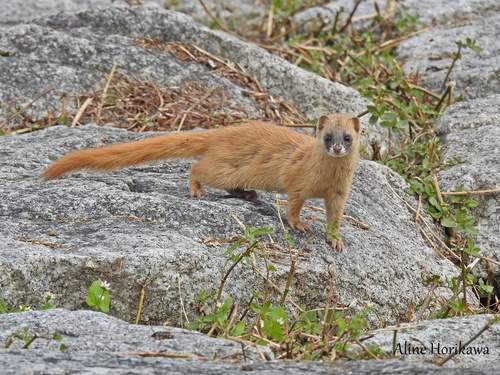
(c) Aline Patricia Horikawa, all rights reserved, uploaded by Aline Patricia Horikawa
Species
Near ThreatenedJapanese Weasel
SPECIES
- KingdomAnimalia
- PhylumChordata
- ClassMammalia
- OrderCarnivora
- FamilyMustelidae
ニホンイタチ ニホンイタチ (Mustela itatsi) (2009年4月) 保全状況評価[1] NEAR THREATENED (IUCN Red List Ver.3.1 (2001)) 分類 界 : 動物界 Animalia 門 : 脊索動物門 Chordata 亜門 : 脊椎動物亜門 Vertebrata 綱 : 哺乳綱 Mammalia 目 : ネコ目(食肉目) Carnivora 科 : イタチ科 Mustelidae 亜科 : イタチ亜科 Mustelinae 属 : イタチ属 Mustela 種 : ニホンイタチ M. itatsi 学名 Mustela itatsi (Temminck, 1844)[2][3] 和名 ニホンイタチ 英名 Japanese Weasel[2] 自然分布域 移入域 ニホンイタチ(日本鼬、Japanese Weasel、学名:Mustela itatsi)は、ネコ目イタチ科イタチ亜科イタチ属に分類される日本固有種のイタチである(→写真1、写真2)。Christopher Wozencraft (1993) は本種をチョウセンイタチの亜種としている[2]。近年ではDNAレベルでの比較が可能になり、別種と判明した。 目次 1 分布 2 形態 3 生態 3.1 繁殖と子イタチの独立 4 北海道への移入 5 チョウセンイタチの侵入 6 種の保全状況評価 7 脚注 8 参考文献 9 関連文献 10 外部リンク 分布[編集] 「#北海道への移入」も参照 自然分布地域は本州、四国、九州など。またネズミ駆除を目的として伊豆諸島などの島嶼部には人為的に移入された。北海道の場合は、北海道本島では偶然の移入、本島周辺島嶼部では人為的な移入である。 形態[編集] 成獣の大きさはオスとメスで異なり、オスはメスより大きい。体長は、オスが27-37 cm、メスが16-25 cm。尾長は、オスが12-16 cm、メスが7-9 cm[2]。体重は、オスが290-650 g、メスが115-175 g[4]。 毛色は個体により様々だが、躯体は茶褐色から黄褐色である。鼻筋周辺は暗褐色。尾の色は躯体とほぼ同色[2]。 歯数は、切歯が上6本下6本、犬歯が上2本下2本、前臼歯が上6本下6本、後臼歯が上2本下4本、合計34本。乳頭数は、胸部は無し、腹部2対、鼠径部2対、合計8個。指趾数(指の数)は、前肢が5本、後肢が5本、合計20本[5]。 新生子の大きさは、体重が約8-12 g[6]。 生態[編集] 本種は冬眠はしないで1年中活動し、その活動時間帯は特に定まっておらず、昼夜活動する。繁殖期以外は基本的に単独で行動する。本種の手足の指の間には蹼(みずかき)があり、泳ぎが得意である。厳冬期にも水に入り、潜ることもある。主な活動地域は川や湖沼、湿地、沢などの水
via GBIF · IUCN
Museum specimens
- Specimen records
- 44
- With media
- 8
- Family
- Mustelidae
- Collections
- MSB, USNM
- Recorded in
- Japan
Wikidata facts
Show 5 more facts
- taxon rank
- species
- IUCN conservation status
- Near Threatened
- Commons category
- Mustela itatsi
- taxon name
- Mustela itatsi
- taxon common name
- ニホンイタチ
Sources (1)
via Wikidata · CC0
~15 min read
Encyclopedic overview
The Japanese weasel (Mustela itatsi) is a carnivorous mammal belonging to the genus Mustela in the family Mustelidae. The most closely related Mustela species is the Siberian weasel (Mustela sibirica). Its taxonomic species name, itatsi, is based on the Japanese word for weasel, itachi (イタチ). It is native to Japan where it occurs on the islands of Honshū, Kyūshū and Shikoku. It has been introduced to Hokkaidō and the Ryukyu Islands to control rodents and has also been introduced to Sakhalin Island in Russia.
It has an orange-brown coloured fur coat with darker markings on the head and varies in size depending on its gender. They have a long slender body, a long tail, relatively short legs and sharp claws. It is often confused with the Siberian weasel which has a different ratio of tail to head and body length. Unlike other species of weasels, their coat does not change colour in winter. Average lifespan of a Japanese weasel is highly dependent on the availability of food and to a lesser extent other factors that affect its life. In the wild it can live for 2 to 3 years with the highest in the range living to about 5 years. The Japanese weasel has a tail ratio of 36–50% while the Siberian weasel has a ratio greater than 50%. The population of the Japanese weasel has seen a decline of 25% over the last 3 generations which has been used to justify its status as near threatened on the IUCN Red List. The government of Japan has prevented the hunting of female Japanese weasels as a measure to conserve the species.
Excerpted from Wikipedia’s “Mustela itatsi” article, available under the CC BY-SA 4.0 licence.