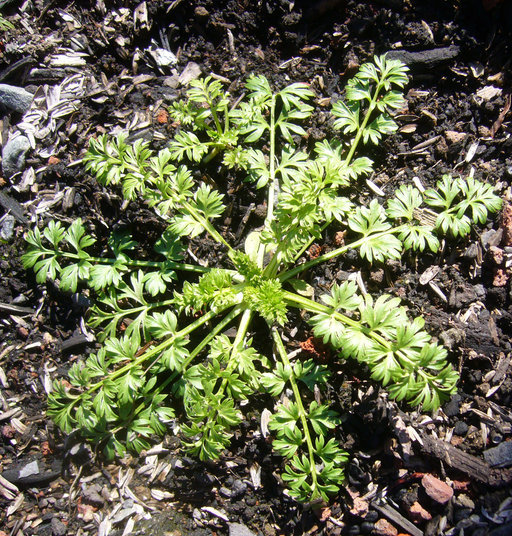
Encyclopedia of Life · EOL (see source)
Nigella damascena
Sign in to saveAlso known as love-in-a-mist, Devil-in-a-bush, Bishop wort, Bishop's wort
species of plant
OverviewAI-generated
*Nigella damascena* is a species of plant in the family Ranunculaceae, belonging to the genus *Nigella*. It is classified within the kingdom Plantae, phylum Tracheophyta, class Magnoliopsida, and order Ranunculales. The species is described by the author citation L. and produces fruit of the follicle type. Common names for this plant include love in a mist, devil in the bush, Damaszener Schwarzkümmel, and Jungfer im Grünen.
The native range of *Nigella damascena* includes Albania, Algeria, Baleares, Bulgaria, the Canary Islands, Corse, Cyprus, the East Aegean Islands, France, Greece, Iran, and Italy. Its taxon range is also listed as China. Occurrence records are held by institutions such as CMN, CHAS, CHSC, CAS, and LOB, with collections documented in Canada, the United States, France, Malta, and Mexico.
Synthesized by Vinony from 34 facts across 7 sources: Wikidata, GBIF, PubMed, Gbif Occ, Plants of the World, iDigBio, Vinony graph. Generated from structured data (not the Wikipedia text) and checked against those facts — may still contain errors.
Species
SPECIES
- KingdomPlantae
- PhylumTracheophyta
- ClassMagnoliopsida
- OrderRanunculales
- FamilyRanunculaceae
Nigella damascena La Nigelle de Damas (Nigella damascena L. 1753), communément appelée « cheveux-de-Vénus », « barbe-de-Capucin »[1], « diable-dans-le-buisson » ou « Belle-aux-cheveux-dénoués », est une espèce de plantes annuelles de la famille des Ranunculaceae, de taille moyenne, à feuilles aux segments très fins et aux fleurs d'un bleu très clair, rarement blanchâtres. Elle se développe dans les champs, les terrains vagues et rocailleux, les bords de route. Les graines de la nigelle de Damas — contrairement à celles de la nigelle cultivée — seraient toxiques. Forme structurelle de la damascénine. On tire de la plante une huile essentielle, riche en alcaloïdes, notamment en damascénine (en). Sommaire 1 Fécondation 2 Horticulture 3 Espèces proches 4 Références 5 Liens externes Fécondation La fleur porte cinq longs pistils groupés au centre, entourés de nombreuses étamines environ moitié moins longs que les pistils. Les pistils ne sont fécondés qu'à la fin de la fleur, lorsque les pétales fanent et tombent : les cinq pistils se plient alors en même temps, ce qui les rapproche des étamines et donc du pollen que ces dernières portent[2]. Horticulture Nigelle de Damas en jardin. L'esp
via GBIF · Kew POWO
Museum specimens
- Specimen records
- 1,783
- With media
- 1,421
- Family
- Ranunculaceae
- Collections
- CMN, CHAS, CHSC, CAS, LOB, DBG
- Recorded in
- Canada, United States, France, Malta, Mexico, Italy
Research
60 papers- The ethnobotany, phytochemistry, and biological properties of Nigella damascena - A review.Phytochemistry · 2022
- Agrobacterium tumefaciens-Mediated Genetic Transformation of Nigella damascena.Methods in molecular biology (Clifton, N.J.) · 2025
- Nigella damascena L. Essential Oil-A Valuable Source of β-Elemene for Antimicrobial Testing.Molecules (Basel, Switzerland) · 2018
- Biological Properties, Phenolic Profile, and Botanical Aspect of Nigella sativa L. and Nigella damascena L. Seeds: A Comparative Study.Molecules (Basel, Switzerland) · 2023
- A MITE insertion abolishes the AP3-3 self-maintenance regulatory loop in apetalous flowers of Nigella damascena.Journal of experimental botany · 2023
via PubMed
Wikidata facts
Show 11 more facts
- taxon rank
- species
- taxon name
- Nigella damascena
- Commons category
- Nigella damascena
- taxon common name
- vzhodna črnika
- Commons gallery
- Nigella damascena
- has fruit type
- follicle
- described by source
- Brockhaus and Efron Encyclopedic Dictionary
- taxon range
- China
- short name
- N. damascena
- taxon author citation
- L.
via Wikidata · CC0
~3 min read
Encyclopedic overview
Nigella damascena, love-in-a-mist, or devil in the bush, is an annual garden flowering plant, belonging to the buttercup family Ranunculaceae. It is native to southern Europe (but adventive in more northern countries of Europe), north Africa and southwest Asia, where it is found on neglected, damp patches of land.
The specific epithet damascena relates to Damascus in Syria. The plant's common name "love-in-a-mist" comes from the flower being nestled in a ring of multifid, lacy bracts.
Excerpted from Wikipedia’s “Nigella damascena” article, available under the CC BY-SA 4.0 licence.