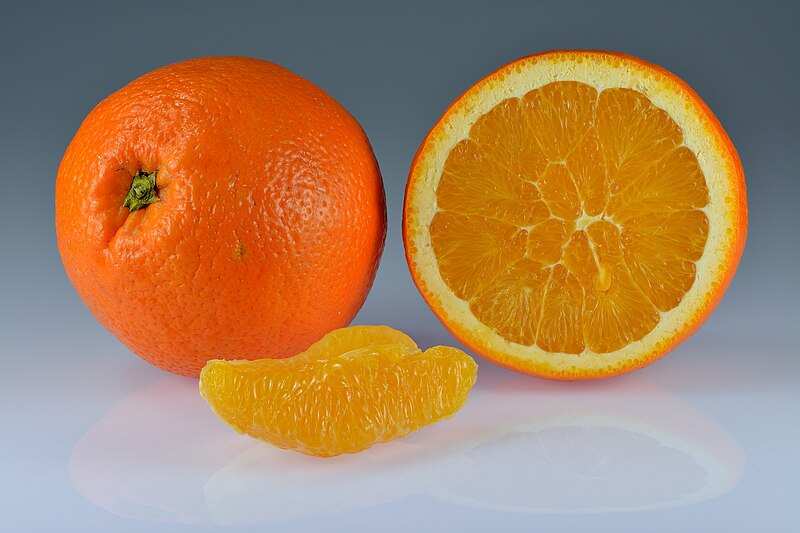
File:Oranges_-_whole-halved-segment.jpg · Wikimedia Commons · See Wikimedia Commons
OverviewAI-generated
The orange is a fruit represented by the Unicode character 🍊 and categorized under "Oranges" on Commons. It is associated with the hashtag "orange_(fruit)" and has exact matches in WordNet.
Nutritional data indicates that oranges contain 49 kcal of energy, 13.6 grams of carbohydrates, 8.7 grams of sugars, 1.9 grams of fiber, and 0.02 grams of salt. They hold a Nutri-Score of b and a NOVA classification of 1.
The fruit has a water footprint of 560 and a carbon footprint of 0.7. Five products are listed in the oranges category on Openfoodfacts. Additionally, the subject is referenced by 1,910 other encyclopedia articles.
Synthesized by Vinony from 16 facts across 3 sources: Wikidata, Openfoodfacts, Vinony graph. Generated from structured data (not the Wikipedia text) and checked against those facts — may still contain errors.
Nutrition · Open Food Facts
Typical values per 100 g · averaged across 5 products
- Energy
- 49 kcal
- Carbohydrates
- 13.6 g
- — of which sugars
- 8.7 g
- Fibre
- 1.9 g
- Salt
- 0.02 g
via Open Food Facts · ODbL
Wikidata facts
- Instance of
- common name
- Subclass of
- tropical fruit
- Has part
- seed
- Named after
- Malta
- Image
- Local Orange Variety of Kozan - Kozan Yerli Portakal 04.jpg
Show 11 more facts
- hashtag
- orange_(fruit)
- Commons category
- Oranges
- topic's main category
- Category:Oranges (fruit)
- exact match
- wordnet-rdf.princeton.edu/wn31/107678230-n
- Unicode character
- 🍊
- color
- orange
- natural product of taxon
- Citrus sinensis
- water footprint
- 560
- carbon footprint
- 0.7
- different from
- Citrus sinensis
- on focus list of Wikimedia project
- Wikipedia:Vital articles/Level/4
Sources (9)
via Wikidata · CC0
~27 min read
Encyclopedic overview
Orange—whole, halved, and peeled segment The orange, also called sweet orange to distinguish it from the bitter orange (Citrus × aurantium), is the fruit of a tree in the family Rutaceae. Botanically, this is the hybrid Citrus × sinensis, between the pomelo (Citrus maxima) and the mandarin orange (Citrus reticulata). The chloroplast genome, and therefore the maternal line, is that of pomelo. Hybrids of the sweet orange form later types of mandarin and the grapefruit. The sweet orange has had its full genome sequenced.
The orange originated in a region encompassing Southern China, Northeast India, and Myanmar; the earliest mention of the sweet orange was in Chinese literature in 314 BC. Orange trees are widely grown in tropical and subtropical areas for their sweet fruit. The fruit of the orange tree can be eaten fresh or processed for its juice or fragrant peel. In 2024, 67 million tonnes of oranges were grown worldwide, with Brazil producing 23% of the total, followed by China and Mexico.
Excerpted from Wikipedia’s “orange” article, available under the CC BY-SA 4.0 licence.
Gallery (12)
Available in 149 languages
- Español
- Français
- Deutsch
- 中文
- Русский
- Português
- Italiano
- العربية
- हिन्दी
- abstract
- Albanian
- Albanian
- Amharic
- Aragonese
- Armenian
- Assamese
- Asturian
- azb
Show 130 more
- Azerbaijani
- Bahasa Indonesia
- Bangla
- Basque
- Batak Toba
- Belarusian
- Bhojpuri
- Bosnian
- Breton
- Catalan
- Central Kurdish
- Cherokee
- Chuvash
- Croatian
- Czech
- Divehi
- Egyptian Arabic
- eml
- Erzya
- Esperanto
- Estonian
- Faroese
- Fijian
- Finnish
- fiu_vro
- Fon
- Galician
- Ganda
- gcr
- Gilaki
- Greek
- Gujarati
- Haitian Creole
- Hebrew
- hyw
- Icelandic
- Ido
- Javanese
- Kara-Kalpak
- Kashmiri
- Kashubian
- Kazakh
- kge
- Khmer
- Kongo
- Kurdish
- Kyrgyz
- Ladino
- Lao
- Latin
- Latvian
- Limburgish
- Lingala
- Lithuanian
- Lojban
- Luxembourgish
- Macedonian
- Maithili
- Malagasy
- Malay
- Malayalam
- Manipuri
- Manx
- map_bms
- Marathi
- Mazanderani
- Mirandese
- Mongolian
- Navajo
- nds_nl
- Neapolitan
- Nederlands
- Nepali
- Nias
- Northern Frisian
- Northern Sami
- Northern Sotho
- Norwegian
- Occitan
- Old English
- Oromo
- Ossetic
- Pampanga
- Pashto
- Polski
- Punjabi
- Romanian
- Rundi
- Samoan
- Sanskrit
- Santali
- Scots
- Serbian
- Serbian (Latin)
- Shona
- Sicilian
- Silesian
- simple
- Sindhi
- Slovak
- Slovenian
- Somali
- Svenska
- Swahili
- Tahitian
- Tamil
- tdd
- Telugu
- Tibetan
- Tiếng Việt
- Tumbuka
- Türkçe
- Tyap
- Ukrainian
- Urdu
- Uyghur
- Uzbek
- Walloon
- Waray
- Western Mari
- Wolof
- Wu Chinese
- Yiddish
- zh_classical
- zh_yue
- Zhuang
- Zulu
- فارسی
- ไทย
- 한국어
via Wikidata sitelinks · CC0