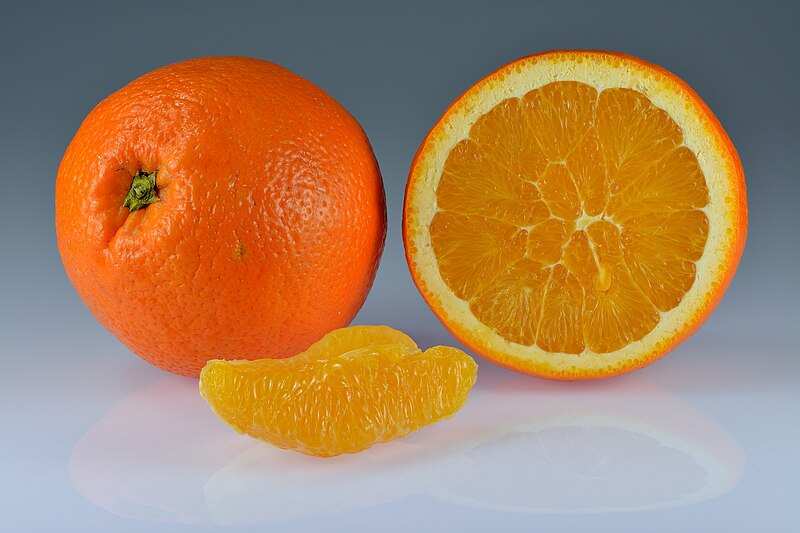
File:Oranges_-_whole-halved-segment.jpg · Wikimedia Commons · See Wikimedia Commons
OverviewAI-generated
The orange is a fruit represented by the Unicode character 🍊 and categorized under "Oranges" on Commons. It is associated with the hashtag "orange_(fruit)" and has exact matches in WordNet.
Nutritional data indicates that oranges contain 49 kcal of energy, 13.6 grams of carbohydrates, 8.7 grams of sugars, 1.9 grams of fiber, and 0.02 grams of salt. They hold a Nutri-Score of b and a NOVA classification of 1.
The fruit has a water footprint of 560 and a carbon footprint of 0.7. Five products are listed in the oranges category on Openfoodfacts. Additionally, the subject is referenced by 1,910 other encyclopedia articles.
Synthesized by Vinony from 16 facts across 3 sources: Wikidata, Openfoodfacts, Vinony graph. Generated from structured data (not the Wikipedia text) and checked against those facts — may still contain errors.
Nutrition · Open Food Facts
Typical values per 100 g · averaged across 5 products
- Energy
- 49 kcal
- Carbohydrates
- 13.6 g
- — of which sugars
- 8.7 g
- Fibre
- 1.9 g
- Salt
- 0.02 g
via Open Food Facts · ODbL
Wikidata facts
- Instance of
- common name
- Subclass of
- tropical fruit
- Has part
- seed
- Named after
- Malta
- Image
- Local Orange Variety of Kozan - Kozan Yerli Portakal 04.jpg
Show 11 more facts
- hashtag
- orange_(fruit)
- Commons category
- Oranges
- topic's main category
- Category:Oranges (fruit)
- exact match
- wordnet-rdf.princeton.edu/wn31/107678230-n
- Unicode character
- 🍊
- color
- orange
- natural product of taxon
- Citrus sinensis
- water footprint
- 560
- carbon footprint
- 0.7
- different from
- Citrus sinensis
- on focus list of Wikimedia project
- Wikipedia:Vital articles/Level/4
Sources (9)
via Wikidata · CC0
Article · Português
A laranja é um fruto de várias espécies cítricas da família Rutaceae (ver ); refere-se principalmente a , que também é chamado de laranja-doce, para distingui-lo do relacionado Citrus × aurantium, referido como laranja-azeda. A laranja-doce reproduz-se assexuadamente (apomixia por embrionário nucelar); variedades de laranja-doce surgem através de mutações. A laranja é um híbrido entre pomelo (Citrus maxima) e tangerina (Citrus reticulata). O e, portanto, a linha materna, é o do pomelo. A laranja doce teve seu . A laranja originou-se em uma região que abrange a China meridional, o nordeste da Índia e Myanmar, e a primeira menção da laranja doce foi na literatura chinesa em 314 a.C. Em 1987, as laranjeiras foram consideradas a árvore frutífera mais cultivada do mundo. As laranjeiras são amplamente cultivadas em climas tropicais e subtropicais por seus frutos doces. O fruto da laranjeira pode ser consumido fresco, ou processado por seu suco ou casca aromatizados. Em 2012, a laranja doce respondeu por aproximadamente 70% da produção de citros. Em 2019, foram cultivadas 79 milhões de toneladas de laranja em todo o mundo, com o Brasil produzindo 22% do total, seguido por China e Índia.
Abstract from DBpedia / Wikipedia · CC BY-SA
Gallery (12)
Available in 149 languages
- Español
- Français
- Deutsch
- 中文
- Русский
- Português
- Italiano
- العربية
- हिन्दी
- abstract
- Albanian
- Albanian
- Amharic
- Aragonese
- Armenian
- Assamese
- Asturian
- azb
Show 130 more
- Azerbaijani
- Bahasa Indonesia
- Bangla
- Basque
- Batak Toba
- Belarusian
- Bhojpuri
- Bosnian
- Breton
- Catalan
- Central Kurdish
- Cherokee
- Chuvash
- Croatian
- Czech
- Divehi
- Egyptian Arabic
- eml
- Erzya
- Esperanto
- Estonian
- Faroese
- Fijian
- Finnish
- fiu_vro
- Fon
- Galician
- Ganda
- gcr
- Gilaki
- Greek
- Gujarati
- Haitian Creole
- Hebrew
- hyw
- Icelandic
- Ido
- Javanese
- Kara-Kalpak
- Kashmiri
- Kashubian
- Kazakh
- kge
- Khmer
- Kongo
- Kurdish
- Kyrgyz
- Ladino
- Lao
- Latin
- Latvian
- Limburgish
- Lingala
- Lithuanian
- Lojban
- Luxembourgish
- Macedonian
- Maithili
- Malagasy
- Malay
- Malayalam
- Manipuri
- Manx
- map_bms
- Marathi
- Mazanderani
- Mirandese
- Mongolian
- Navajo
- nds_nl
- Neapolitan
- Nederlands
- Nepali
- Nias
- Northern Frisian
- Northern Sami
- Northern Sotho
- Norwegian
- Occitan
- Old English
- Oromo
- Ossetic
- Pampanga
- Pashto
- Polski
- Punjabi
- Romanian
- Rundi
- Samoan
- Sanskrit
- Santali
- Scots
- Serbian
- Serbian (Latin)
- Shona
- Sicilian
- Silesian
- simple
- Sindhi
- Slovak
- Slovenian
- Somali
- Svenska
- Swahili
- Tahitian
- Tamil
- tdd
- Telugu
- Tibetan
- Tiếng Việt
- Tumbuka
- Türkçe
- Tyap
- Ukrainian
- Urdu
- Uyghur
- Uzbek
- Walloon
- Waray
- Western Mari
- Wolof
- Wu Chinese
- Yiddish
- zh_classical
- zh_yue
- Zhuang
- Zulu
- فارسی
- ไทย
- 한국어
via Wikidata sitelinks · CC0