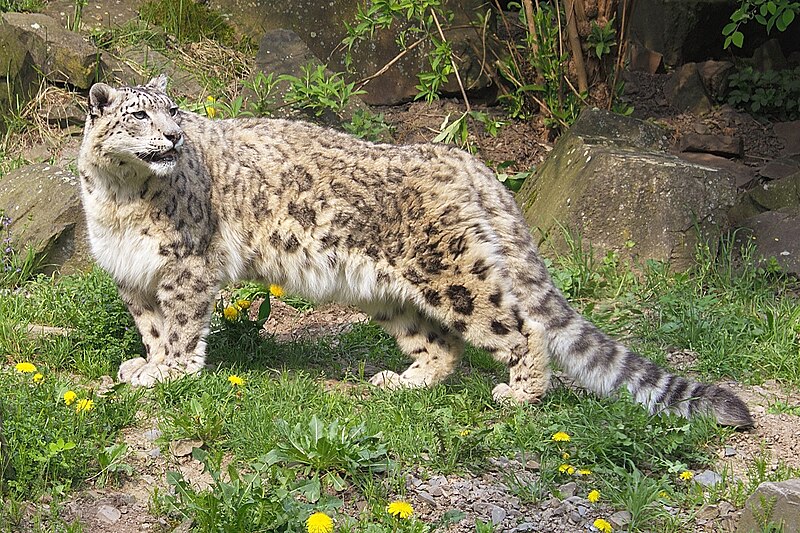
File:Schneeleopard_Koeln.jpg · Wikimedia Commons · See Wikimedia Commons
Pantherinae
Sign in to saveThe Pantherinae is a subfamily of the Felidae; it was named and first described by Reginald Innes Pocock in 1917 as only including the Panthera species, but later also came to include the clouded leopards (genus Neofelis). The Pantherinae genetically diverged from a common ancestor between and .
Pantherinae is a subfamily of big cats that includes the genus Panthera (lions, tigers, leopards, and jaguars) and clouded leopards, and was first formally named and described by scientist Reginald Innes Pocock in 1917. It matters because understanding this group helps scientists classify and study the evolutionary relationships among some of the world's largest and most powerful wild cats.
AI-generated from the Wikipedia summary — may contain errors.
Wikidata facts
Show 4 more facts
- taxon name
- Pantherinae
- Commons category
- Pantherinae
- topic's main category
- Category:Pantherinae
- taxon rank
- subfamily
Sources (1)
via Wikidata · CC0
~4 min read
Encyclopedic overview
7 sectionsContents
- Characteristics
- Evolution
- Taxonomy
- Living genera
- See also
- References
- External links
The Pantherinae is a subfamily of the Felidae; it was named and first described by Reginald Innes Pocock in 1917 as only including the Panthera species, but later also came to include the clouded leopards (genus Neofelis). The Pantherinae genetically diverged from a common ancestor between and .
==Characteristics== Pantherinae species are characterised by an imperfectly ossified hyoid bone with elastic tendons that enable their larynx to be mobile. They have a flat rhinarium that only barely reaches the dorsal side of the nose. The area between the nostrils is narrow, and not extended sidewards as in the Felinae.
Excerpted from Wikipedia’s “Pantherinae” article, available under the CC BY-SA 4.0 licence.
Gallery (12)
Available in 68 languages
- Español
- Français
- Deutsch
- 中文
- 日本語
- Русский
- Português
- Italiano
- العربية
- हिन्दी
- Albanian
- Aragonese
- Armenian
- azb
- Azerbaijani
- Bahasa Indonesia
- Balinese
- Basque
Show 49 more
- be_x_old
- Belarusian
- Breton
- Bulgarian
- Catalan
- Chuvash
- Croatian
- Czech
- Danish
- Egyptian Arabic
- Filipino
- Finnish
- Galician
- Georgian
- Hebrew
- Hungarian
- Kabyle
- Kurdish
- Latvian
- Lithuanian
- Luxembourgish
- Macedonian
- Marathi
- Mingrelian
- Nederlands
- Northern Frisian
- Norwegian
- Occitan
- Polski
- Romanian
- Scots
- Serbian
- Serbian (Latin)
- Slovak
- Svenska
- Swahili
- Tamil
- Tatar
- Tiếng Việt
- Türkçe
- Ukrainian
- Uzbek
- Waray
- Western Frisian
- Wu Chinese
- zh_min_nan
- فارسی
- ไทย
- 한국어
via Wikidata sitelinks · CC0