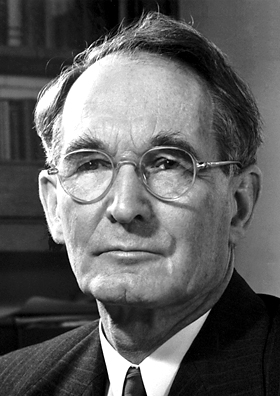
Percy Williams Bridgman
Also known as Percy Bridgman
American physicist
AI overview
Percy Williams Bridgman was an American physicist who made important contributions to understanding how materials behave under extreme pressure and developed influential ideas about the nature of scientific measurement and theory. His work helped advance both experimental physics and the philosophy of science, shaping how scientists think about what their measurements and concepts actually mean.
AI-generated from the Wikipedia summary — may contain errors.
Recent publications · Crossref
5 total works indexed
- The PHQ-9
· 2001 · cited 38,345x
- A Brief Measure for Assessing Generalized Anxiety Disorder
· 2006 · cited 27,926x
- Learning representations by back-propagating errors
· 1986 · cited 23,655x
- Geant4—a simulation toolkit
· 2003 · cited 20,936x
- Initial sequencing and analysis of the human genome
· 2001 · cited 18,520x
via Crossref · CC0
Article
Percy Williams Bridgman (April 21, 1882 – August 20, 1961) was an American physicist who received the Nobel Prize in Physics in 1946 for his work on the physics of high pressures. He also wrote extensively on the scientific method and on other aspects of the philosophy of science. The Bridgman effect, the Bridgman–Stockbarger technique, and the high-pressure mineral bridgmanite are named after him.
Early life and education