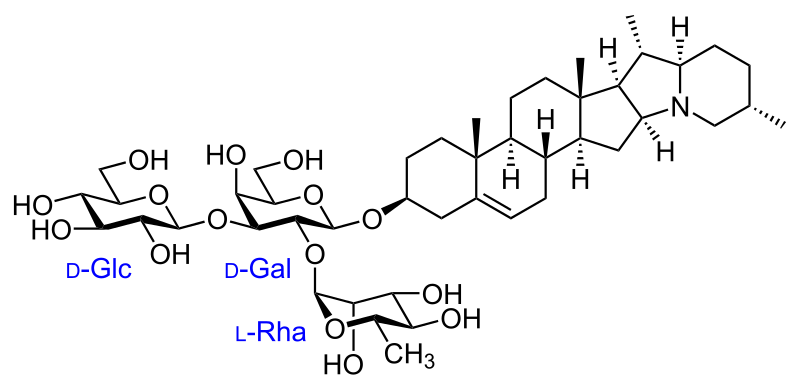
File:Solanine.svg · Wikimedia Commons · See Wikimedia Commons
saponin
Sign in to saveAlso known as Sapogenins glycosides, saponins, triterpene glycosides
Saponins (Latin sapon, 'soap' + -in, 'one of') are bitter-tasting, usually toxic plant-derived secondary metabolites. They are organic chemicals that become foamy when agitated in water and have high molecular weight. They are present in a wide range of plant species throughout the bark, leaves, stems, roots and flowers but particularly in soapwort (genus Saponaria), a flowering plant, the soapbark tree (Quillaja saponaria), common corn-cockle (Agrostemma githago L.), baby's breath (Gypsophila spp.) and soybeans (Glycine max L.). They are used in soaps, medicines (e.g., drug adjuvants), fire e
Research
33,258 papers- Saponin constituents of Achyranthes root.Journal of natural medicines · 2022
- Saponin monomers: Potential candidates for the treatment of type 2 diabetes mellitus and its complications.Phytotherapy research : PTR · 2024
- An overview of tea saponin as a surfactant in food applications.Critical reviews in food science and nutrition · 2024
- Saponin surfactants used in drug delivery systems: A new application for natural medicine components.International journal of pharmaceutics · 2021
- [Saponin drugs].Dansk tidsskrift for farmaci · 1966
via PubMed
Wikidata facts
- Image
- Protopanaxadiol.gif
Show 1 more fact
- Commons category
- Saponins
via Wikidata · CC0
~11 min read
Article
15 sectionsContents
- Classification based on chemical structure
- Classification by aglycone
- Steroid glycosides
- Triterpenoid glycosides
- Classification by glycone
- Classification of similar molecules
- Glycosteroidalkaloids
- Uses
- Decoction
- Biological sources
- Role in plant ecology and impact on animal foraging
- Ethnobotany
- Chemical structure
- See also
- References
Saponins (Latin sapon, 'soap' + -in, 'one of') are bitter-tasting, usually toxic plant-derived secondary metabolites. They are organic chemicals that become foamy when agitated in water and have high molecular weight. They are present in a wide range of plant species throughout the bark, leaves, stems, roots and flowers but particularly in soapwort (genus Saponaria), a flowering plant, the soapbark tree (Quillaja saponaria), common corn-cockle (Agrostemma githago L.), baby's breath (Gypsophila spp.) and soybeans (Glycine max L.). They are used in soaps, medicines (e.g., drug adjuvants), fire extinguishers, dietary supplements, steroid synthesis, and in carbonated beverages (for example, being responsible for maintaining the head on root beer). Saponins are both water and fat soluble, which gives them their useful soap properties. Some examples of these chemicals are glycyrrhizin (licorice flavoring) and quillaia (alt. quillaja), a bark extract used in beverages.
==Classification based on chemical structure==