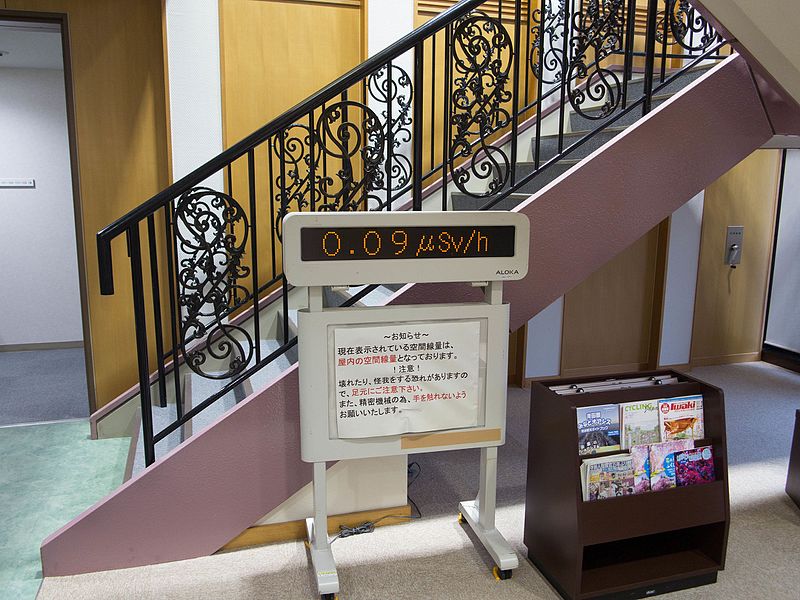
File:展望の宿_天神_2016_(26182596995).jpg · Wikimedia Commons · See Wikimedia Commons
sievert
Sign in to saveAlso known as Sv
The sievert (symbol: Sv) is a derived unit in the International System of Units (SI) intended to represent the stochastic health risk of ionizing radiation, which is defined as the probability of causing radiation-induced cancer and genetic damage. The sievert is important in dosimetry and radiation protection. It is named after Rolf Maximilian Sievert, a Swedish medical physicist renowned for work on radiation dose measurement and research into the biological effects of radiation.
A sievert is a unit of measurement that quantifies the health risk from exposure to ionizing radiation, specifically the likelihood that radiation will cause cancer or genetic damage. It's an important tool used by scientists and health professionals to assess radiation safety and protect people from harmful exposure.
AI-generated from the Wikipedia summary — may contain errors.
Key facts
- Unit.name
- sievert
- Unit.image
- File:展望の宿 天神 2016 (26182596995).jpg
- Unit.caption
- Display of background radiation in a hotel at Naraha, Japan, showing dose rate in microsieverts per hour, five years after the Fukushima disaster
- Unit.standard
- SI
- Unit.quantity
- Stochastic health effect of ionizing radiation (equivalent dose)
- Unit.symbol
- Sv
- Unit.namedafter
- Rolf Maximilian Sievert
- Unit.units1
- SI base units
- Unit.inunits1
- m2⋅s−2
- Unit.units2
- Sv indicates absorbed dose modified by weighting factors.
- Unit.inunits2
- J⋅kg−1
- Unit.units3
- CGS units (non-SI)
- Unit.inunits3
- 100 rem
via Wikipedia infobox
Wikidata facts
- Image
- Radioactivity and radiation-ca.svg
Show 6 more facts
- Commons category
- Sievert (unit)
- unit symbol
- Sv
- conversion to SI unit
- 1
- name in kana
- シーヴェルト
- short name
- 希
- Wikidata SPARQL query equivalent
- wd:Q103246 p:P2370/psn:P2370 [wikibase:quantityAmount ?source; wikibase:quantityUnit ?base]. ?item p:P2370/psn:P2370 [wikibase:quantityAmount ?target; wikibase:quantityUnit ?base]. BIND(?source / ?target as ?value)
Sources (1)
via Wikidata · CC0
~34 min read
Article
33 sectionsContents
- Definition
- CIPM definition of the sievert
- ICRP definition of the sievert
- External dose quantities
- Naming conventions
- Physical quantities
- Operational quantities
- Protection quantities
- Instrument and dosimetry response
- Calculating protection dose quantities
- Radiation type weighting factor ''W''<sub>''R''</sub>
- Tissue type weighting factor ''W''<sub>''T''</sub>
- Operational quantities
- Ambient dose equivalent
- Directional dose equivalent
- Personal dose equivalent
- Proposals for changing the definition of protection dose quantities
- Internal dose quantities
- Health effects
- Stochastic effects
- Deterministic effects
- ICRP dose limits
- Dose examples
- Dose examples
- Dose rate examples
- History
- Common SI usage
- Ionizing radiation quantities
- Rem equivalence
- See also
- Explanatory notes
- References
- External links
The sievert (symbol: Sv) is a derived unit in the International System of Units (SI) intended to represent the stochastic health risk of ionizing radiation, which is defined as the probability of causing radiation-induced cancer and genetic damage. The sievert is important in dosimetry and radiation protection. It is named after Rolf Maximilian Sievert, a Swedish medical physicist renowned for work on radiation dose measurement and research into the biological effects of radiation.
The sievert unit is used for radiation dose quantities such as equivalent dose and effective dose, which represent the risk of external radiation from sources outside the body, and committed dose, which represents the risk of internal irradiation due to inhaled or ingested radioactive substances. According to the International Commission on Radiological Protection (ICRP), one sievert results in a 5.5% probability of eventually developing fatal cancer based on the disputed linear no-threshold model of ionizing radiation exposure.
Gallery (26)
Available in 65 languages
- Español
- Français
- Deutsch
- 中文
- 日本語
- Русский
- Português
- Italiano
- العربية
- Armenian
- Bahasa Indonesia
- Bangla
- Basque
- be_x_old
- Belarusian
- Bosnian
- Bulgarian
- Catalan
Show 46 more
- Chuvash
- Croatian
- Czech
- Danish
- Esperanto
- Estonian
- Finnish
- Galician
- Georgian
- Greek
- Hebrew
- Hungarian
- Icelandic
- Irish
- Kazakh
- Latin
- Latvian
- Lithuanian
- Low German
- Macedonian
- Malay
- Mongolian
- Nederlands
- Norwegian
- Norwegian Nynorsk
- Occitan
- Polski
- Romanian
- Serbian
- Serbian (Latin)
- Sicilian
- simple
- Slovak
- Slovenian
- Svenska
- Tamil
- Tibetan
- Tiếng Việt
- Türkçe
- Ukrainian
- Welsh
- Wu Chinese
- zh_yue
- فارسی
- ไทย
- 한국어
via Wikidata sitelinks · CC0