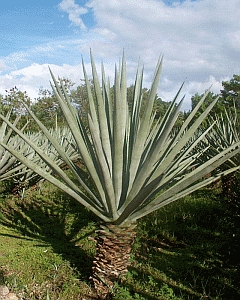
File:Plantsisal.jpg · Wikimedia Commons · See Wikimedia Commons
sisal
Sign in to saveAlso known as Agave sisalana
Sisal (, ; Agave sisalana) is a species of flowering plant native to southern Mexico, but widely cultivated and naturalized in many other countries. It yields a stiff fibre used in making rope and various other products. The sisal fiber is traditionally used for rope and twine, and has many other uses, including cloth, footwear, hats, bags, carpets, geotextiles, and dartboards. It is also used as fiber reinforcements for composite fiberglass, rubber, and concrete products. Like other agaves, the pith of the leaves can be fermented and distilled to make mezcal.
OverviewAI-generated
Sisal is a plant species classified as *Agave sisalana*, with the taxon author citation Perr. ex Engelm. It belongs to the family Agavaceae, which is also commonly referred to as sisal. The organism is part of the Plantae group and is not considered extinct.
The species has been recorded in 12,407 observations. It is referenced by 686 other encyclopedia articles.
Synthesized by Vinony from 18 facts across 4 sources: Wikidata, iNaturalist, Plants of the World, Vinony graph. Generated from structured data (not the Wikipedia text) and checked against those facts — may still contain errors.
Species
Tall Tumblemustard
species
Die Sisal-Agave (Agave sisalana) ist eine Pflanzenart aus der Unterfamilie der Agavengewächse (Agavoideae). Sie ist eine bedeutende Faserpflanze. Das Epitheton der Art verweist auf die mexikanische Hafenstadt Sisal an der Nordküste von Yucatán.
via · Kew POWO
Wikidata facts
- Instance of
- taxon
- Subclass of
- perennial plant
- Image
- Plantsisal.jpg
- Has use
- medicinal plant
Show 13 more facts
- taxon rank
- species
- taxon name
- Agave sisalana
- Commons category
- Agave sisalana
- Commons gallery
- Agave sisalana
- this taxon is source of
- sisal
- taxon common name
- sisalova agava
- taxon range
- Myanmar
- invasive to
- Madagascar
- short name
- A. sisalana
- Flora of the Hawaiian Islands URL
- naturalhistory2.si.edu/botany/hawaiianflora/speciesdescr.cfm?genus=Agave&species=sisalana
- taxon author citation
- Perr. ex Engelm.
- external data available at URL
- www.gbif.org/dataset/93725bf2-6ada-47f9-bd5e-0e679e3d245e
via Wikidata · CC0
~12 min read
Encyclopedic overview
15 sectionsContents
- Taxonomy
- Plant description
- Cultivation
- Propagation
- Fiber extraction
- Environmental impacts
- Uses
- Carpets
- Global production and trade patterns
- Heraldry
- In literature
- See also
- References
- Further reading
- External links
Sisal (, ; Agave sisalana) is a species of flowering plant native to southern Mexico, but widely cultivated and naturalized in many other countries. It yields a stiff fibre used in making rope and various other products. The sisal fiber is traditionally used for rope and twine, and has many other uses, including cloth, footwear, hats, bags, carpets, geotextiles, and dartboards. It is also used as fiber reinforcements for composite fiberglass, rubber, and concrete products. Like other agaves, the pith of the leaves can be fermented and distilled to make mezcal.
Sisal has an uncertain native origin, but is thought to have originated in the Mexican state of Chiapas. Sisal plants have a lifespan of 7–10 years, producing 200–250 usable leaves containing fibers used in various applications. Sisal is a tropical and subtropical plant, thriving in temperatures above and sunshine.
Excerpted from Wikipedia’s “sisal” article, available under the CC BY-SA 4.0 licence.
Gallery (18)
Available in 63 languages
- Español
- Français
- Deutsch
- 中文
- 日本語
- Русский
- Português
- Italiano
- العربية
- Afrikaans
- Amharic
- Armenian
- Azerbaijani
- Bahasa Indonesia
- Bangla
- Basque
- Bikol
- Bulgarian
Show 44 more
- Burmese
- Catalan
- Cebuano
- Corsican
- Croatian
- Czech
- Danish
- Egyptian Arabic
- Esperanto
- Finnish
- Greek
- Haitian Creole
- Hebrew
- Hungarian
- Icelandic
- Latvian
- Lithuanian
- Malagasy
- Malay
- Malayalam
- nah
- Nederlands
- Northern Frisian
- Norwegian
- Papiamento
- Polski
- pwn
- Quechua
- Romanian
- Serbian
- Serbian (Latin)
- Shona
- Slovak
- Svenska
- Swahili
- Tamil
- Tiếng Việt
- Türkçe
- Ukrainian
- Upper Sorbian
- Waray
- Wolof
- zh_yue
- فارسی
via Wikidata sitelinks · CC0