File:Sliderule.PickettN902T.agr.jpg · Wikimedia Commons · See Wikimedia Commons
A slide rule is a mechanical device that uses sliding scales to perform mathematical calculations, functioning as an early analog computer before electronic calculators became common. It was essential for engineers, scientists, and mathematicians throughout the 20th century because it allowed them to quickly solve complex multiplication, division, and other calculations by hand.
AI-generated from the Wikipedia summary — may contain errors.
Wikidata facts
- Image
- Sliderule 2005.jpg
Show 3 more facts
- maintained by WikiProject
- WikiProject Mathematics
- Commons gallery
- Slide rules
- Commons category
- Slide rules
Sources (3)
via Wikidata · CC0
~40 min read
Encyclopedic overview
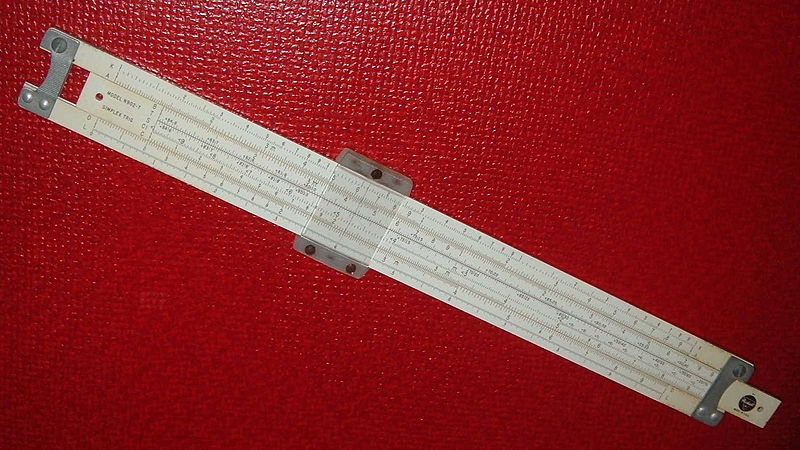
Typical ten-inch (25 cm) student slide rule (Pickett N902-T simplex trig)
A slide rule is a hand-operated mechanical calculator consisting of slidable rulers for conducting mathematical operations such as multiplication, division, exponents, roots, logarithms, and trigonometry. It is one of the simplest analog computers.
Excerpted from Wikipedia’s “slide rule” article, available under the CC BY-SA 4.0 licence.