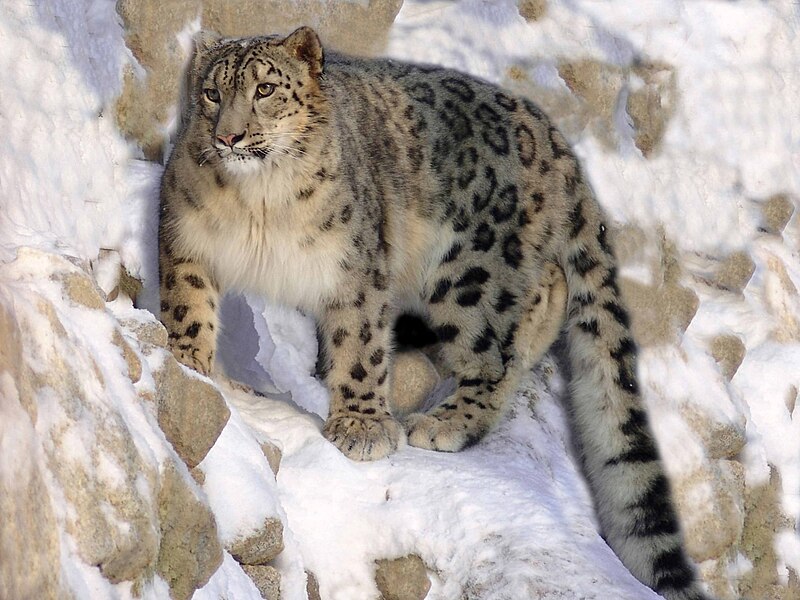
File:Irbis4.JPG · Wikimedia Commons · See Wikimedia Commons
leopardo de las nieves
Sign in to saveAlso known as ounce, Uncia uncia, Panthera uncia, P. uncia
especie de mamíferos
OverviewAI-generated
The snow leopard (Panthera uncia) is a species within the genus Panthera. It functions as an apex predator and flagship species. Its primary food sources include onager, Gazella subgutturosa, Common Pheasant, and Tibetan fox. The animal inhabits mountain and forest environments.
The International Union for Conservation of Nature lists the snow leopard as Vulnerable, a status recorded in 2017. It is included in Appendix I of CITES. The taxon has been described in the Brockhaus and Efron Encyclopedic Dictionary and the Encyclopædia Britannica 11th edition. Its gestation period is 102 days.
Synthesized by Vinony from 20 facts across 3 sources: Wikidata, IUCN Red List, Vinony graph. Generated from structured data (not the Wikipedia text) and checked against those facts — may still contain errors.
Species
VulnerableMaximum longevity: 21.2 years (captivity) Observations: In zoos, these animals can live up to 21.2 years (Richard Weigl 2005).
via IUCN
Wikidata facts
- Instance of
- flagship species
- Parent taxon
- Panthera
- Image
- Uncia uncia - A tail and a cat cropped.jpg
Show 15 more facts
- main food source
- Siberian ibex
- taxon rank
- species
- IUCN conservation status
- Vulnerable
- taxon name
- Panthera uncia
- Commons gallery
- Panthera uncia
- taxon common name
- snežni leopard
- gestation period
- 102
- Commons category
- Panthera uncia
- exact match
- wordnet-rdf.princeton.edu/wn30/02128757-n
- described by source
- Encyclopædia Britannica 11th edition
- CITES Appendix
- Appendix I of CITES
- sequenced genome URL
- www.dnazoo.org/assemblies/Panthera_uncia
- different from
- Snow Leopard
- habitat
- forest
- short name
- P. uncia
Sources (7)
via Wikidata · CC0
Article · Español
El leopardo de las nieves o irbis (Panthera uncia) es una especie de mamífero carnívoro de la familia Felidae propia de las montañas de Asia Central. Viven en montañas remotas a altitudes de hasta 6000 m s. n. m., motivo por el cual es poco lo que se sabe de ellos. Su pelo es gris, suave y excepcionalmente denso, y tiene una cola también de longitud excepcional que enrolla alrededor del cuerpo para abrigarse. Caza de día y ataca a todo tipo de animales salvajes, así como al ganado. Son a veces matados por granjeros, pero también cazados por su piel.[cita requerida] Se desconoce la cantidad de ejemplares que quedan en estado salvaje, aunque el Fondo Mundial para la Naturaleza estima que habrá apenas cuatro mil ejemplares. El período de gestación es de aproximadamente cien días, teniendo normalmente dos cachorros, aunque puede tener un máximo de cinco crías. Se consideran adultos a los dos años.[cita requerida]
Abstract from DBpedia / Wikipedia · CC BY-SA
Gallery (13)
Available in 126 languages
- Español
- Français
- Deutsch
- 中文
- 日本語
- Русский
- Português
- Italiano
- العربية
- हिन्दी
- Afrikaans
- Albanian
- Amharic
- Armenian
- Assamese
- Asturian
- Avaric
- azb
Show 107 more
- Azerbaijani
- Bahasa Indonesia
- Balinese
- Bangla
- Bashkir
- Basque
- be_x_old
- Belarusian
- Bosnian
- Breton
- Bulgarian
- Burmese
- Catalan
- Cebuano
- Chuvash
- Cornish
- Croatian
- Czech
- Danish
- dty
- Egyptian Arabic
- Esperanto
- Estonian
- Filipino
- Finnish
- fiu_vro
- Galician
- Georgian
- Greek
- Guarani
- Hebrew
- Hungarian
- Icelandic
- Ido
- Inari Sami
- Ingush
- Irish
- Javanese
- Kabyle
- Kannada
- Kashmiri
- Kazakh
- Kotava
- Kurdish
- Kyrgyz
- Latgalian
- Latin
- Latvian
- Lithuanian
- Luxembourgish
- Macedonian
- Malay
- Malayalam
- Marathi
- Mari
- Mingrelian
- Mongolian
- Navajo
- Nederlands
- Nepali
- Northern Frisian
- Norwegian
- Norwegian Nynorsk
- Occitan
- Odia
- Oromo
- Ossetic
- Pashto
- Polski
- Punjabi
- Romanian
- Scots
- Scottish Gaelic
- Serbian
- Serbian (Latin)
- simple
- Sindhi
- Slovak
- Slovenian
- Svenska
- Swahili
- Tajik
- Tamil
- Tatar
- Tibetan
- Tiếng Việt
- Tok Pisin
- Türkçe
- Tuvinian
- Udmurt
- Ukrainian
- Urdu
- Uyghur
- Uzbek
- Waray
- Western Frisian
- Western Panjabi
- Wu Chinese
- Yakut
- Yiddish
- Zaza
- zh_classical
- zh_min_nan
- zh_yue
- فارسی
- ไทย
- 한국어
via Wikidata sitelinks · CC0