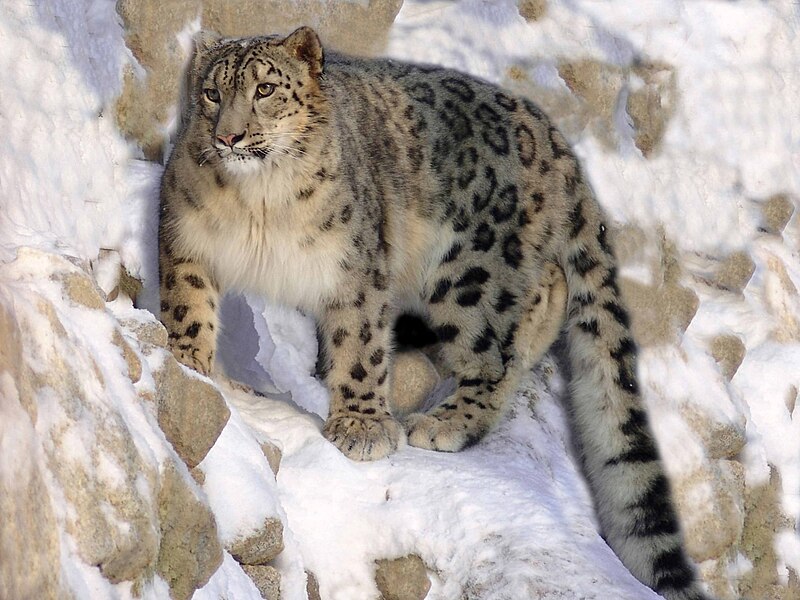
File:Irbis4.JPG · Wikimedia Commons · See Wikimedia Commons
snow leopard
Sign in to saveAlso known as ounce, Uncia uncia, Panthera uncia, P. uncia
large felid native to the mountains of Central and South Asia
OverviewAI-generated
The snow leopard (Panthera uncia) is a species within the genus Panthera. It functions as an apex predator and flagship species. Its primary food sources include onager, Gazella subgutturosa, Common Pheasant, and Tibetan fox. The animal inhabits mountain and forest environments.
The International Union for Conservation of Nature lists the snow leopard as Vulnerable, a status recorded in 2017. It is included in Appendix I of CITES. The taxon has been described in the Brockhaus and Efron Encyclopedic Dictionary and the Encyclopædia Britannica 11th edition. Its gestation period is 102 days.
Synthesized by Vinony from 20 facts across 3 sources: Wikidata, IUCN Red List, Vinony graph. Generated from structured data (not the Wikipedia text) and checked against those facts — may still contain errors.
Species
VulnerableMaximum longevity: 21.2 years (captivity) Observations: In zoos, these animals can live up to 21.2 years (Richard Weigl 2005).
via IUCN
Wikidata facts
- Instance of
- flagship species
- Parent taxon
- Panthera
- Image
- Uncia uncia - A tail and a cat cropped.jpg
Show 15 more facts
- main food source
- Siberian ibex
- taxon rank
- species
- IUCN conservation status
- Vulnerable
- taxon name
- Panthera uncia
- Commons gallery
- Panthera uncia
- taxon common name
- snežni leopard
- gestation period
- 102
- Commons category
- Panthera uncia
- exact match
- wordnet-rdf.princeton.edu/wn30/02128757-n
- described by source
- Encyclopædia Britannica 11th edition
- CITES Appendix
- Appendix I of CITES
- sequenced genome URL
- www.dnazoo.org/assemblies/Panthera_uncia
- different from
- Snow Leopard
- habitat
- forest
- short name
- P. uncia
Sources (7)
via Wikidata · CC0
~28 min read
Encyclopedic overview
The snow leopard (Panthera uncia) is a species of large cat in the genus Panthera of the family Felidae. It is native to the mountain ranges of Central and South Asia, ranging from eastern Afghanistan, the Himalayas and the Tibetan Plateau to southern Siberia, Mongolia and Western China. It inhabits alpine and subalpine zones at elevations of 3,000–4,500 m (9,800–14,800 ft), but also lives at lower elevations in the northern part of its range.
The snow leopard was long classified in the monotypic genus Uncia. Since phylogenetic studies revealed the relationships among Panthera species, it has been considered a member of that genus. Two subspecies were described based on morphological differences, but genetic differences between the two have not been confirmed. It is therefore regarded as a monotypic species. It forms a sister group with the tiger and the genetic divergence is estimated to have occurred 4.62 to 1.82 million years ago.
Excerpted from Wikipedia’s “snow leopard” article, available under the CC BY-SA 4.0 licence.
Gallery (13)
Available in 126 languages
- Español
- Français
- Deutsch
- 中文
- 日本語
- Русский
- Português
- Italiano
- العربية
- हिन्दी
- Afrikaans
- Albanian
- Amharic
- Armenian
- Assamese
- Asturian
- Avaric
- azb
Show 107 more
- Azerbaijani
- Bahasa Indonesia
- Balinese
- Bangla
- Bashkir
- Basque
- be_x_old
- Belarusian
- Bosnian
- Breton
- Bulgarian
- Burmese
- Catalan
- Cebuano
- Chuvash
- Cornish
- Croatian
- Czech
- Danish
- dty
- Egyptian Arabic
- Esperanto
- Estonian
- Filipino
- Finnish
- fiu_vro
- Galician
- Georgian
- Greek
- Guarani
- Hebrew
- Hungarian
- Icelandic
- Ido
- Inari Sami
- Ingush
- Irish
- Javanese
- Kabyle
- Kannada
- Kashmiri
- Kazakh
- Kotava
- Kurdish
- Kyrgyz
- Latgalian
- Latin
- Latvian
- Lithuanian
- Luxembourgish
- Macedonian
- Malay
- Malayalam
- Marathi
- Mari
- Mingrelian
- Mongolian
- Navajo
- Nederlands
- Nepali
- Northern Frisian
- Norwegian
- Norwegian Nynorsk
- Occitan
- Odia
- Oromo
- Ossetic
- Pashto
- Polski
- Punjabi
- Romanian
- Scots
- Scottish Gaelic
- Serbian
- Serbian (Latin)
- simple
- Sindhi
- Slovak
- Slovenian
- Svenska
- Swahili
- Tajik
- Tamil
- Tatar
- Tibetan
- Tiếng Việt
- Tok Pisin
- Türkçe
- Tuvinian
- Udmurt
- Ukrainian
- Urdu
- Uyghur
- Uzbek
- Waray
- Western Frisian
- Western Panjabi
- Wu Chinese
- Yakut
- Yiddish
- Zaza
- zh_classical
- zh_min_nan
- zh_yue
- فارسی
- ไทย
- 한국어
via Wikidata sitelinks · CC0