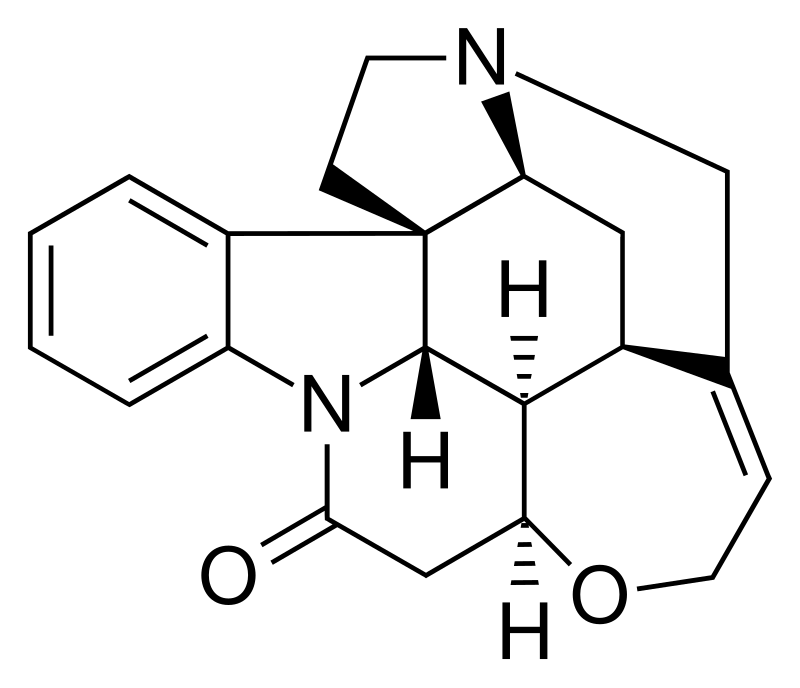
File:Strychnine.svg · Wikimedia Commons · See Wikimedia Commons
strychnine
Sign in to saveAlso known as sanaseed, strychnin
OverviewAI-generated
Strychnine is a chemical compound with the formula C₂₁H₂₂N₂O₂. It has a density of 1.36 and a mass of 334.168. The compound exhibits a melting point of 514 and a solubility of 0.02. Its pKa value is 8.26, and it possesses a charge of 0.
Physical properties include an xlogp of 1.9 and a tpsa of 32.8. The molecule contains 0 hydrogen bond donors and 3 hydrogen bond acceptors. Safety data indicates an immediately dangerous to life or health level of 3 and a time-weighted average exposure limit of 0.15. The substance is identified by the NIOSH Pocket Guide ID 0570.
Synthesized by Vinony from 24 facts across 4 sources: Wikidata, PubChem, PubMed, Vinony graph. Generated from structured data (not the Wikipedia text) and checked against those facts — may still contain errors.
Chemical data
- Formula
- C21H22N2O2
- Molecular weight
- 334.4 g/mol
- IUPAC name
- (4aR,5aS,8aR,13aS,15aS,15bR)-4a,5,5a,7,8,13a,15,15a,15b,16-decahydro-2H-4,6-methanoindolo[3,2,1-ij]oxepino[2,3,4-de]pyrrolo[2,3-h]quinolin-14-one
- SMILES
- C1CN2CC3=CCO[C@H]4CC(=O)N5[C@H]6[C@H]4[C@H]3C[C@H]2[C@@]61C7=CC=CC=C75
- InChIKey
- QMGVPVSNSZLJIA-FVWCLLPLSA-N
- XLogP
- 1.9
- Polar surface area
- 32.8 Ų
- H-bond donors
- 0
- H-bond acceptors
- 3
- Formal charge
- 0
via PubChem
Research
6,836 papers- Strychnine poisoning.ReviewPediatric emergency care · 1999Flood RG
- Biosynthesis of strychnine.Nature · 2022Hong B, Grzech D, Caputi L et al.DOI: 10.1038/s41586-022-04950-4
- Strychnine poisoning.The Journal of the Association of Physicians of India · 2003Santhosh GJ, Joseph W, Thomas M
- Anti-Strychnine Immunoconjugate Reduces the Effects of Strychnine-Induced Toxicity in Mice.ACS chemical neuroscience · 2023Baehr C, Kassick AJ, Vigliaturo J et al.DOI: 10.1021/acschemneuro.2c00797
- From Decades to Minutes: Steps Toward the Structure of Strychnine 1910-1948 and the Application of Today's Technology.ReviewAngewandte Chemie (International ed. in English) · 2020Seeman JI, Tantillo DJDOI: 10.1002/anie.201916566
- Acute strychnine intoxication.Clinical toxicology · 1970Teitelbaum DT, Ott JEDOI: 10.3109/15563657008990475
- Strychnine-containing tonics.British medical journal · 1973Jackson G, Diggle GDOI: 10.1136/bmj.2.5859.176-b
- Strychnine.Journal of the Chemical Society · 1946CLEMO GR, RAPER R
via PubMed
Wikidata facts
- Has part
- carbon
- Material used
- Antiaris
- Mass
- 334.168
- Has use
- adulterant
Show 15 more facts
- has characteristic
- bitterness
- Commons category
- Strychnine
- NIOSH Pocket Guide ID
- 0570
- density
- 1.36
- chemical formula
- C₂₁H₂₂N₂O₂
- immediately dangerous to life or health
- 3
- melting point
- 514
- solubility
- 0.02
- time-weighted average exposure limit
- 0.15
- color
- white
- canonical SMILES
- C1CN2CC3=CCOC4CC(=O)N5C6C4C3CC2C61C7=CC=CC=C75
- isomeric SMILES
- C1CN2CC3=CCO[C@H]4CC(=O)N5[C@H]6[C@H]4[C@H]3C[C@H]2[C@@]61C7=CC=CC=C75
- described by source
- Brockhaus and Efron Encyclopedic Dictionary
- subject has role
- neurotoxin
- pKa
- 8.26
Sources (6)
via Wikidata · CC0
~19 min read
Encyclopedic overview
18 sectionsContents
- Biosynthesis
- Chemical synthesis
- Mechanism of action
- Toxicity
- Animal toxicity
- Human toxicity
- Treatment
- Activated charcoal
- Other treatments
- Pharmacokinetics
- Absorption
- Distribution
- Metabolism
- Excretion
- History
- Usage as a drug
- See also
- References
Strychnine (, , US chiefly ) is a highly toxic, colorless, bitter, crystalline alkaloid used as a pesticide, particularly for killing small vertebrates such as birds and rodents. Strychnine, when inhaled, swallowed, or absorbed through the eyes or mouth, causes poisoning which results in muscular convulsions and eventually death through asphyxia. While it is no longer used medicinally, it was used historically in small doses to strengthen muscle contractions, such as a heart and bowel stimulant and performance-enhancing drug. The most common source is from the seeds of the Strychnos nux-vomica tree.
== Biosynthesis == class=skin-invert-image|left|350px|Strychnine biosynthesis
Excerpted from Wikipedia’s “strychnine” article, available under the CC BY-SA 4.0 licence.